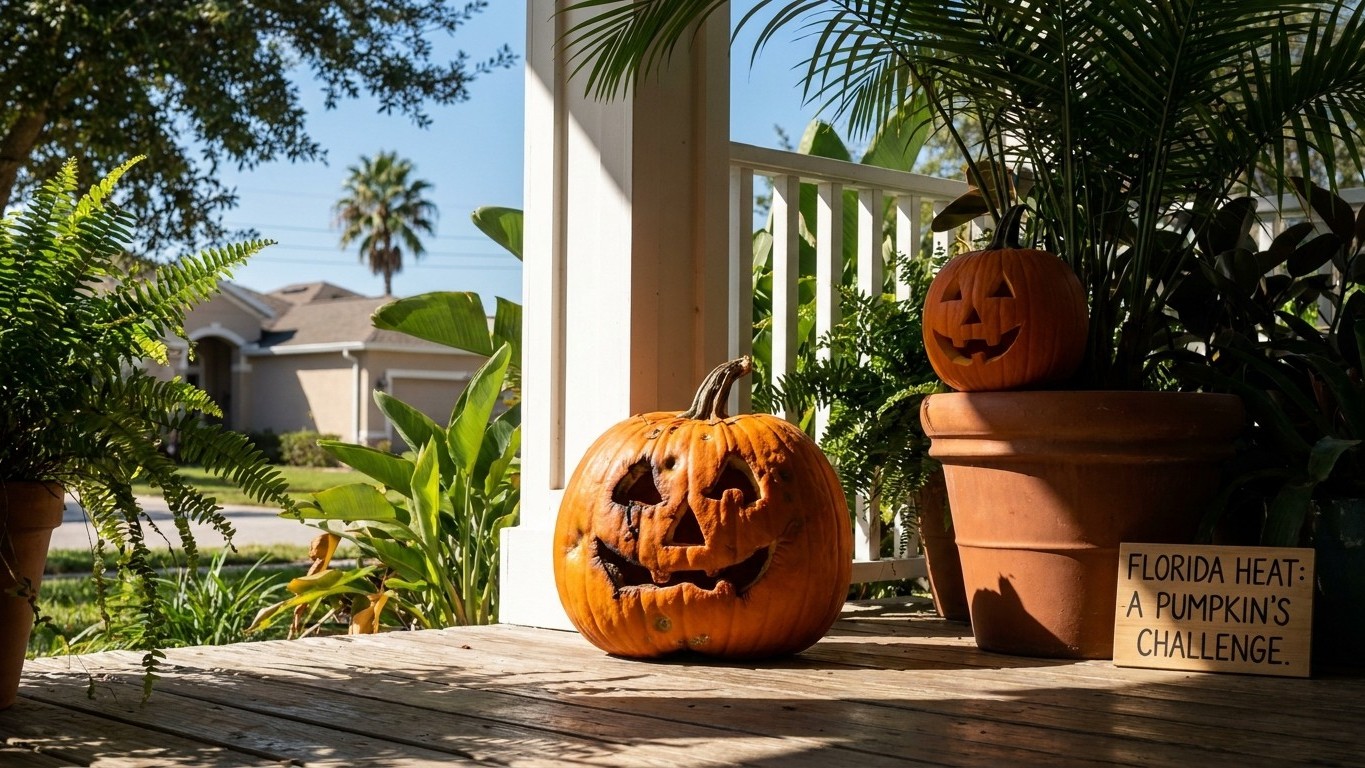

In Jacksonville, the mean first fall frost lands somewhere around November 26 to December 13. That’s not a typo: frost in north Florida arrives roughly a month or more after Halloween, and in central and south Florida it often doesn’t arrive at all. So if you’re wondering whether your porch pumpkin will freeze before trick-or-treaters show up, the honest answer is no. The real threat in Florida isn’t cold. It’s heat.
The short answer

Florida’s frost timing makes this state an outlier on the pumpkin-carving calendar. NOAA’s climate normals for the Jacksonville reference station put the mean first fall frost around November 26 to December 13, based on 32°F freeze probabilities across three decades of data. That’s a wide window, and it’s worth repeating: this is an average, not a promise. Some years bring an early cold snap, some years bring nothing close to freezing until deep into December. In fact, out of thirty tracked falls at that station, three saw no freeze whatsoever. So even in the coldest corner of the state, frost is not something a Halloween pumpkin needs to worry about.
Head south from Jacksonville and the picture changes entirely. Central and south Florida, think Orlando, Tampa, Miami, are effectively frost-free zones. There, the growing calendar flips on its head compared to most of the country: the main outdoor growing season runs through the cooler winter months, and summer heat is the limiting factor, not winter cold. That inversion matters for anyone thinking about pumpkin patches, harvest timing, or storage, because it means the seasonal stress on a Florida pumpkin is warmth, not frost, from Pensacola to Key West.
So what’s the actual carving window? Since frost isn’t a countdown clock here, the calendar isn’t about outrunning a freeze the way it might be in Minnesota or Montana. It’s about limiting how long a carved, exposed pumpkin sits in warm air before it softens and spoils. That means the smart move statewide, regardless of which Florida climate zone you’re in, is to carve within a few days of Halloween itself, close enough that heat and humidity don’t get a long head start on decay. Buy or pick the pumpkin early if you want, keep it whole and stored properly, but save the knife for the final stretch before October 31.
That’s the short version: frost gives Florida carvers no deadline pressure at all. Heat does. And the fix isn’t a date on a calendar so much as a habit: choose well, store cool and dark, and cut it close to the day.
Frost or heat: which one gets it here
The cold end
Even in Jacksonville, the state’s coldest reliably-tracked reference point, the numbers don’t point to frost as an autumn concern. NOAA’s climate normals put the coldest month’s mean daily minimum at 42.9°F. That figure describes the average low during the chilliest stretch of Florida’s winter, typically January, not October or November. It’s close to the 45-50°F range recommended for storing a whole pumpkin, but it applies to the depths of winter, weeks after Halloween has come and gone. By the time real cold settles into north Florida, the holiday is long over. South of Jacksonville, freezing temperatures become rarer still, and in the southern half of the peninsula they’re essentially a non-event most years.
The warm end
Here’s where Florida diverges from most of the pumpkin-carving map. A whole pumpkin ideally rests somewhere in that 45-50°F band, cool enough to slow the ripening process without freezing the flesh. Florida’s ambient temperatures in October rarely cooperate. Daytime highs across the state commonly sit well above that range, and even overnight lows in central and south Florida often stay warmer than 50°F straight through Halloween week. That gap is the whole story: without air conditioning or refrigeration, there’s no spot outdoors, and often no spot indoors without cooling, that naturally holds a Florida pumpkin at the temperature it wants. Heat accelerates softening, invites mold, and shortens the window between “just carved” and “collapsing on the porch.” That’s the risk that actually applies here, not frost, not a freeze, just steady warmth doing its slow work.
Where to keep it until you carve
Getting a Florida pumpkin from the store or patch to Halloween night in good shape comes down to fighting heat, not cold. Here’s a practical order of operations:
- Choose one with 1 to 2 inches of stem intact. The stem acts as a seal. Once it snaps off, that spot on the pumpkin is exposed and spoils faster. Never lift or carry a pumpkin by the stem; hold it from underneath instead.
- Inspect for soft spots and blemishes before you buy. Weight matters more than shape. A heavy pumpkin with clean skin will outlast a lighter one every time, regardless of how it looks.
- Store it indoors, in the coolest, darkest room you have. An interior closet, a laundry room, or an air-conditioned garage beats a porch or windowsill in Florida almost every time, because ambient outdoor air rarely gets close to the 45-50°F range this state’s climate calls for.
- Keep it away from direct sun and hot surfaces. A window ledge or a concrete slab that bakes in afternoon light will warm the pumpkin from the outside in, even if the room itself feels comfortable.
- Separate it from ripening fruit. Apples, potatoes, and tomatoes release a gas that speeds up aging in nearby produce. Storing a pumpkin next to a bowl of ripening apples in the kitchen quietly shortens its shelf life.
- Carve it only in the last few days before Halloween. Whole storage can stretch three to six months under the right conditions. Once cut open, that clock changes entirely, and no extension service publishes a reliable number of days a carved pumpkin lasts. Treat “carve late” as the safest rule, not a guess about how many days you’ll get afterward.
Checking this against your own county
Florida’s climate shifts dramatically from the panhandle to the Keys, and the frost data here comes from a single north Florida reference station. If you’re in Miami, Naples, or anywhere south of Orlando, frost is even less of a factor than the numbers above suggest, and heat management matters even more. For local guidance tailored to your specific county, including soil, pest, and growing-season questions that go beyond pumpkin storage, reach out to your county’s UF/IFAS Extension office. Extension agents can speak to conditions on your exact street in a way that statewide averages never fully capture.
Common questions
Does Florida ever get frost before Halloween?
Rarely, and in most of the state, essentially never. Even Jacksonville’s mean first fall frost lands around late November to mid-December, weeks after Halloween. Central and south Florida are frost-free for practical purposes.
How long will a carved pumpkin last in Florida heat?
No university extension publishes a specific number of days for a carved pumpkin, and there’s no verified preservation trick that changes that. The safest approach is choosing a firm, heavy pumpkin with an intact stem, storing it whole and cool until you’re ready, and carving as close to Halloween as you can.
Where should I store a whole pumpkin in a Florida home?
Aim for the coolest, darkest interior space you have, ideally something air-conditioned, since outdoor and porch temperatures in Florida rarely reach the 45-50°F range a whole pumpkin prefers. Keep it away from windows, hot concrete, and ripening fruit.
Is it true you can carry a pumpkin by its stem?
No. The stem isn’t a handle, it’s a seal that protects the top of the pumpkin from early spoilage. Lifting by the stem risks snapping it off, which exposes that section and speeds up decay. Always support the pumpkin from below.