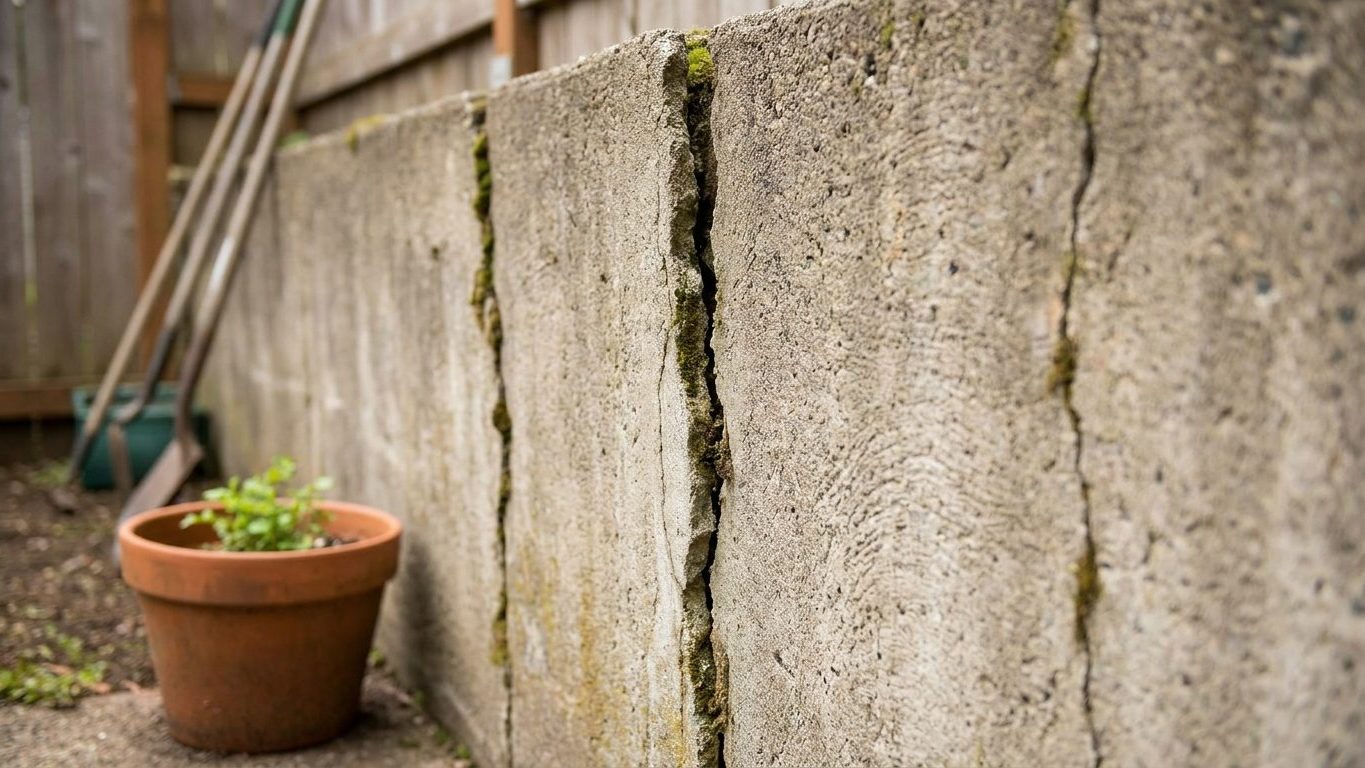

A dead-straight vertical crack running down a poured concrete wall is usually just concrete doing what concrete does: shrinking as it cures. Most vertical cracks are cosmetic and stop moving within the first year or two. Check whether the crack stays the same width from top to bottom, and whether water tracks down it after rain, before deciding it needs nothing more than a look now and then.
What is actually going on

Poured concrete loses water volume as it hardens, and that shrinkage happens across the whole wall at once. The footing below is fixed, the top of the wall is usually tied into a sill plate or the floor framing above, so the middle of the wall has nowhere to go when it contracts. The stress has to release somewhere, and a single vertical line, often near the center of a wall section or running up from a window opening, is the shape that release usually takes. This is part of the same shrinkage-and-curing behavior that runs through most of what happens to a foundation in its first year or two, before the surrounding soil and the wall settle into equilibrium.
The timing tends to follow the same pattern as the mechanism. A shrinkage crack typically shows up within the first year, often within the first several months, as the concrete finishes curing and the wall goes through its first real swing between a hot and a cold season. A crack that shows up years after the house was built, with no history of one being there before, is a different situation and deserves more attention than a crack that has clearly been there since the pour.
Vertical is not the only direction, and direction matters
A vertical crack is the least concerning shape a crack can take, but it is not the only shape. A diagonal or stair-step crack, especially one running off the corner of a window or door opening, points toward the footing settling unevenly rather than the wall simply shrinking. A horizontal crack, particularly one paired with the wall bowing inward, points to lateral pressure from the soil outside pushing against the wall, which is a mechanically different problem and generally a more serious one. None of that changes what a vertical crack on its own means. It just means that not every crack in a poured wall belongs in the same category, and the direction is the first thing worth noting before you decide how much attention this one deserves.
What does elevate a vertical crack out of the ordinary is not its direction but what is happening along its length. A crack where one side sits slightly proud of the other, a crack that is visibly wider at one end than the other, or a crack running with water rather than just leaving a stain, are the three things that move a crack from routine shrinkage toward something a structural engineer should look at.
What to look at, and in what order
Work from the cheapest and least invasive check to the more involved one. Each step either confirms ordinary shrinkage or rules it out, and there is no reason to skip ahead to a professional call before you have done the free ones.
| Step | What you do | What it tells you |
|---|---|---|
| 1. Look at the pattern | Trace the crack’s full length and note its direction | A single vertical line rules out the stair-step pattern typical of footing settlement and the horizontal pattern typical of soil pressure |
| 2. Run a hand across it | Feel both sides of the crack for a lip or offset | A flush, even surface on both sides rules out the wall rotating or one section moving independently of the other |
| 3. Compare the width top to bottom | Look closely at where the crack is narrowest and widest | A consistent width along the length suggests a one-time shrinkage event; a crack that fans out wider at one end suggests ongoing movement |
| 4. Check it after a hard rain | Look for dampness or a visible trickle rather than just a stain | Rules in or out active water entry, which is a drainage question even when the crack itself is not structural |
| 5. Track it over time | Mark the ends and the width with a pencil and a date, or use a simple crack monitor | Rules out slow, ongoing movement that a single look-in can’t catch |
That last step deserves more than one line, because it is the one people skip and the one that actually settles the question for a borderline crack. A crack that looks identical on two visits eight months apart is behaving very differently from one that has grown even a little in that time, and the only way to know which one you have is to check it against a fixed reference more than once. There’s a full method for doing that properly on “/foundations/monitoring-a-crack/”>watching a crack to see if it is moving, and it is worth doing before you decide either that a crack is nothing or that it needs a professional.
Water deserves a separate note here. A crack can be entirely a shrinkage crack, structurally meaningless, and still let water through, because a shrinkage gap in a poured wall is still a gap. Finding water at the crack does not by itself make the crack structural. It does mean the wall has an active leak point that needs a drainage answer, regardless of what a structural engineer eventually says about the crack itself.
Watch it, or get someone in
This is the split that actually matters, and it is worth being explicit about which side of it you are on. Monitor it yourself if the crack is a single vertical line, the two sides are flush with no offset, the width is consistent along its length, and repeated checks over several months show no change. That combination describes an ordinary shrinkage crack, and there is nothing to fix beyond keeping an eye on it and handling any water it lets through.
Call a structural engineer if any one of these shows up: a visible offset between the two sides, a crack that is clearly widening at one end, a crack that has grown between two monitoring checks, or a vertical crack that appears alongside a horizontal one or alongside doors and windows that have started sticking. Any of those is a sign of ongoing movement rather than a one-time shrinkage event, and movement in a foundation wall is not something to diagnose from a blog post or guess at from a photo.
Which professional, and why it matters which one
The three people who might show up to look at a cracked wall are not interchangeable, and calling the wrong one first wastes a visit. A structural engineer assesses the wall and tells you whether it is a structural problem, and does this without selling you a repair, because a structural engineer’s business is the assessment, not the fix. A drainage contractor deals with water reaching the wall from outside, grading, downspouts, and the soil around the foundation, and is the right call when the crack itself checks out fine but water keeps showing up at it. A waterproofing salesman pitching an interior sealing system is not the person to diagnose a crack at all, and is worth being skeptical of if that is the first call that gets made. Get the engineer’s answer on the crack before anyone quotes you a fix for it.
What has to happen first
The order of operations is where most people waste money on this problem, and it runs the same direction every time. Outside before inside, water before finishes, diagnosis before repair. A crack that is letting water through needs the water dealt with at its source, which means grading, gutters, and drainage around the outside of the wall, before anything gets done to the inside face of that wall.
Sealing the inside of a basement wall does nothing to stop water that is arriving under pressure from the outside. An interior coating or sealant can hide a stain and manage some humidity, but it sits on the dry side of the problem, and water finds its way around or underneath it. The full explanation of why that approach fails on its own, and what it actually treats versus what it just covers up, is laid out in why sealing a basement from inside usually fails. Read that before spending money on an interior product for a wall you haven’t sorted the drainage on.
The exterior side of this problem overlaps with a few other systems in the house that are easy to overlook because they don’t look related. Gutters that dump water right at the foundation are a roofing problem before they’re a foundation problem, so the roofing guides on gutter sizing and placement are worth checking. A basement that stays damp no matter what you do outside may need a sump pump, which is covered in the plumbing guides. If you’re finishing a basement wall after a crack has been checked and cleared, the insulation guides cover what goes against a foundation wall, and the flooring guides cover what’s appropriate directly on a slab. None of that finish work should happen before the crack has been looked at and the water dealt with. Doing it in the other order means redoing it.
Common questions
Can I just fill the crack with epoxy and call it done?
Not until the crack has been checked over time or looked at by a structural engineer if it shows any of the warning signs. Filling a crack before you know whether it’s still moving hides the one thing you needed to be watching.
Does a vertical crack mean my foundation is failing?
Not by itself. A single vertical crack with no offset, consistent width, and no growth over several months of checking is ordinary shrinkage, which is a normal part of how poured concrete cures.
Why did this crack show up years after the house was built, not right after?
A crack appearing long after construction, with no earlier sign of one, is a different situation from an early shrinkage crack and is worth a structural engineer’s opinion rather than an assumption either way.
Should I worry more about a crack near a window than one in the middle of the wall?
Cracks often start at window and door openings because the wall is weaker there, and that alone doesn’t make it more serious. What matters is still whether it’s offset, widening, or growing, not where along the wall it sits.