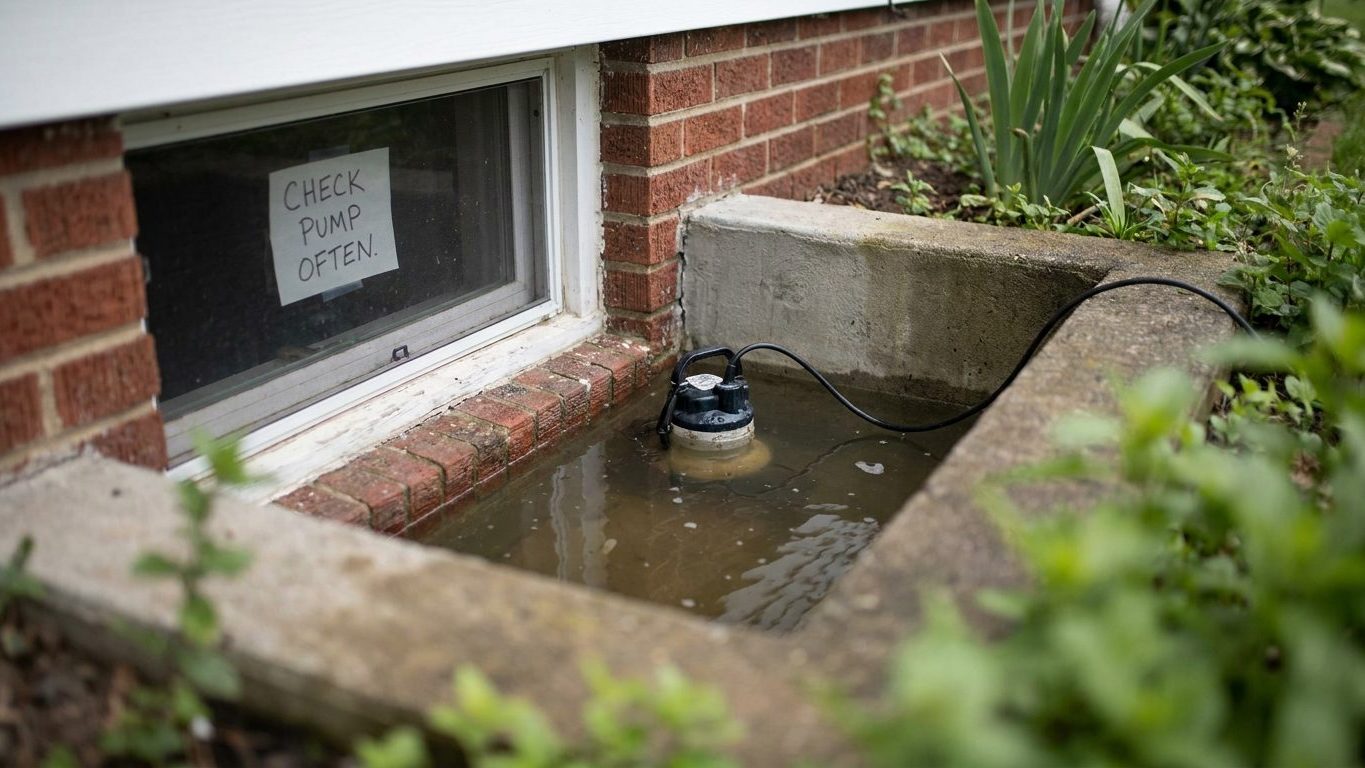

Everywhere else on the house, a water problem starts with a clogged gutter or bad grading. At a window well, the design itself creates the weak point: a hole dug against the foundation, sitting below the surrounding grade, with a window at its bottom becoming the lowest opening water can reach. Check how the well drains before you touch anything on the glass or the frame.
What is actually going on

A window well is built to hold a below-grade window in place, not to manage water. Below-grade windows bring light, and in some rooms an emergency exit, into a basement, and they only work if the window sits lower than the yard around it. The whole design is a pocket dug against the foundation wall, the window dropped into it, and the soil held back by a metal or plastic shell.
The trouble is that a hole below grade is also a collection point. Rain that would otherwise run off across the yard, along with snowmelt and whatever the wall above sheds, drains straight into the well instead. A well that’s working handles this by conducting water down through a bed of gravel to a footing drain or a dry well, the same principle behind an exterior French drain running along the rest of the foundation. When that path stays open, the water that lands in the well also leaves it.
When it doesn’t, whatever falls in stays in, and the well fills like a bucket. Once it does, the window is the lowest opening in that stretch of wall, below the sill, below the surrounding soil, below any other gap in the foundation nearby. Water does not need much pressure to get past a window frame that was only ever built to keep out weather. A well holding even a shallow depth of water for more than a day is telling you the drainage underneath it has stopped working, not that the window has failed.
This is also why interior fixes solve the wrong half of the problem. A coating painted on the inside of the frame or the wall manages humidity and hides staining, which is genuinely useful once the outside is under control. Water sitting against the outside of a wall is under pressure, though, and pressure finds the gaps a coating can’t reach. Drainage first, interior second is the order for a reason. Skip it and you repaint the same stain in a year, on a wall that’s still wet behind the paint.
A well that keeps filling is rarely an isolated fault either. It’s usually one symptom of drainage patterns affecting the whole house, the kind covered at large in the foundations and basements guide.
What to look at, and in what order
Before assuming the well itself is broken, work through these checks starting with the ones that cost nothing to look at and rule out the most.
Work through these in order
- Look at the gravel at the bottom. If it’s buried under silt and leaves instead of open and loose, water has nowhere to go even if the drain below it still works. This rules out a failed underground pipe, because the blockage is one you can see and clear yourself.
- Check whether there’s a drain at all. Some wells were built as a simple bowl with no connection to a footing drain or dry well. If a few inches down through the gravel you hit solid soil rather than a pipe or a gravel-filled pit, the well was never designed to drain on its own, and clearing debris won’t change that.
- Trace where nearby downspouts empty. A downspout discharging within a few feet of the well, or a splash block aimed toward it, can put more water into the well than any drain was sized to carry. This rules out the well as the primary cause and points to gutter and grading work instead.
- Check the grade around the well. Soil sloping toward the foundation rather than away from it feeds runoff into the well from every direction, not only from the roof. Ground that’s flat or tilted inward within a few feet of the well can explain repeat flooding even with a clear drain underneath.
- Look at the cover, if there is one. A well cover keeps out leaves and cuts evaporation loss, but a solid dome can shed water off its sides straight into the well faster than an open well would collect it on its own. There’s no drain in a cover, only over one, so a broken or missing cover rules out nothing by itself.
- Check the window frame and sill separately from the well. Staining that appears only after the well visibly overflows points to the well. Staining that shows up on dry days, with no standing water anywhere in the well, points instead to a frame seal or a crack in the wall, a different repair entirely.
Work down this list before paying for anything below the surface. Most wells that flood repeatedly fail at the first two checks, not because an underground drain has collapsed, but because nobody has ever cleared the gravel or connected one in the first place.
Watch it, or get someone in
Clearing gravel, stopping a cover from turning into a water slide, and moving a downspout away from the well are all jobs a homeowner can do and watch over a season, ideally checking after at least one heavy rain rather than trusting a single dry inspection.
When it’s a different call
Some signs mean the well and the wall behind it need someone else’s eyes, and which someone matters. If the well shell is separating from the foundation, if there’s cracking in the concrete or block it’s bolted to, or if the wall itself is bowing, call a structural engineer before anyone touches drainage or coatings. An engineer’s job is to assess the wall and the well’s effect on it, not to sell a fix, so the report you get isn’t shaped by what the company also happens to install.
If the wall and window frame are sound but water keeps arriving faster than the well can shed it, that’s a job for a drainage contractor, the person who works on grading, downspout routing, and the exterior drain lines feeding the well, not on the foundation wall itself.
A waterproofing salesman is a third, different call, worth naming as its own category because the pitch often arrives before the diagnosis does. A company selling interior sealants, wall membranes, or a packaged waterproofing system is selling a product, and its read on your well tends to arrive with a quote already attached. Getting an engineer’s or a drainage contractor’s independent opinion on the actual cause first is worth doing before signing anything from a company whose diagnosis and its remedy are sold on the same visit.
How urgently you act also depends on what the water is touching. A well that holds water below the sill for a day after a storm and drains within a day or two is a drainage nuisance to keep watching. A well where water reaches the window sash itself, especially a below-grade bedroom window meant to open for egress, needs attention now rather than at the next dry spell, since a swollen frame can jam the one exit that room has.
What has to happen first
The single biggest way money gets wasted on a wet window well is doing the steps in the wrong order. Interior coating, a new cover, or a fresh bead of caulk around the frame all get done first because they’re visible and cheap, and all of them fail if the water outside was never redirected.
Outside comes first: the well’s own drainage as covered above, plus the parts of the system feeding it. Gutters that keep roof water away from that stretch of wall are a gutter question, not a window well question, and worth checking against your roofing guide before blaming the well itself.
Inside, sequence still matters once the outside is under control. If water is reaching the basement floor as well as the well, moving that water back out is normally a sump pump job, a plumbing fix that needs to be in place and tested before anyone finishes the floor or the walls around it. Basement wall insulation installed over a wall that’s still taking on water traps moisture against the framing instead of the concrete, which makes things worse, not better. What you can safely put on a basement floor, versus a slab-on-grade with no crawl space or basement beneath it, depends on which foundation type you actually have, since a sump pump and a footing drain only do anything for a foundation type built to include them.
None of that is a reason to put off checking the well itself, since it’s usually the cheapest and fastest item on the list. It’s a reason not to stop there. A well that drains properly on its own but still lets water into a basement with a wet floor is telling you the problem was never really about the well.
Common questions
Can I just add more gravel to a window well that keeps filling?
Only if there’s already a working drain underneath for the gravel to sit on. Piling clean gravel over a well with no connection to a footing drain or dry well raises the bottom of the bowl but gives the water nowhere new to go, so it fills to the new, higher bottom just as fast.
Does a window well cover mean I don’t have to check the drain?
No. A cover cuts down on rain and debris getting into the well, but it doesn’t create a drain where none exists. A well with no working drain still holds whatever gets past the cover, plus condensation, plus anything blown in sideways during a storm.
Is water touching the bottom of the window frame an emergency?
It depends on where that window leads. In a bedroom that relies on that window as its emergency exit, treat repeated water contact with the frame as urgent, since a swollen sash can jam. In a utility room or unfinished space with no other use for the window, it’s a drainage problem to fix rather than a same-day emergency, though one that only gets worse the longer standing water sits against the frame.
Will a sump pump fix a window well that keeps flooding?
A sump pump manages water that has already reached the basement floor. It doesn’t do anything for water sitting in the well outside. If the well feeds the same system the pump empties, fixing the well’s own gravel and drain connection is still the first step, and the pump handles whatever gets past that, not a substitute for it.