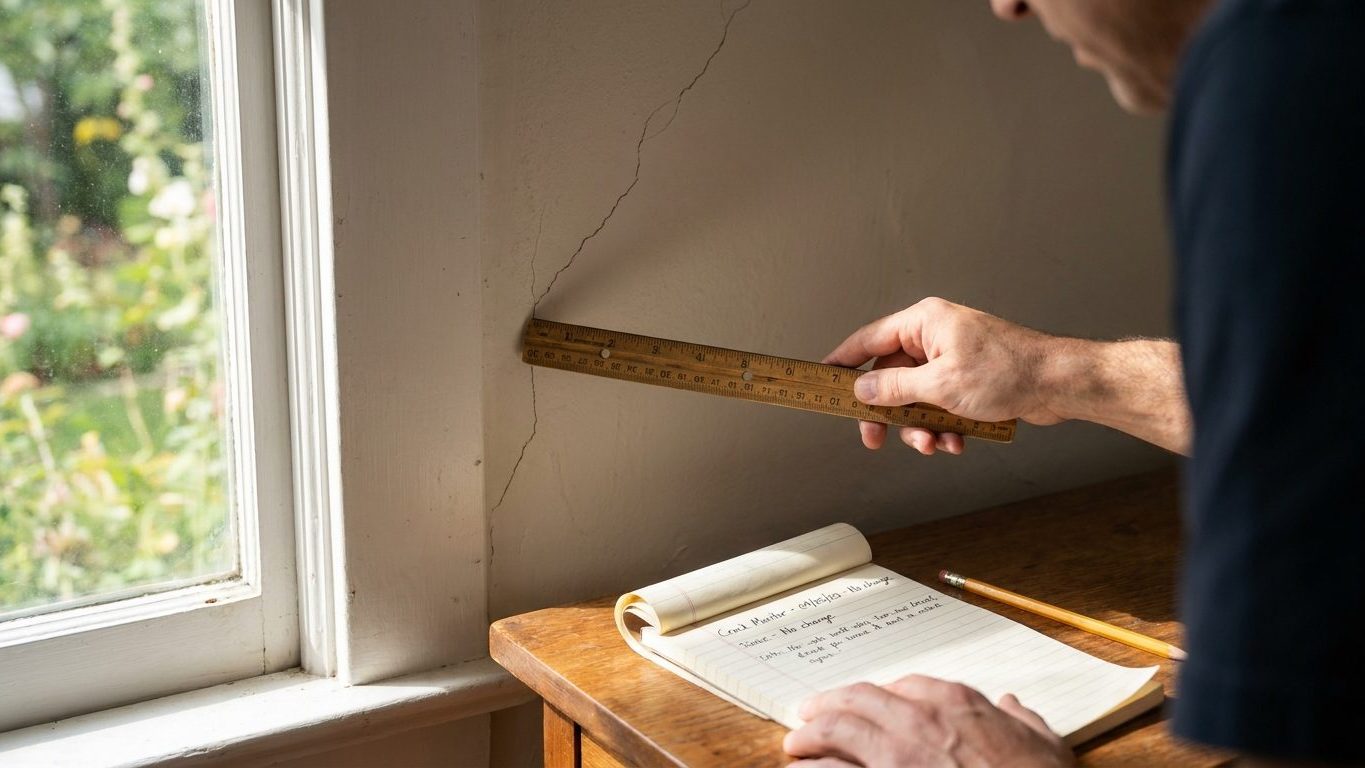

A crack’s width today tells you almost nothing on its own. What decides whether it matters is whether that same width is bigger next month, and that comparison only exists once you go make it. Mark the ends of the crack with a pencil line, write the date beside it, and check back in a few weeks.
What is actually going on

A crack shows up because something moved: soil settling under a footing, concrete curing and shrinking as it dries, a slab losing moisture unevenly, or a wall responding to pressure from wet soil pushing against it. The crack is the evidence, not the event. What decides whether you have a problem worth acting on is not how the crack looks today, it is whether it is still moving. A crack that formed once and stopped is a record of something that already happened. A crack that keeps opening is a record of a process that has not finished, and those two situations call for completely different responses.
This is why guessing a crack’s width from memory gets you nowhere. Memory rounds numbers, and a crack that looks unchanged from one glance to the next might have widened by an amount you would only catch by measuring. The fix costs nothing: mark it, date it, and let time answer the question instead of your eyes.
Read the details around the crack, not just the crack
Staining tells you as much as the gap does. A crust of white, powdery mineral deposit along the crack line means water has been moving through the material and left residue behind as it evaporated, a symptom covered in more detail in The White Powder on Basement Walls. That points toward a water problem more than a structural one, though the two often travel together because water softens soil and gives it somewhere to go. A crack with a clean, dry edge and no staining is more often a shrinkage crack that already ran its course during curing.
None of this replaces looking at your foundation as a whole system. If you have not worked out where water collects around your house and how it finds its way into the basement, the overview at Foundations and Basements: Almost Everything Here Is Water is the better starting point before you spend weeks watching one isolated crack.
What monitoring rules out is ongoing, active movement. What it never does, on its own, is tell you whether a crack is structural. That call depends on the crack’s location, its direction relative to how the wall carries load, whether it runs through mortar joints or through the masonry itself, and what else is happening around it. Only a structural engineer can make that determination. Monitoring tells you whether something is still happening. It does not tell you what that something is.
What to look at, and in what order
Start with the cheapest method and add rigor only if it leaves you unsure. Each step either sets a baseline or reads one you already set, and each result narrows the field of what you are dealing with.
| Method | What it involves | What a change tells you | What no change rules out |
|---|---|---|---|
| Pencil mark and date | Draw a light line across the crack at its widest point and at both ends, with the date written next to it. | A gap opening between the old mark and the crack edge means it has moved since that date. | Any movement at all during the period you watched it. |
| Dated photographs | Photograph the crack next to a ruler or a coin for scale, from the same distance and angle each time. | Side-by-side comparison catches gradual widening a single glance would miss. | Movement large enough to see clearly in a photo. |
| Tape strip across the crack | Lay a strip of masking tape or paper across the crack, well anchored on both sides, and date it. | The strip tearing or buckling means the crack opened enough to break its grip. | Movement large enough to break a taped seal. |
| Crack monitor gauge | A small plastic gauge with two overlapping scales, one half fixed to each side of the crack. | A different reading on a return visit shows both the amount of movement and its direction. | Both widening and any sideways shift, in a single reading. |
| Professional survey | A structural engineer measures against a documented baseline over a set period of time. | A defensible, documented answer instead of a homeowner’s best guess. | Nothing on its own. It is what interprets everything above. |
Give each of the first four methods a real stretch of time before drawing a conclusion. Cracks tied to seasonal soil movement swell and ease with wet and dry spells, so a single dry month showing no change does not mean the process has stopped, only that it is not active under this month’s ground moisture. A county extension office or a local soils engineer can tell you how ground movement runs in your specific area, since it varies with soil type and rainfall pattern more than most homeowners expect.
Read the direction of movement, not just the amount. A crack that widens at the top and stays fixed at the bottom is telling you something different from one that widens evenly along its length, and one that shifts sideways as well as apart is different again. A crack monitor gauge is built to catch that, a pencil mark is not, which is why the gauge sits further down the list of effort even though it still costs little.
Whatever method you use, monitoring only answers whether this crack is currently active. It does not tell you whether the wall around it is losing its ability to carry load, and it does not tell you whether a crack that looks stable this year will start moving again next year under different groundwater conditions. That is a separate question, and a professional answers it, not a gauge.
Watch it, or get someone in
A homeowner can reasonably monitor a hairline crack in a concrete slab that traces back to curing shrinkage, a crack in interior drywall or plaster tied to normal seasonal settling, or any crack that has shown no movement across a full monitoring period covering different weather. These are candidates for the pencil-mark-and-wait approach above, and most of them stay exactly as they are.
Some signs move you straight past monitoring. A crack that runs horizontally across a block or poured wall is a different animal from a vertical one, because horizontal cracking follows the direction a wall bows when soil pressure pushes against it from outside. If the wall itself is starting to lean or bulge inward, that is described in A Basement Wall That Is Bending Inward, and it is not a monitoring situation. Neither is a crack that widens rapidly over days rather than weeks, one accompanied by doors and windows that have suddenly started sticking, or a stair-step crack running through mortar joints that keeps extending further with each check.
Which professional, and why it matters which one
Three people will offer to look at a crack, and they are not the same call. A structural engineer assesses the crack and the wall around it and gives you a written opinion. This is their job, not a sales pitch, and they are paid for the assessment whether or not any repair follows. A drainage contractor deals with grading, gutters, and drain tile, which addresses where water is going but does not diagnose whether a wall has a structural problem. A waterproofing salesman is selling a specific product or system, and their incentive is to find a problem their product fixes, which is a very different position from an engineer’s.
If a crack shows the signs above, call the structural engineer first, before anyone who is also going to quote you a repair. Their assessment is what tells the drainage contractor and the waterproofing company what they are actually dealing with, rather than the other way around.
What has to happen first
Sequence is where money gets wasted on this subject. A crack tied to water pressure will not stay fixed just because someone sealed the inside of it, and treating the inside before the outside is the single most common mistake homeowners make here. Water has to be dealt with at its source before anything else makes sense.
That means outside drainage comes before any inside treatment. Gutters that dump water against the foundation instead of away from it, covered in the roofing guides on this site, are worth checking before you spend a cent on the basement itself. A sump pump that is not keeping up with groundwater, covered in the plumbing guides, matters more than any interior sealant. Grading that slopes toward the house instead of away from it undoes almost everything else on this list.
Water has to be controlled before finishes go back on. Insulating a basement wall, a step covered in the insulation guides, traps moisture against masonry if that wall is still taking on water, and the same goes for flooring: what goes down on a slab, covered in the flooring guides, should go down only after you know the slab is dry and staying dry, not just dry on the day you checked.
Diagnosis comes before repair, always. A crack that is actively moving needs an engineer’s opinion on why before anyone fills, injects, or covers it. Filling a crack that has not been diagnosed hides the one thing that mattered: whether it was still moving when you sealed it shut.
Common questions
Can I just fill the crack while I keep an eye on it?
No. Filling a crack seals over the exact movement you are trying to track, and once it is patched you have no way to tell if it opens again underneath the patch. Monitor first, patch after a professional has told you what is going on, if a patch is even the right fix.
How long do I actually need to watch a crack before I trust the result?
Long enough to cover different weather, not just a dry spell or a wet spell. Ground movement tied to soil moisture can go quiet for weeks and then resume, so a short calm stretch is not proof the crack has stopped for good.
The crack is only on the inside wall, not visible outside. Does that change anything?
Not necessarily. An interior crack in drywall or plaster can reflect movement happening in the structural wall behind it, or it can just be the drywall itself responding to humidity and temperature. Mark and date the interior crack the same way, and if it tracks with a crack on the structural wall behind it, treat it with the same seriousness as that wall’s crack.
My crack hasn’t moved in months. Does that mean my foundation is fine?
It means that particular crack is not currently active, nothing broader than that. A foundation can have one stable crack and a separate, unrelated issue elsewhere, so a clean result on one crack is not a clearance for the whole house.