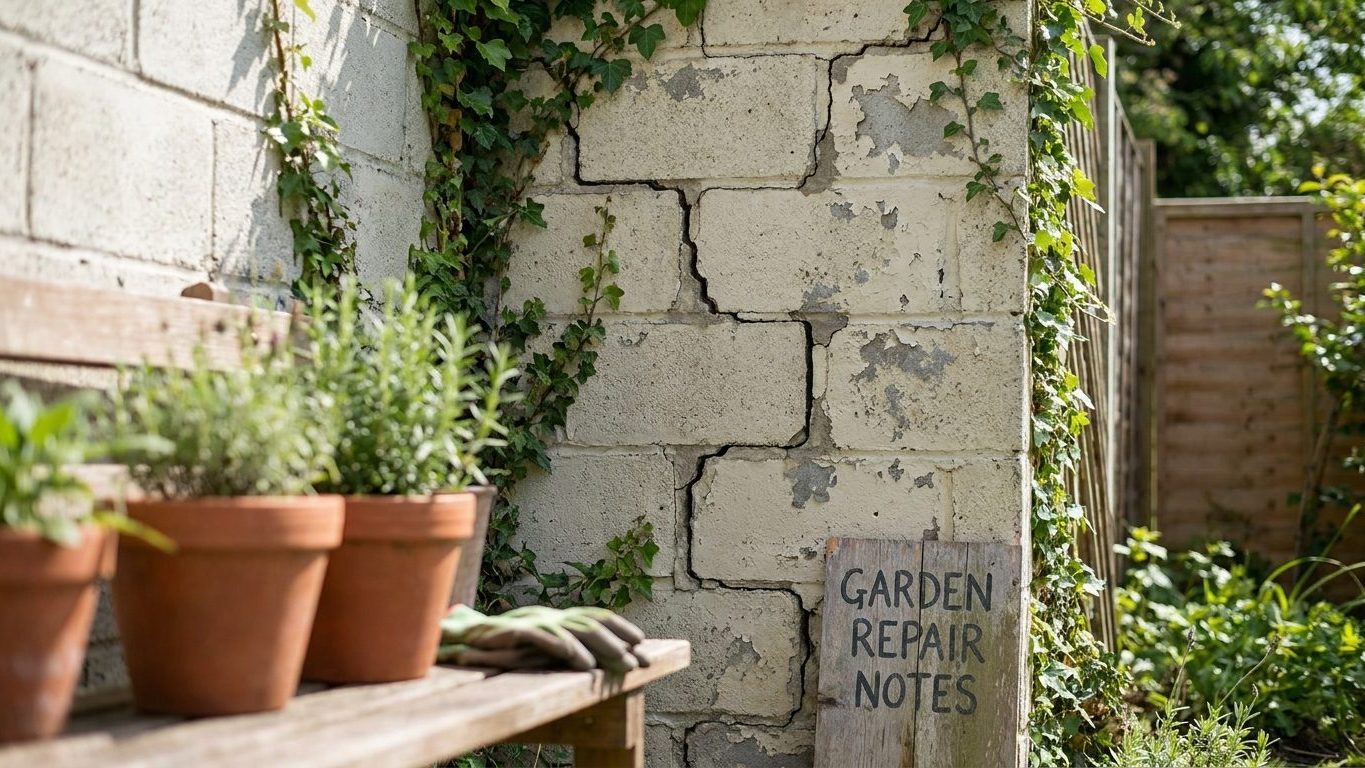

Stair-step cracks in a block wall follow the mortar joints because the joint is weaker than the block itself, and the direction of the step tells you which way the wall is moving. Patch one of these before you know why it’s there and you’ve buried the evidence along with the crack. Photograph it, mark its ends with a pencil line on the block, and watch it through a change of season before deciding it needs more than watching.
What is actually going on

A concrete block wall is built from rigid units glued together with mortar that is softer and weaker than the block. When the wall is under stress, whether from soil pressure, settlement, or a footing that has moved unevenly, the crack does not tear through the block itself. It travels along the path of least resistance, which is the mortar joint. That’s why the crack zigzags: up the vertical head joint of one course, sideways along the horizontal bed joint, up the next head joint, and so on. The result looks like a staircase, and the term describes exactly what you’re seeing rather than a specific cause.
The direction the step runs carries information. A crack that climbs toward a corner as it rises, widening as it goes, usually points to differential settlement: one section of the foundation under the wall has dropped relative to another, often near a corner where the footing carries less soil bearing or sits over disturbed fill. A crack that runs more horizontally along a bed joint, especially if it appears with a bulge or an inward lean in the wall, suggests lateral pressure from outside the wall pushing it in rather than one part of the footing dropping. These are different mechanisms with different consequences, and neither is something to guess at from a photograph.
What separates ordinary movement from a structural problem
Concrete block walls move a little with normal seasonal changes in soil moisture and temperature, and a stable hairline crack that has existed for years without changing is a different animal from one that is actively opening. What would make a stair-step crack structural rather than cosmetic is displacement across the crack: if one side of the joint sits proud of the other so you can feel a lip with your fingers, if the crack runs with an accompanying bulge or bow in the block face, or if it’s paired with doors and windows nearby that have started sticking or racking out of square. Any of those signs means the wall has actually shifted, not just cracked at the surface.
None of this is something to diagnose by eye and then fix. A structural engineer is the only person qualified to say whether a given stair-step crack reflects movement that has stopped, movement that is ongoing, or movement serious enough to affect the wall’s ability to do its job. The checks below tell you what to watch for and in what order to look at it. It does not tell you how wide is too wide, because that number means nothing without knowing the wall’s design, the soil behind it, and the history of the crack, all of which only an engineer can weigh together.
What to look at, and in what order
Work from the cheapest and least invasive checks toward the ones that require bringing someone in. Each step either points toward a cause or rules one out, and doing them in order saves you from paying for an assessment that a five-minute look outside could have made unnecessary.
| Check | What it suggests | What it rules out |
|---|---|---|
| Photograph the crack and mark its ends, then recheck after a season change | Active, ongoing widening means the cause is still at work | Rules out an old, stable crack that predates you and isn’t currently moving |
| Walk the perimeter and note where the ground slopes toward the wall instead of away | Water pooling against the wall on that side lines up with the crack’s location | Rules out the crack being unrelated to surface drainage on that face |
| Check downspouts for where they actually discharge, not just where the gutter run appears to end | A downspout dumping close to the foundation near the crack ties surface water to the symptom | Rules out roof water as the driver if downspouts already carry water well clear of the wall |
| Look at the interior face of the same wall section for staining, efflorescence, or a matching crack | A crack visible on both faces confirms it runs through the wall rather than sitting only in a surface parge coat | Rules out a coating or stucco crack that never touched the block underneath |
| Check nearby door and window frames on that wall for square, and check whether doors have started sticking | Racked frames point to the wall itself shifting, not just a cosmetic joint failure | Rules out cracking that is confined to the mortar with no frame movement behind it |
| Look at the rest of the house for similar step cracks on other walls | Multiple walls stepping the same way suggests a whole-house settlement pattern rather than one local spot | Rules out an isolated, localized cause specific to just this section |
None of these checks tells you what to do about the crack. They tell you what to bring to the person who will. A structural engineer who hears “the crack has grown a visible amount since spring, the downspout on that corner discharges right against the foundation, and two doors nearby have started sticking” has a far more useful starting point than one who is shown a photo with no history attached. If you’re also seeing a vertical crack elsewhere on a poured concrete wall rather than a block wall, that’s a related but distinct symptom worth reading up on separately: see “/foundations/vertical-cracks/”>Vertical Cracks in a Poured Wall for how that pattern differs.
Watch it, or get someone in
A stair-step crack you can reasonably monitor yourself is one that is hairline, has been there without visible change for a long stretch of time, shows no lip or displacement when you run a finger across it, and isn’t paired with sticking doors, racked windows, or a bulge in the wall face. For that crack, the plan is to keep the photograph log going, note the season and the weather leading up to each check, and revisit your notes at the same time each year.
A crack that needs a professional now is one that is actively widening between checks, that shows a step or lip where one side sits higher or further out than the other, that runs alongside a bulging or leaning section of wall, or that has appeared at the same time as new sticking doors or windows nearby. Any one of those on its own is reason enough to call. Two or more together should move it to the top of the list.
Which professional, and why it matters which one
The professional to call for that assessment is a structural engineer, not a waterproofing contractor and not a general drainage company. This distinction matters because an engineer is paid for their assessment whether or not any work follows it, while a company that sells crack injection, wall anchors, or waterproofing membranes has an obvious interest in finding something to sell. That doesn’t make every contractor dishonest, but it means their diagnosis and their bid arrive from the same mouth, and a homeowner has no independent way to check whether the diagnosis was accurate or simply profitable.
A drainage contractor is the right call for a separate problem: water actively entering the basement or crawlspace, standing water after rain, or grading and gutter issues that don’t involve visible wall displacement. That’s a different job from assessing whether a stair-step crack reflects structural movement, and it’s worth knowing which one you actually need before you make the call, since the two get confused constantly and homeowners often pay for the wrong visit first.
What has to happen first
The order of operations is where money gets wasted on this subject more than anywhere else in a house. Fixing or finishing anything on a foundation wall before dealing with water outside it is a near guarantee of doing the work twice. If the wall behind that stair-step crack is damp, if the soil against it drains poorly, or if downspouts discharge close to the foundation, that gets addressed before anyone talks about sealing the crack, painting the wall, or finishing the basement space in front of it.
Exterior grading and gutter discharge come first because they’re the cheapest interventions and they address water at the point it enters the system rather than after it has already reached the wall. If you haven’t already gone through gutter sizing and downspout placement, that’s worth doing before anything involving the wall itself.
Interior drainage, if it turns out to be needed at all, comes after the exterior work and after any structural question has been answered, not before. Installing an interior system without first dealing with the water source outside treats a symptom while leaving the cause in place. For what an interior drainage system actually does and doesn’t do, see “/foundations/interior-drainage/”>Interior Drainage Systems: What They Actually Do.
Diagnosis comes before repair, always, and that ordering is the single most common thing people get backward. A crack that gets filled or painted over before an engineer has looked at it, if one was needed, has had its evidence erased along with its appearance. If the wall in question is part of a basement or crawlspace, the broader pattern of how water moves through and around foundations is worth understanding before you plan any of this work: see Foundations and Basements: Almost Everything Here Is Water for that bigger picture.
Common questions
Is a stair-step crack always a foundation problem?
Not always. It tells you the mortar joint gave way before the block did, which is normal because mortar is the weaker material, but the cause behind that joint failure can range from ordinary seasonal shrinkage to genuine settlement. The direction, size trend, and any accompanying displacement are what separate the two, not the stair-step shape itself.
Can I fill the crack myself while I wait to get it checked?
Hold off. Filling it before a structural engineer has looked, if one is warranted, hides the movement that made the crack in the first place and removes the visual record you’d want to show them. Photograph and monitor instead until you know what you’re dealing with.
Why does the crack only show up on one side of the house?
That usually points to a localized cause on that side, like a downspout discharging close to the foundation, a grading slope that pushes water toward that wall, or a footing that bears on different soil than the rest of the house. Check that side’s drainage first, since it’s the easiest thing to rule in or out.
Does a stair-step crack mean the same thing on a brick wall as on a block wall?
The mechanism is similar since both are built from units and mortar, but the wall systems behave differently enough that the guidance here applies specifically to concrete block. A cracking brick veneer wall on a wood-framed house is a separate problem from a block foundation or retaining wall, and it’s worth confirming which type of wall you actually have before applying any of this.