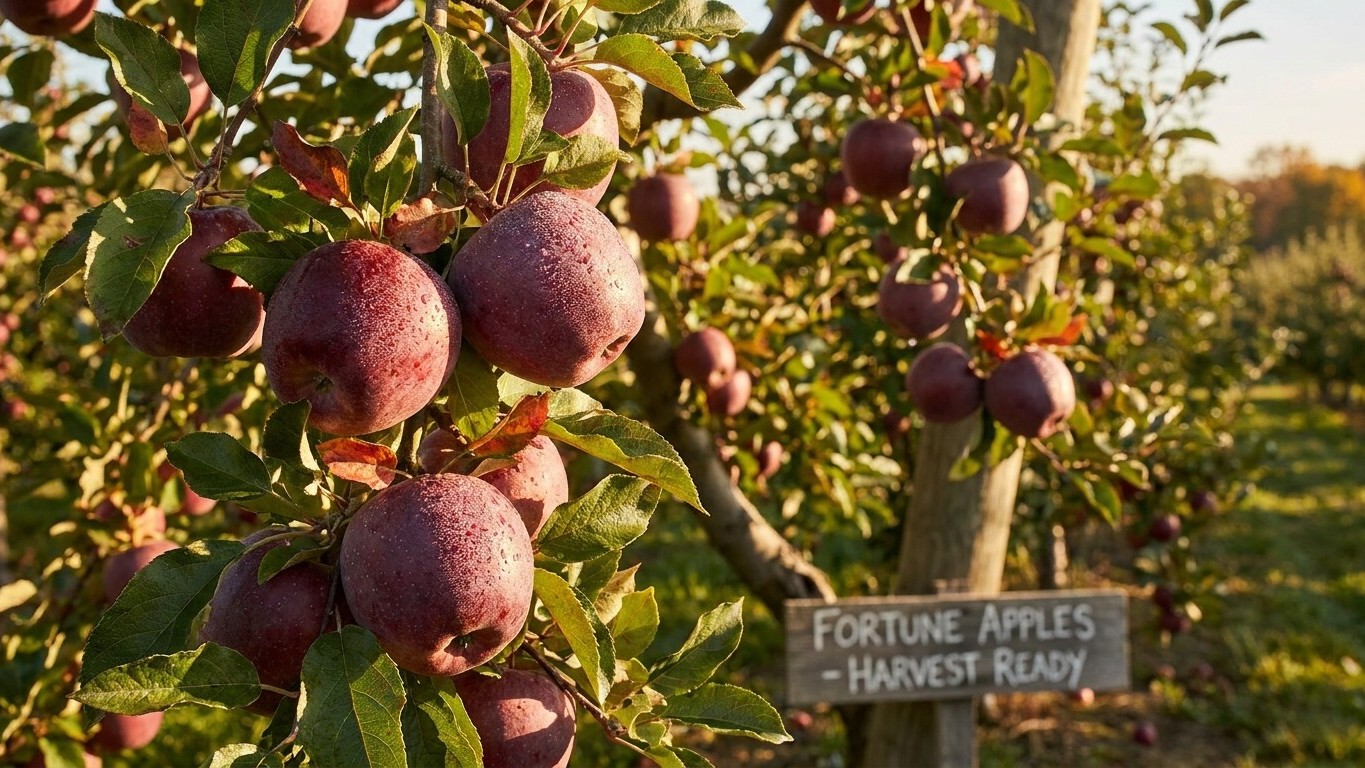

Fortune is a mid-season dessert apple with rich, spicy, sweet-tart flavor and firm crisp flesh, ready mid to late October and hardy across zones 5 through 8. It handles pie duty as well as fresh eating, but before you plant one, you need to know what pollinates it, where it actually thrives, and what it demands from a grower once it’s in the ground.
What Fortune actually is

According to USU Extension’s Apple Production for the Utah Home Garden, Fortune is defined by four practical facts that matter more to a home orchardist than any marketing description:
- When it ripens: mid to late October
- What it tastes like: rich and spicy, sweet-tart, with firm crisp flesh
- What it’s good for: firm and acid enough for pies, and holds its flavor through months of storage
- How Long It Keeps: several months in proper storage
That flavor profile puts Fortune closer to a baking apple than to a soft, sugary snacking one. The distinction isn’t marketing language, it’s physics. A pie apple needs flesh dense enough to hold its shape through heat and acidity strong enough to survive baking without turning to mush or going flat and sweet. Fortune’s firm crisp texture and sweet-tart balance check both boxes, which is why the source lists pies specifically rather than just calling it a “dessert apple” and leaving it there.
The mid to late October harvest window places Fortune among the later-season apples, well after early varieties have already come and gone from the tree. That timing matters for planning: if you’re building an orchard with a succession of ripening dates, Fortune fills the back half of the calendar rather than the front.
Nothing in the sourced facts ties this variety to another name it’s sold under, so unlike some apples that carry a marketing name in stores and a different name on the nursery tag (Mutsu sold as Crispin, Pink Lady sold as Cripps Pink), Fortune appears to travel under one identity. If you bought a tree or fruit labeled Fortune, you’re working with the variety described here.
Will it grow where you are
Hardiness zones 5 through 8
USU Extension lists Fortune’s hardiness range as zones 5 through 8, which is a wide band. That range stretches from parts of the upper Midwest and interior Northeast down through much of the mid-South and into milder western zones. It’s a range, not a single number, so a grower in zone 6 and a grower in zone 8 can both plant this tree and expect it to survive winter cold, but survival isn’t the same as a good crop. The hardiness rating only tells you the tree won’t be killed by typical minimum winter temperatures in that band.
Winter chill: not published for this variety
A second, separate filter determines whether the tree actually fruits well: winter chill, meaning the accumulated hours of cold temperatures a tree needs during dormancy before it can break bud and flower normally in spring. Apples in general lean toward the higher end of the chill-requirement spectrum compared to stone fruit, which is part of why apple orchards cluster in northern and higher-elevation regions rather than the Deep South or low-desert Southwest. USU Extension’s guidance doesn’t publish a specific chill-hour figure for Fortune, so rather than guessing at a number, the honest answer is that this figure isn’t documented in the source used for this page.
What that means practically: growers in the cooler, higher end of the zone 5 to 8 range (the interior Northeast, the upper Midwest, higher elevations in the Mountain West) are on safer ground than growers at the warm edge of zone 8, where mild winters can sometimes fall short of what apples generally need. If you garden in a borderline warm climate, it’s worth checking with a local extension office before committing, since chill accumulation varies year to year even within the same zone.
What to plant beside it
This is usually the question that brings a reader to a variety page, and it deserves a straight answer even when the answer is limited. Nearly all apple varieties crop better with a compatible partner nearby, since very few set a full, reliable harvest on their own pollen alone. Some varieties are partly self-fertile and will produce a modest crop solo, but even those tend to size up and set more fruit with a neighbor’s tree or a nearby crabapple contributing pollen during bloom.
For Fortune specifically, the source used for this page (USU Extension’s Apple Production for the Utah Home Garden) does not publish a list of confirmed pollination partners. That’s a real gap, not an oversight to paper over: rather than name a variety at a guess, the accurate statement is that Fortune’s pollination partner list isn’t documented in the facts available here.
What the source does confirm is Fortune’s bloom timing, which is mid-season. That’s a useful starting point even without a named partner list. A compatible pollinator needs to flower at the same time or with enough overlap to shed pollen while Fortune is in bloom, so any candidate partner should also carry a mid-season bloom rating. Varieties blooming very early or very late in your region are unlikely to overlap enough to pollinate Fortune reliably, regardless of how well they might otherwise pair on paper.
A second wrinkle worth flagging for any apple planting, even where a source doesn’t name it for this specific variety: a parent variety generally cannot pollinate its own seedling. Two trees blooming at the same time is necessary but not sufficient, since genetic compatibility matters as much as timing. Nothing in the sourced facts identifies Fortune’s parentage or names an excluded partner, so no such exclusion is stated here.
Given the gap in published partner data, the most reliable path is to choose a mid-season blooming variety from a nursery or extension list local to your region, confirm overlap with Fortune’s mid-season bloom, and consult a dedicated apple pollination guide for how bloom groups and compatibility work before finalizing a planting plan.
Growing it well
Fire blight: moderately susceptible
USU Extension rates Fortune as moderately susceptible to fire blight, a bacterial disease that spreads fastest during warm, wet weather at bloom time. In the garden, moderate susceptibility means you’ll likely see it eventually rather than never, but it shouldn’t run rampant through the tree if you catch it early. Watch for blackened, wilted shoot tips that curl into a shape often described as a shepherd’s crook, and for bark that looks water-soaked or oozes in spring. The standard response is to prune out infected wood well below the visible damage, sanitizing pruning tools between cuts, and to avoid heavy nitrogen fertilization, which pushes soft, vulnerable new growth that fire blight exploits.
Habit and biennial bearing
The source used for this page doesn’t publish specifics on Fortune’s growth habit or its tendency toward biennial bearing (the pattern where a tree alternates a heavy crop one year with a light one the next). Rather than assign a tendency the facts don’t support, it’s more honest to say this isn’t documented here. What does apply broadly to most apple varieties, Fortune included, is that thinning young fruit in late spring, leaving one apple per cluster spaced several inches apart, tends to even out fruit size and reduce the odds of a tree overloading itself into a poor year that follows a heavy one. That’s a standard orchard practice worth applying even without variety-specific data confirming a biennial pattern.
- Prune out fire blight strikes well below visible damage
- Avoid excess nitrogen, especially in the years after planting
- Thin fruit clusters in late spring as routine good practice
Picking it and keeping it
USU Extension places Fortune’s harvest window at mid to late October, but a calendar date is only a starting guide since actual ripeness shifts year to year with weather. The more reliable approach is to check the fruit itself using a short sequence of physical signs, in this order:
- Lift and twist: cup a ripe-looking apple in your hand, lift it gently upward, and give it a slight twist. A ripe apple separates from the spur with little resistance; one that clings and requires yanking isn’t ready yet.
- Seed color: cut one test apple open and check the seeds. Ripe apples generally show seeds that have turned brown rather than pale or white.
- Ground color: look at the background skin color, not the red blush, in the shaded side of the fruit. A shift away from green toward a yellower undertone is a sign of advancing ripeness.
Storage
Fortune’s flavor holds through several months of storage, according to the sourced facts, which makes it a genuinely useful keeper for anyone planning to eat apples well past harvest. Cold, humid conditions, close to refrigerator temperature with some humidity to prevent shriveling, are the general standard for extending storage life in home settings. Checking stored fruit periodically and removing any apple that starts to soften or spot helps keep the rest of the batch from spoiling early, since one decaying apple can hasten breakdown in others nearby.
Common questions
When does Fortune apple ripen?
Mid to late October, according to USU Extension’s Apple Production for the Utah Home Garden.
What does Fortune apple taste like?
Rich and spicy with a sweet-tart balance and firm, crisp flesh, per the same source.
Is Fortune apple good for pies?
Yes. Its flesh stays firm and its acidity holds up through baking, and it also keeps its flavor through months of storage, making it useful well beyond harvest season.
What zones can grow Fortune apple?
Zones 5 through 8, based on the sourced hardiness range. Winter chill requirements for this specific variety aren’t published in that source, so growers at the warm edge of zone 8 should check local extension guidance before planting.
What pollinates Fortune apple?
No confirmed partner list is published in the source used for this page. Fortune blooms mid-season, so any pollination partner should share that bloom timing, and consulting a dedicated pollination guide is the safest next step before choosing a specific variety to plant alongside it.