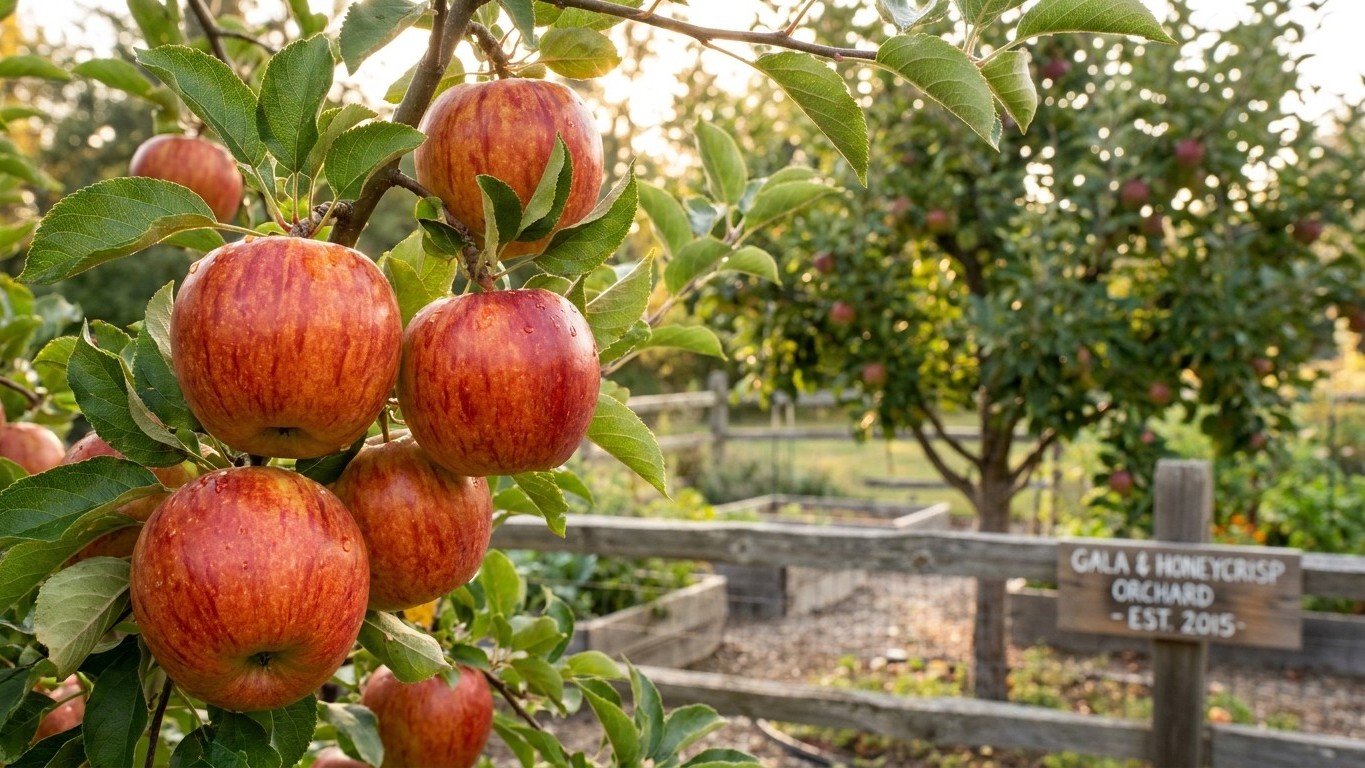

Gala ripens in September, carries a mild, floral sweetness best eaten fresh, and needs a genetically different variety nearby to set a full crop, since its own pollen won’t do the job on Mutsu and a few others don’t overlap in bloom time at all. Here’s what a home orchardist actually needs to know before planting one.
What Gala actually is

Gala shows up on nursery tags and grocery shelves under its own name almost everywhere, unlike some apples that trade under two identities (Mutsu sold as Crispin, Pink Lady sold as Cripps Pink). What you’re buying is what you’re growing. Four things matter most to a grower sizing this variety up:
- When it ripens: September
- What it tastes like: mildly sweet and floral, crisp but tender flesh
- What it’s good for: fresh eating or salads
- How Long It Keeps: about three and a half months in an ordinary cool store
According to Clemson Cooperative Extension’s HGIC 1350 variety table, Gala’s eating quality comes down to that combination of sweetness and floral aromatics riding on flesh that’s crisp without being hard as a rock. That texture is also why it lands squarely in the fresh-eating and salad column rather than the baking column. A pie apple needs flesh that holds its structure at oven temperature and acid sharp enough to survive an hour of heat without going flat and syrupy. Gala’s flesh is tender enough to soften into mush when baked, and its acidity is on the mild side, so it will cook down into something closer to applesauce than to distinct slices. None of that is a flaw. It’s simply a different apple built for a different job, and it’s worth planting with that job already decided rather than discovering it at pie time.
The USU Extension guide for the Utah home garden lists Gala’s harvest window as September and its bloom timing as mid-season, which matters as much for the pollination puzzle below as it does for the calendar on your kitchen wall.
Will it grow where you are
Hardiness zones
USU Extension places Gala in hardiness zones 4 through 8. That’s a wide band, running from winters that drop well below zero up through much milder Southern winters, and it means the variety itself isn’t the limiting factor for most of the continental United States. The real constraint usually shows up on the other end of the thermometer.
Winter chill
Hardiness zone tells you how much cold a tree can survive. Winter chill tells you whether it will actually bloom and fruit properly, and the two are not the same question. Apples need a certain number of hours below about 45°F each winter to break dormancy evenly and flower on schedule; too little chill and you get straggling, uneven bloom that hurts pollination and yield. Gala has a long history as a workhorse variety across a range of chill conditions, which is part of why it’s planted from the upper Midwest down into warmer growing regions. The USU Extension source used for this page doesn’t publish a specific chill-hour figure for Gala, so that number isn’t stated here rather than guessed at. If you garden in a mild-winter region, it’s worth checking with a regional extension office or a local nursery before committing, since chill requirements are usually confirmed locally rather than in a single national source.
What to plant beside it
Nearly all apple varieties crop better with a compatible partner nearby, and Gala is no exception. Left alone, or paired with the wrong neighbor, it will often set a light, disappointing crop even on an established tree. The good news is that Gala has a long list of documented partners. According to Clemson HGIC 1350 and UGA Extension bulletin C740, which classify Gala in bloom group B, the following varieties can pollinate it:
- Fuji
- Ginger Gold
- Granny Smith
- Jerseymac
- Mollie’s Delicious
- Red Delicious
- Yates
Plant one of these within pollinating range (generally the same yard or an adjoining one, close enough for bees to move between them) and you’ve solved the biggest single reason a young apple tree underperforms.
One pairing deserves a specific warning. Mutsu flowers at the same time as Gala, in the same bloom group, which makes it look like an obvious match on paper. It isn’t. Mutsu carries sterile pollen, meaning it can accept pollen from other varieties and be pollinated itself, but it cannot supply usable pollen to anything else, Gala included. Plant only these two together and you’ll get bloom, bees, and very little fruit, because the pollen half of that arrangement never arrives. If Mutsu is part of your planting plan, it needs a Gala partner and Gala needs a separate variety too, which usually means three trees minimum rather than two.
For the fuller logic behind bloom groups, sterile pollen, and how far apart trees can realistically stand and still cross-pollinate, see our apple pollination guide.
Growing it well
Fire blight
USU Extension rates Gala as susceptible to fire blight, a bacterial disease that spreads fast in warm, wet spring weather right around bloom time. In the garden, susceptible means watching for blackened shoot tips that curl over into a hook shape (often called a shepherd’s crook), and blossoms that suddenly wilt and turn brown or black as if scorched. Once you see it, the standard response is to prune well below the visible damage, disinfecting shears between cuts so you don’t carry the bacteria to the next branch. Susceptible varieties also mean going easier on high-nitrogen fertilizer, since soft, fast new growth is exactly what the bacteria exploits.
Habit and bearing pattern
Gala is a reliable, heavy-cropping variety, which is part of why it’s planted commercially at such scale. That heavy cropping habit is also the reason growers thin the fruit, removing some of the small developing apples in late spring so the tree isn’t carrying more than it can properly size and ripen. Left unthinned, a tree that sets a very heavy crop one year can slip into a lighter, biennial pattern the next, alternating a bumper year with a lean one. Thinning early, when fruits are still small, is the standard way to smooth that pattern out and keep production more even year to year.
Remember that a mature tree’s eventual size depends entirely on the rootstock it’s grafted onto, not on Gala itself. A nursery tag naming both the variety and the rootstock is the only reliable way to know how tall and wide the tree will ultimately get.
Picking it and keeping it
USU Extension lists Gala’s harvest window as September, but a calendar date is only a starting point. Weather shifts the actual moment from year to year, so the tree itself gives better signals than the month printed on a chart. Check these in order:
- Lift and twist: cup a fruit in your hand, tilt it upward, and give it a slight twist. A ripe apple separates from the spur easily; one that resists and has to be pulled or yanked isn’t ready yet.
- Seed color: cut one test apple open. Pale or greenish seeds mean more time is needed; seeds that have turned brown are a sign of maturity.
- Ground color: look at the background skin color, the part not covered in red blush. As Gala ripens, that background shifts from green toward yellow.
Storage
Once picked, Gala keeps for about three and a half months in an ordinary cool store, the kind of result a home grower can expect from a cool cellar, garage, or root cellar-style storage held near freezing with decent humidity. A longer figure of roughly six months exists, but that number comes from controlled atmosphere storage, the kind of regulated-oxygen, regulated-temperature system commercial packhouses run, not equipment available in a home setting. If you’re storing a home harvest, plan around the shorter figure and expect quality to decline gradually as that window closes.
Common questions
Can I grow just one Gala tree and still get apples?
You may get a light, inconsistent crop, since nearly all apple varieties benefit from cross-pollination, but a second compatible variety nearby (Fuji, Ginger Gold, Granny Smith, Jerseymac, Mollie’s Delicious, Red Delicious, or Yates) will produce a far more reliable harvest.
Will planting a Mutsu tree next to my Gala solve my pollination problem?
No. Mutsu blooms at the same time as Gala but has sterile pollen, so it can’t pollinate Gala or anything else. You’d need a third variety in the mix to get fruit from either tree.
Is Gala a good baking apple?
Not really. Its tender flesh and mild acidity are suited to fresh eating and salads; baked, it tends to soften into a mush rather than holding distinct slices the way a firmer, tarter variety would.
How do I know if a Gala apple is ripe without cutting it open every time?
The lift-and-twist test is the quickest field check: a ripe apple separates from the branch with a gentle twist, with no yanking required. Seed color and background skin color are useful backup checks if you’re unsure.
Can Gala grow in a warm, mild-winter climate?
Its hardiness range covers zones 4 through 8, which includes many milder regions, but winter chill hours aren’t published for Gala in the sources used here. Check with a local extension office before planting in a very mild-winter area to confirm chill needs are likely to be met.