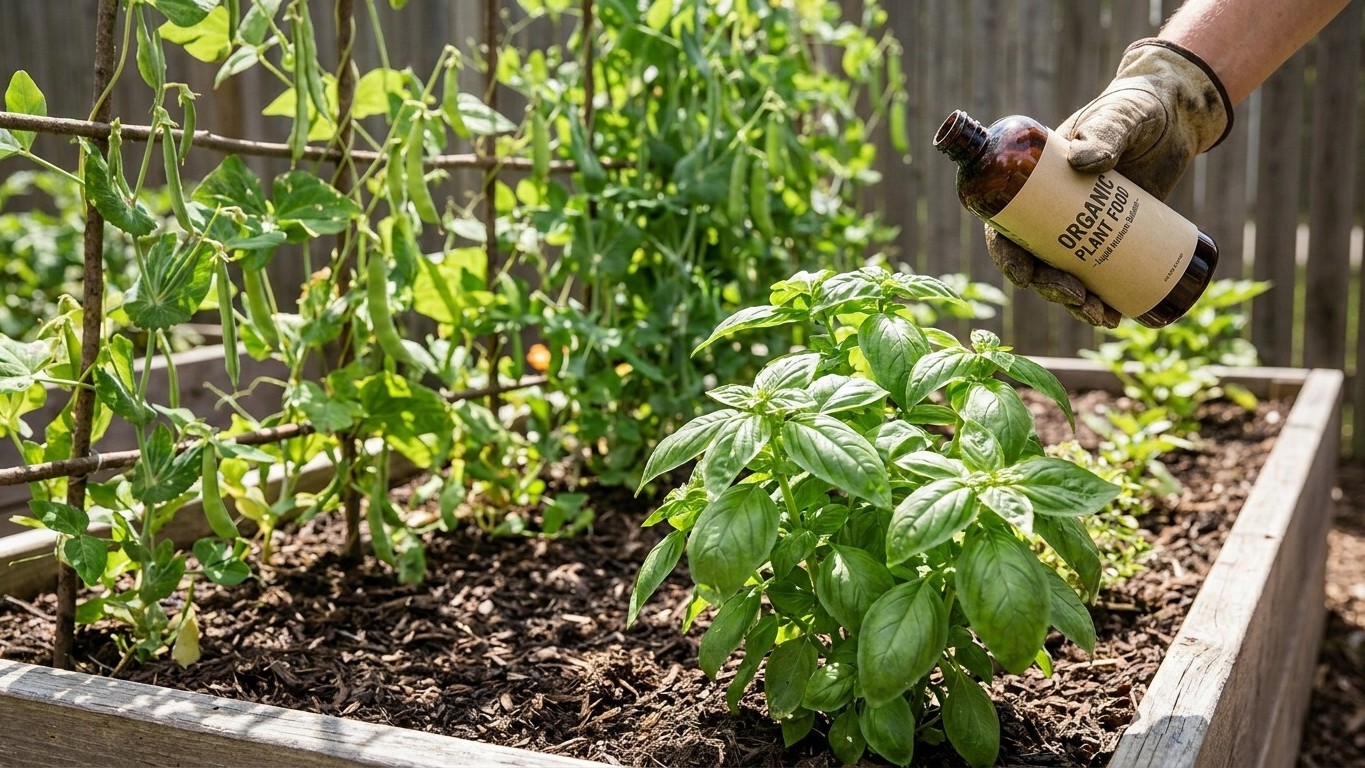

Basil needs feeding because you’re harvesting leaves, not pods. According to Utah State University Extension’s guide Basil in the Garden, the plant “requires some additional nitrogen to sustain rapid leaf growth,” and once it reaches harvestable size, the recommendation is to sidedress with an organic or all-purpose liquid nitrogen source: 1-2 tablespoons of fertilizer every 2-3 weeks per 10 foot of row, or weekly for potted plants.
The short answer
That’s the opposite of what beans and peas want in the same bed. Those crops fix Their Own Nitrogen through bacteria living on their roots, and feeding them extra nitrogen actually backfires, pushing lush foliage at the expense of pods. Basil doesn’t have that partnership. It has no nodules pulling nitrogen from the air, so every bit of nitrogen it uses has to come from the soil, from compost, or from the fertilizer you apply.
That distinction matters because gardeners who’ve internalized “don’t feed legumes” sometimes carry that rule over to everything else nearby. Basil is grown for its leaves, and leaf production is nitrogen-hungry work in a way that pod production simply isn’t. Utah State University Extension is explicit about this: pinch the plants back to force more leaf growth, or grow them in containers, and you need to fertilize regularly with an all-purpose soluble fertilizer to keep up with the demand.
Timing matters as much as the nitrogen itself. Basil goes into the ground only after your last frost date has passed, whatever that date happens to be where you garden. Plant it too early and a late cold snap will set it back or kill it outright, no amount of fertilizer will fix that kind of stress. Once it’s in and growing, the feeding schedule from Utah State University Extension gives you a rhythm to follow: sidedress every 2-3 weeks in the ground, or weekly if it’s in a pot, where nutrients wash through the soil faster and there’s less reserve to draw on.
What actually decides it

Leaves versus pods change the nitrogen math
The common advice floating around most gardens, “don’t overfeed nitrogen or you’ll get all leaves and no fruit,” applies to tomatoes, peppers, and yes, beans and peas. It does not apply to basil, because leaves are the entire point of growing it. There’s no fruit or pod to sacrifice. A basil plant that’s putting all its energy into leaf mass is doing exactly what you want it to do, and that leaf mass is built from nitrogen. Skimp on it and growth slows down long before the plant looks obviously starved.
Water stress undoes what fertilizer does
Nitrogen alone won’t carry a basil plant through a dry stretch. Utah State University Extension recommends watering basil regularly to supply 1 1/2 inches of water per week, and frames irrigation as protection against wilting that “slows growth, damages roots, and stunts plants.” A plant that wilts repeatedly is spending its energy recovering instead of growing, which means the fertilizer you applied doesn’t get used the way you intended. Feeding and watering aren’t separate chores here, they’re two halves of the same growth curve.
Weeds compete before roots can defend themselves
There’s a mechanical piece to this too. Basil “does not compete well with weeds,” according to the extension guide, which is why weed control during seedling establishment is described as critical. The fix isn’t to dig deep and pull hard, though. The guide specifically warns to cultivate shallowly and avoid root pruning, because basil’s root system near the surface is easily damaged by aggressive cultivation, and a damaged root system can’t take up the nitrogen and water you’re providing even when both are available in the soil.
How to do it
- Wait for your last frost date to pass before setting basil into the garden or its final pot. Cold-stressed transplants struggle to establish roots, and a struggling root system can’t take up nitrogen efficiently no matter how well you feed it later.
- Establish the seedlings weed-free. Cultivate shallowly around young plants and avoid root pruning, since basil’s shallow roots are easily damaged and weed competition during this stage is what the extension guide calls critical.
- Water consistently at 1 1/2 inches per week. This prevents the wilting that slows growth and stunts the plant, keeping it in a state where it can actually use the nitrogen you apply.
- Remove leaves before any flower forms to force branching. This is the harder cut than most gardeners expect: taking off leaves early, well before flower buds appear, pushes the plant to send out new side shoots from the leaf axils below the cut, which is how you multiply harvestable growth instead of just topping the plant once.
- Begin sidedressing once plants reach harvestable size. Apply an organic or all-purpose liquid nitrogen source at 1-2 tablespoons of fertilizer every 2-3 weeks per 10 foot of row.
- Switch to a weekly schedule for potted basil. Container plants need feeding more often than in-ground rows because nutrients leach out with each watering, leaving less reserve in that small volume of soil.
- Keep repeating the leaf-removal and feeding cycle through the growing season, harvesting as you go, rather than letting the plant grow unchecked toward flowering.
What Goes Wrong
- Pinching the flowers instead of the leaves. Once flower buds have already formed, pinching them off does not restore leaf yield the way removing leaves earlier would have. Utah State University Extension notes that pinching flowers actually “encourages flowers to form in the axils of the leaves,” which reduces yield further instead of protecting it. The remedy is preventive, not reactive: remove leaves before flowering starts, and plan successive sowings so a new batch of plants is always coming along behind the one that’s starting to bolt.
- Skipping fertilizer because “it’s just an herb.” Treating basil like a low-maintenance houseplant leaves it short on the nitrogen it needs to sustain rapid leaf growth, and growth simply slows without much visible drama, no yellowing, no drooping, just smaller and slower leaves. The fix is the sidedress schedule: every 2-3 weeks per 10 foot of row in the ground, weekly in pots.
- Watering on a random schedule instead of a consistent one. Letting basil dry out between waterings, even occasionally, triggers wilting that damages roots and stunts the plant. Aim for the steady 1 1/2 inches per week the extension guide recommends rather than a heavy soak followed by days of neglect.
- Deep cultivation to control weeds. Digging in around basil roots to pull weeds does more damage than the weeds themselves, since the guide specifically warns against root pruning. Cultivate shallowly instead, or better, get ahead of weeds before the basil is even in the ground.
- Letting potted basil run on the same schedule as garden rows. Containers dry out and lose nutrients faster than garden soil, so following the row-crop feeding interval for a pot leaves it underfed. Pots need water and fertilizer on their own, more frequent rhythm, weekly rather than every 2-3 weeks.
Common questions
Does basil need as much nitrogen as beans and peas avoid?
Yes, and that’s exactly the reversal to remember. Beans and peas fix their own nitrogen and suffer from extra feeding, while basil has no such mechanism and depends entirely on soil nitrogen and fertilizer to sustain the leaf growth it’s grown for.
Can I use the same fertilizer schedule for basil in the ground and in pots?
No. Utah State University Extension recommends sidedressing garden rows every 2-3 weeks at 1-2 tablespoons per 10 foot of row, but feeding potted basil weekly, since containers lose nutrients faster.
Does pinching off the flowers give me more leaves?
No, and this is the point most commonly gotten backward. Removing leaves before any flower forms encourages branching and more leaf production. Pinching the flowers themselves, once they’ve already appeared, instead encourages more flowers to form in the leaf axils and reduces yield.
How much water does basil actually need each week?
About 1 1/2 inches per week, applied consistently. The extension guide ties this directly to preventing wilting, which otherwise slows growth, damages roots, and stunts the plant regardless of how well it’s fertilized.