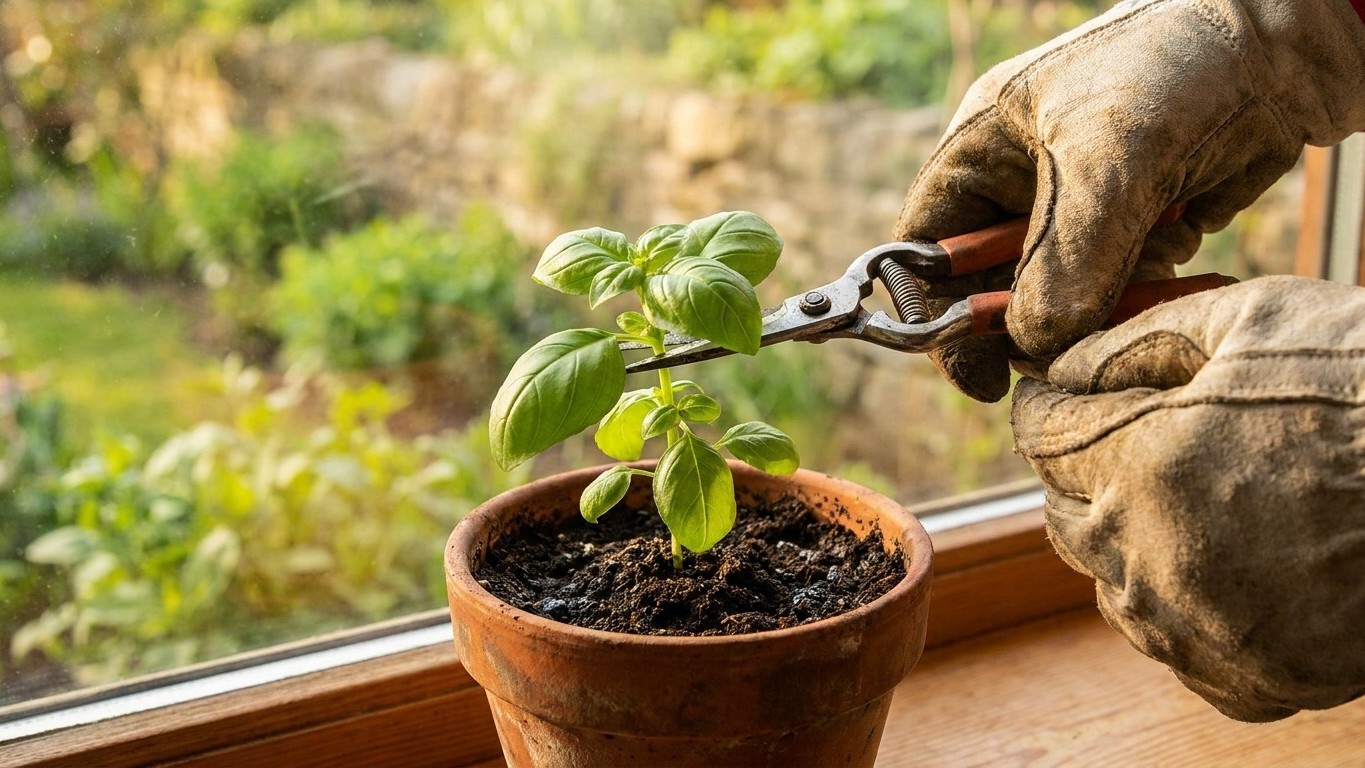

Cut basil back hard, down to just two to four leaves per stem, once the plant has six to eight leaves. That’s the exact threshold Utah State University Extension gives in its guide Basil in the Garden, and it’s more aggressive than most gardeners expect. Removing most of a young stem, rather than snipping a leaf here and there, is what pushes the plant to branch instead of just growing taller. The reward is a bushier plant and a much bigger harvest over the season.
The short answer
Utah State University Extension’s guide gives the exact line: “When the plants have 6-8 leaves, harvest the leaves from the plant using a sharp knife or scissors to remove enough of the stem to leave only 2-4 leaves.” That’s the whole method, but the number deserves a second look. A basil seedling with six to eight leaves is still small, often just a few inches tall, and cutting it back to two to four leaves means removing half the plant or more on the very first harvest.
That timing only makes sense once the seedling is past its tender stage and the soil has warmed up for good. Basil has essentially no cold tolerance, so it goes into the ground after the last frost date for your area, not on any fixed calendar date that happens to work somewhere else. Plant too early and a cold snap can take out the crop before that first cut is ever possible.
Leaf production from there depends partly on variety, though the guide is careful to note that how much pinching back you do matters just as much.
| Variety | Foliage production |
|---|---|
| ‘Genoa Green’ | Top producer |
| ‘Purple Ruffles’ | Low producer |
For planning purposes, the guide recommends 5-10 plants per person for fresh use, plus another 5-10 plants per person if you want enough to preserve for later. Because a well-cut plant keeps branching and producing through the season, alternating which plants you harvest each time keeps the whole bed in steady supply instead of exhausting one plant while others sit untouched.
What actually decides it

The leaf-node cut
Where you cut matters as much as how much you remove. The extension guide instructs gardeners to “cut stems just above a leaf node, leaving a few leaves behind to promote new growth and branching.” A leaf node is where a pair of leaves attaches to the stem, and it’s also where the plant stores the dormant buds that become new branches. Cut just above that point and those buds stay intact, so the plant sends growth in two directions instead of one. Cut through a bare stretch of stem instead, above no node at all, and there’s nothing there to branch from. That single detail explains why some gardeners cut hard and still end up with a single leggy stem: they removed enough tissue but cut in the wrong place.
Leaves versus flowers, and where the common advice goes wrong
Most garden advice tells you to pinch the flowers to keep basil productive. The extension guide draws a sharper line than that, and it’s worth understanding rather than skimming past. Removing leaves before any flower has formed is what makes a basil plant branch and produce more foliage; that’s the mechanism behind the 6-8-leaf cut described above. Pinching flowers after they’ve already appeared is a different gesture entirely, and the guide states plainly that it “encourages flowers to form in the axils of the leaves thus reducing the yield.” Snipping off a flower spike doesn’t reset the plant to leafy growth. It tells the plant to try flowering again from every leaf joint, pulling energy away from leaf production instead of adding to it. The real fix sits upstream of the problem: stagger your plantings so new basil is always coming along behind older plants, and keep plants free of the heat, drought, or crowding that pushes them to flower early in the first place.
Why basil needs nitrogen, unlike beans or peas
Gardeners who’ve grown beans or peas nearby sometimes assume basil follows the same low-input rules. It doesn’t. Beans and peas host nitrogen-fixing bacteria in root nodules and largely feed themselves. Basil has no such partnership. Every leaf it regrows after a hard cut is built from nitrogen pulled straight out of the soil, and a plant recovering from a cut down to two to four leaves is under real pressure to rebuild fast. A nitrogen-short plant branches more slowly and produces thinner, paler leaves at each new node, even when the cut itself was done exactly right.
How to do it
- Wait until the plant has six to eight leaves before making the first cut. A seedling with fewer leaves doesn’t have enough tissue left to recover from such a hard cut.
- Find a leaf node on the stem, the point where a pair of leaves attaches, and decide how many nodes down you want to cut.
- Cut just above that node with a sharp knife or scissors, leaving only two to four leaves behind. This is the step that catches people off guard: you’re removing most of the stem, not trimming a few inches off the top. That hard cut is exactly what triggers branching from the dormant buds near the node.
- Alternate which plant you harvest next time, rather than repeatedly cutting the same one while others go untouched.
- Cut fresh basil just before you plan to use it, since flavor and texture hold up best right off the stem.
- For basil you’re not using immediately, re-cut the stems and stand them in a jar of water, away from direct sunlight.
- For longer storage, up to 7-10 days, cover the jar and stems with a plastic bag and refrigerate. The bag traps humidity so the leaves don’t wilt or blacken in the dry, cold air of the fridge.
What Goes Wrong
- Pinching flowers instead of removing leaves before they form. This is the most common mix-up, and it works backward: once a flower has formed, pinching it off doesn’t return the plant to leafy growth. The extension guide notes it actually encourages flowers to form in the axils of the leaves, reducing yield instead of raising it. The fix is preventive, not corrective: cut leaves back to two to four per stem before flowering starts, and stagger new plantings so an older, flower-prone plant is never your only source.
- Cutting too lightly. Snipping a few leaves off the top feels safer than cutting down to two to four leaves, but a light trim doesn’t expose enough dormant buds to trigger real branching, so the plant just keeps growing as one tall stem.
- Harvesting the same plant every time. Stripping one plant repeatedly while others sit untouched leads to an uneven, exhausted plant and an uneven harvest overall. Alternate which plants you cut so the whole planting stays productive.
- Skimping on nitrogen. Basil doesn’t fix its own nitrogen the way beans or peas do, so a plant recovering from a hard cut in poor soil regrows slowly with thin, pale leaves. If regrowth looks weak after a correctly placed cut, soil fertility is the more likely culprit, not the cutting technique.
- Freezing leaves plain. Tossing whole basil leaves straight into the freezer is a common shortcut, but plain leaves turn black and slimy once thawed as the cell walls break down. The tested storage method sticks to short-term freshness instead: re-cut the stems, stand them in water out of direct sunlight, and refrigerate under a loose plastic bag for up to 7-10 days.
- Planting Before the Last Frost. Basil has no cold tolerance, and a seedling set out too early can be killed by a single cold night before it ever reaches the six-to-eight-leaf stage.
Common questions
How many leaves should be on the plant before the first cut?
Wait until the plant has six to eight leaves, per Utah State University Extension’s guide, before cutting it back to two to four leaves. Cutting earlier leaves too little tissue for the plant to recover from.
Does pinching the flowers make basil produce more leaves?
No. The extension guide states that pinching flowers once they’ve formed “encourages flowers to form in the axils of the leaves thus reducing the yield.” It’s the leaf-removal cut done before flowering that boosts production, not pinching flowers after the fact.
How many basil plants should I grow per person?
The guide recommends 5-10 plants per person for fresh eating, plus another 5-10 plants per person if you want enough to store for later.
How long does cut basil stay fresh?
Stood in a jar of water away from direct sunlight, cut basil stays usable for several days at room Temperature. Covered with a plastic bag and refrigerated, the same cut stems keep for 7-10 days.