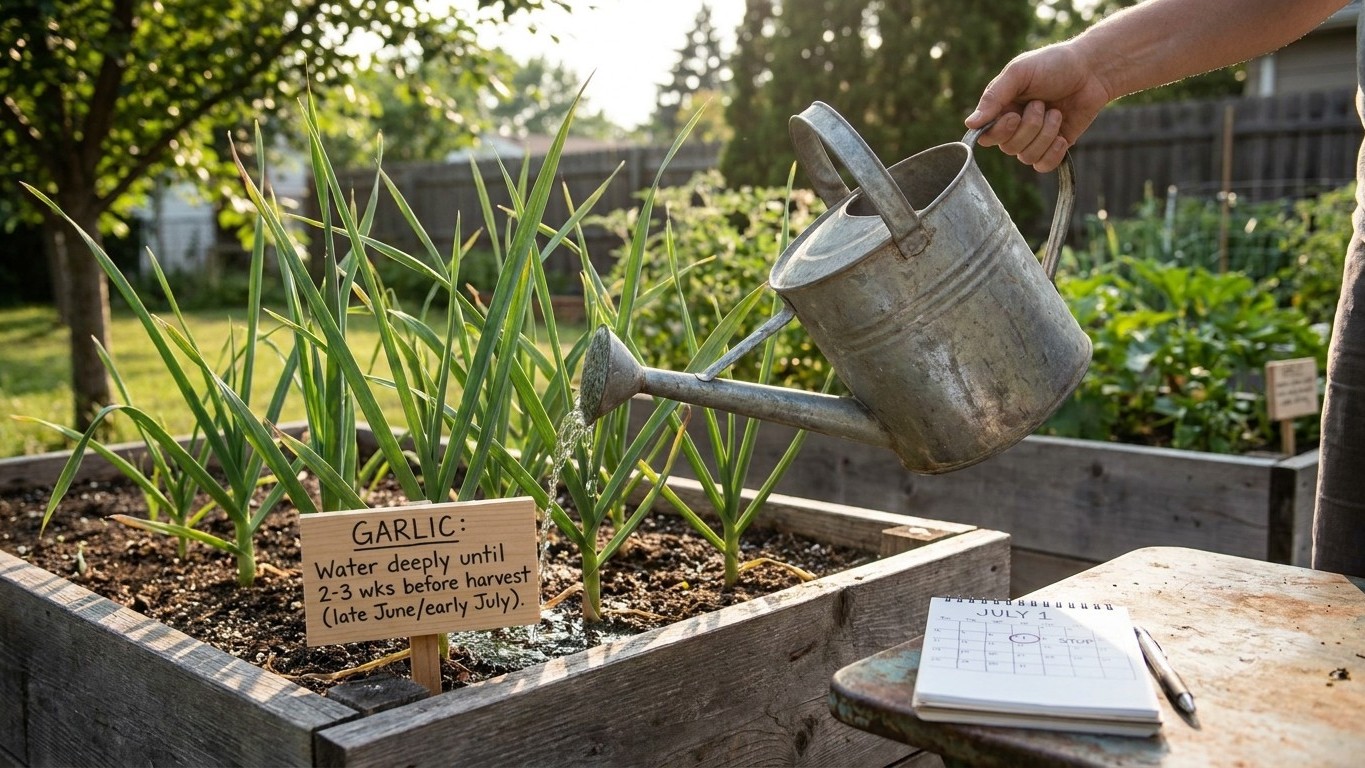

Nine or ten months in the ground is what makes garlic different from nearly everything else you grow, and it’s the reason watering it wrong is so easy and so invisible. The mistake never shows up when you make it. Water short during the compressed weeks when bulbs are actually sizing up, and that loss never gets recovered later. Water heavy right up to harvest, and the damage waits quietly until curing, or until you open the braid in midwinter.
Why this matters for garlic

Garlic spends nine or ten months in the ground, longer than almost anything else in the vegetable patch, and that long timeline is exactly why watering mistakes are so easy to miss. Plant it too dry in fall and the cloves root poorly before winter, which you will not notice until spring growth is weak and uneven. Water it too heavily right up to harvest and the bulbs can split their wrappers, pick up soil-borne rot, or simply store poorly, none of which shows up until you are curing the crop weeks later or opening the braid in midwinter.
The reverse mistake, letting the bed go too dry during the stretch when bulbs are actually sizing up in late spring, costs you in a different way: small, single-clove-feeling bulbs that never filled out. Garlic does most of its bulb growth in a compressed window before the tops start to die back, and a moisture gap during that stretch cannot really be made up later in the season. The plant does not compensate the way some annual vegetables can. Whatever water it was short during bulb formation, it stays short.
Because the payoff or the failure only shows up at harvest, it pays to think about watering garlic the same way you think about feeding garlic in autumn and spring. Both are decisions you make months before you can judge whether they worked.
When to do it
Water in newly planted cloves at fall planting to settle the soil around them and start root growth before the ground freezes, a step that assumes you have already got your cloves in at the right depth and spacing, which is covered on the main growing garlic page if you have not planted yet. Through winter, garlic under snow cover or frozen soil does not need irrigation at all. It resumes needing water once the ground thaws and green growth restarts in spring.
Spring through the drying-off stage
From spring green-up through the period when bulbs are actively sizing, keep the soil consistently moist. This is the stretch that matters most, and it runs until the plant itself signals it is finishing up. The signal to stop is the foliage, not a date: once a good portion of the lower leaves have died back and turned brown or yellow while the upper leaves stay green, the bulb is largely done sizing and further water mostly risks the wrappers and invites rot.
Sources disagree on exactly how many leaves should be down before you cut water, and on how many days or weeks that translates to before digging, because it depends heavily on regional rainfall patterns and how wet or dry the run-up to harvest has been. A grower in a region prone to wet, humid summers needs to cut water earlier relative to leaf die-back than a grower in a dry summer climate, because ambient soil moisture and humidity are already doing some of the drying-out work for the second grower and none for the first. Check with your local extension office for the timing pattern typical in your area.
How to do it
Garlic has a shallow, fairly modest root system compared to its size above ground, so the goal with every watering is to moisten the root zone a few inches down rather than to wet just the surface. A quick surface sprinkle that dries out in an afternoon does the plant almost no good and can actually encourage roots to stay shallow, which makes the whole planting more sensitive to the next dry spell. Water deeply and less often rather than lightly and daily.
Checking moisture instead of guessing
The simplest check is a finger or a trowel: push down a couple of inches into the bed between plants and feel whether the soil is moist at that depth. If it is dry an inch or two down, it is time to water. If it is still damp, wait. This beats watering on a fixed schedule, because rainfall, temperature and wind all change how fast a bed dries out from one week to the next, and a schedule cannot account for that the way your own hand can.
A soaker hose or drip line laid along the row is the most efficient way to deliver that deep, even moisture without wetting the foliage, which also helps keep down the leaf diseases covered on the garlic diseases page, several of which spread faster on wet leaves. Overhead watering with a sprinkler works too, but do it earlier in the day so the foliage has time to dry before evening, rather than late in the day when leaves stay wet overnight.
Mulch does a lot of the moisture-holding work for you. A layer of straw, shredded leaves or another loose organic mulch spread over the bed after planting slows evaporation, moderates soil temperature swings, and suppresses the weeds that would otherwise compete for the same water. In milder climates it also helps protect against frost heaving through freeze-thaw cycles in late winter. Pull mulch back slightly in spring if the soil beneath it is staying too wet and cold for too long, since garlic sitting in cold, waterlogged soil in early spring is slow to get going.
- Check soil moisture a few inches down before every watering, rather than on a fixed day of the week.
- Favor drip or soaker lines over overhead sprinklers where leaf disease has been a problem.
- Keep mulch in place through the moisture-critical spring stretch, then watch it as leaves begin dying back.
- Stop irrigation once lower leaves show significant yellowing or browning while upper leaves are still green.
What goes wrong
The most common failure is watering straight through to harvest out of habit, the same way you might water tomatoes right up until you pick them. Garlic is not tomatoes. Water that keeps the ground wet in the final weeks before digging softens the wrapper leaves that are supposed to protect the bulb in storage, and it can push soil-borne fungi like the ones covered on the diseases page into direct contact with the bulb through cracked or waterlogged wrappers. You will not see this at harvest. It shows up two to six weeks later, in storage, as soft spots, staining, or bulbs that mold from the neck down.
The opposite failure, a dry spell during active bulb sizing in spring, produces small bulbs at harvest with no other visible symptom beforehand. The foliage can look perfectly healthy while the bulb underneath simply never filled out, because the plant prioritizes keeping its leaves alive over swelling the bulb when water is short. You only find out at harvest, when the bulbs come up undersized despite a normal-looking season.
A third, less obvious problem is uneven watering: long dry stretches followed by a heavy soak, often from an irregular rain pattern or an owner who waters only when they remember. This kind of on-off cycling can cause cloves to crack or bulbs to split their skins as they swell unevenly, a defect that again only becomes obvious once you lift and clean the bulbs. Consistent moisture, even if it is on the lower end of what garlic wants, beats a feast-and-famine pattern almost every time.
How this changes across the country
Garlic grown in a region with cold, dry winters and a hard freeze that locks up the soil for months behaves differently from garlic grown where winters stay mild and wet, and the watering calendar has to follow suit. In the Upper Midwest and the interior Northeast, where snow cover typically sits over the beds for a long stretch, there is effectively no watering decision to make in winter at all: the ground is frozen or under snow, and the next decision point is spring green-up. Growers there tend to compress the whole watering season into spring and early summer, with a clear, relatively short window before the drying-off period starts.
In the Pacific Northwest and other regions with wet, mild winters and dry summers, the pattern flips. Winter rainfall can keep beds plenty moist without any help, so the watering decision does not start in earnest until the rains taper off in late spring, and then it runs through a longer dry summer stretch until harvest. Growers in the Gulf Coast and other humid, warm-winter regions face a different problem again: soil rarely dries out completely on its own, so timing the cutoff before harvest matters more, since ambient humidity keeps things damp for longer after you stop watering than it would in a drier climate.
Because these patterns differ so much by region, the most reliable move is to check your own state or provincial cooperative extension service for the typical planting window, frost timeline, and drying-off pattern local to your area, rather than applying a rule of thumb written for a different climate.
Common questions
Can I water garlic through a scape-cutting stage?
Yes, cutting the scape does not change the watering plan. Keep watering on the same schedule you were already using through the bulb-sizing stage, and only shift to drying off once the lower leaves start showing the yellowing or browning that signals the plant is finishing up.
What happens if it rains a lot right before I want to stop watering?
A run of rain in that window is one of the more frustrating things about garlic, because you cannot control it and it can push back your harvest date. If the soil stays wet, hold off digging even if the leaves say the bulb is ready, since pulling bulbs out of saturated soil makes them harder to cure and more prone to the storage rot covered on the diseases page.
Does mulch mean I can water less often?
Generally yes, since mulch slows evaporation and holds moisture longer between waterings, but it also means you need to check moisture under the mulch rather than judging by the surface, which can look dry while the soil beneath stays damp.
I forgot to water for a couple of weeks in spring. Is the crop ruined?
Not ruined, but likely smaller. A short dry stretch during active bulb sizing tends to show up as undersized bulbs at harvest rather than a total crop loss. Resume regular watering as soon as you catch it, and expect the bulbs to be on the small side rather than absent.