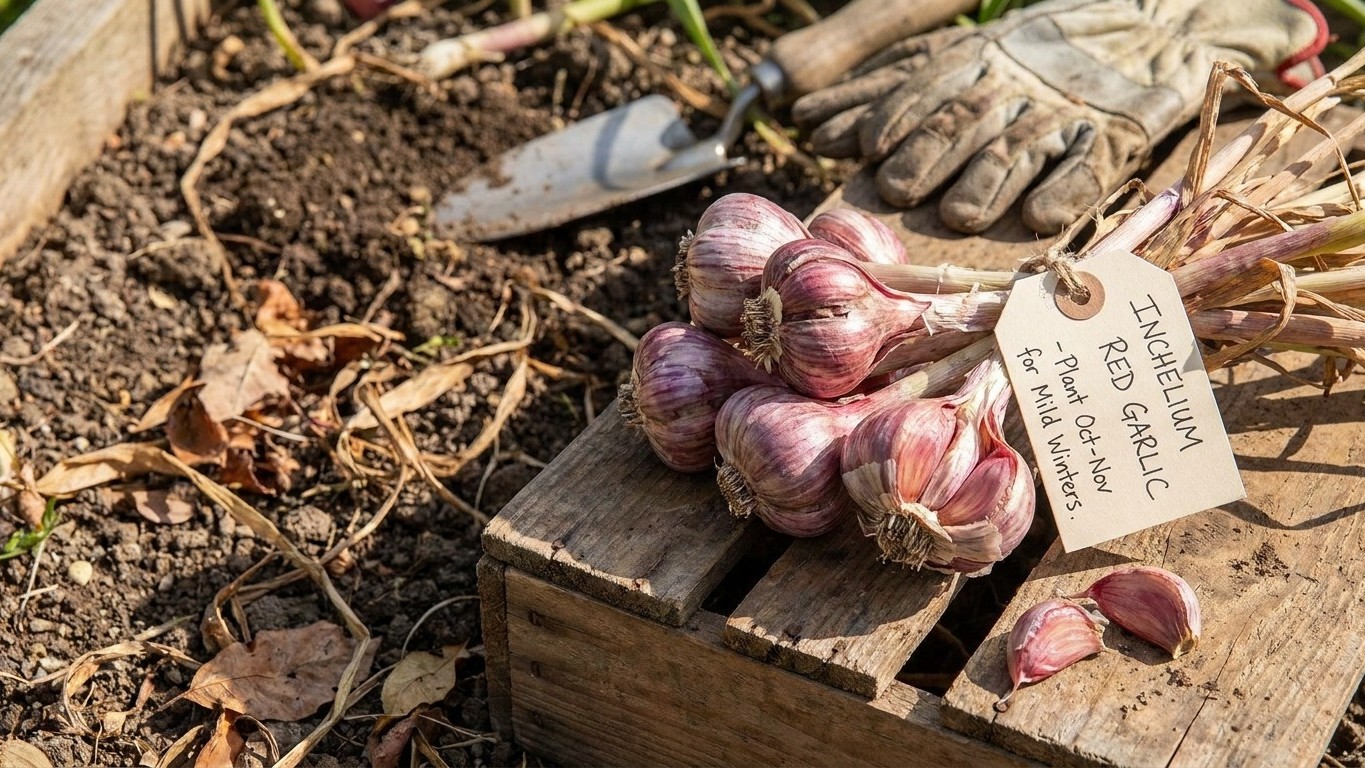

Inchelium Red is a softneck Artichoke-type garlic known for a mild, sweet flavor and unusually long storage among softnecks. It needs a real but moderate stretch of winter cold after planting to split its clove into a full head, so it suits climates with a mild winter rather than none at all. If your winter rarely stays below 40°F for more than a week or two, refrigerate your seed cloves before planting to fake the chill, or plant a lower-chill cultivar instead.
What Inchelium Red actually is

Inchelium Red belongs to the Artichoke group, the same broad softneck family that includes ‘Lorz Italian’ and most supermarket garlic, one of several families gardeners sort through in our guide to Garlic Varieties. It is a true softneck: no rigid central stalk, no scape to cut, and cloves arranged in overlapping layers around the stem like the leaves of an artichoke, which is where the group gets its name.
Seed catalogs and the variety taste trial once run by Rodale’s Organic Gardening magazine both describe it as one of the mildest, sweetest garlics available, without the sharp bite that hardneck types like Rocambole or Porcelain carry raw. That mildness is part of why it is a favorite for people who eat garlic raw in dressings and salsas rather than only cooked.
A mature bulb typically holds somewhere between twelve and twenty cloves, more and smaller than a hardneck’s four to eight, and catalog descriptions consistently rank it among the longest-keeping softnecks grown, staying firm well past the point where most hardnecks have gone soft, provided the bulbs were cured properly before storage. That keeping quality, combined with its low chill needs relative to hardneck types, is exactly why it suits gardeners in milder winter regions who still want a crop that lasts into the following year.
What Inchelium Red tastes like, and what to do with it
Flavor in garlic runs on a spectrum tied to how much pungent compound the clove produces and how that compound behaves under heat. Hardneck types like Rocambole or Porcelain load their cloves with sharp, complex sulfur compounds that make raw bite intense but break down fastest in storage. Softnecks in the Artichoke group, including Inchelium Red, produce a milder version of that same chemistry to begin with, which is part of why they keep so long: less pungent compound to degrade means a longer window before the bulb turns soft or sprouts. Heat changes the equation for any garlic. Cooking converts the sharp raw compounds into sweeter, mellower ones, and slow roasting pushes that conversion furthest, caramelizing sugars until the clove turns soft, spreadable, and almost candy-like. That is where Inchelium Red is specifically documented to perform well: baked whole.
Because it starts mild, baking does not need to fight against a harsh raw edge the way it would with a hotter hardneck variety. Roast a whole head until the cloves are soft enough to squeeze out, and the result is a sweet, spreadable paste with none of the raw sting — good worked into mashed potatoes, spread on bread in place of butter, or stirred into a sauce for depth without heat. Whether it holds any of that mild character raw in a way distinguishable from other Artichoke-type garlics, or shows any different behavior sautéed, sliced thin, or used in a long-simmered braise, is not documented and should not be assumed. The category tells you it is built to be gentle rather than fiery in any form, but the specific published guidance stops at baking, and no other cooking method or flavor nuance for this variety is recorded beyond that.
Will it get the cold it needs where you are
Garlic cloves do not divide on their own. A planted clove needs a sustained run of cold weather to trigger the biological signal that splits it into a full head of cloves. Skip that cold and you dig up one round, undivided bulb instead of a head, which is the single most common reason a garlic crop disappoints a first-time grower. Our regional planting data for Inchelium Red puts that requirement at roughly six weeks with temperatures under 40°F after planting, a moderate chill compared to hardneck Porcelains and Rocamboles, but still real.
Where the chill runs short
At the reference station in Los Angeles, winter delivers essentially zero weeks below 40°F in a typical year, the same story at the reference stations for New Orleans, Houston, Jacksonville, Honolulu and Phoenix. In every one of those places the clove has nothing to work with. That does not mean the crop is impossible there, but it does mean the grower has to supply the missing cold artificially or accept a round bulb instead of a head.
At the opposite extreme, places with genuinely cold winters have more chill than they know what to do with, but some of them run short on the cumulative growing-season heat garlic needs to actually bulb up once spring arrives. The reference station at Charlottetown, Prince Edward Island logs about 1,569 growing degree-days across the season, described as thin but workable. Anchorage logs around 917, Calgary around 1,171, Yellowknife around 905, Whitehorse around 600, and Rankin Inlet in Nunavut only about 159, all short of what unassisted bulbing wants, which pushes those growers toward a tunnel or greenhouse regardless of how comfortable the chill itself is.
| Territory (reference station) | Limiting factor | Set out window | Verdict |
|---|---|---|---|
| California (Los Angeles) | 0 weeks under 40°F, 6 needed | not established locally | Risky without help |
| Louisiana (New Orleans) | 0 weeks under 40°F, 6 needed | late November to mid December | Risky without help |
| Texas (Houston) | 0 weeks under 40°F, 6 needed | early to late November | Risky without help |
| Prince Edward Island (Charlottetown) | 1,569 degree-days, thin | late September | Comfortable, marginal heat |
| Alaska (Anchorage) | 917 degree-days, short | early September | Needs a tunnel |
| Nunavut (Rankin Inlet) | 159 degree-days, far short | late August | Greenhouse only |
If you garden somewhere on the risky list, you have two honest options. Refrigerate your seed cloves at cold-storage temperature for roughly the same six weeks the ground would otherwise provide, then plant them out once the refrigeration period ends. Or switch to a cultivar bred to need less cold in the first place, such as ‘Lorz Italian’ garlic, another Artichoke type bred for mild winters that some growers find slightly more forgiving of a short chill season. Neither option is a workaround for a bad site, both are standard practice among garlic growers in warm-winter states.
When to put the cloves in
Garlic is a fall-planted, summer-lifted crop almost everywhere, and the planting window is set by the first fall frost, not by a fixed calendar date. The goal is a clove that has rooted into the soil before the ground freezes solid, but has not pushed enough leaf growth above ground to be damaged by hard cold. Miss that window on the early side and the plant wastes energy on top growth it will lose to frost. Miss it late and the roots never establish before winter locks the soil.
How the window shifts by climate
In warm-winter states the window sits much later in the year than gardeners further north expect. At the reference stations, Louisiana growers set cloves out from late November to mid December, Texas growers from early to late November, and Florida growers on roughly the same early-to-late November timeline. In each case the ground never really freezes, so the risk is planting too early and getting excess soft growth going into winter, not too late.
In genuinely cold territories the window moves much earlier, because the ground itself becomes the limiting factor. Prince Edward Island’s reference station points to a late September set-out, Alaska’s to early September, Alberta’s and the Northwest Territories’ to late August, and Nunavut’s and Yukon’s earlier still, into August. These growers are racing the first hard freeze that would otherwise seal the soil before roots take hold.
Sources for exact planting windows disagree from one extension office to another even within a single state, because local soil, snow cover and microclimate all shift the ideal date by a week or two in either direction. Treat any date you find, including the ones above, as a range to test against your own site rather than a fixed rule, and check your state or provincial extension service for the closest published guidance to your county.
Hardneck or softneck: what this one asks of you
Inchelword Red is a softneck through and through, which changes what a season of growing it actually looks like compared to a hardneck. There is no scape to cut in early summer, one less task on the calendar and one less signal to watch for as harvest approaches. In exchange, you get more cloves per bulb than a hardneck gives, arranged in the layered, papery wrapping that makes softnecks the type used for braiding.
Those extra cloves are individually smaller than a hardneck’s, and the layered wrapper takes a bit more patience to peel than the single clean skin around a hardneck clove. What you get back for that fiddliness is storage life. A well-cured softneck like this one holds in a cool, dry pantry for months past the point most hardnecks have started to soften or sprout, which is the whole reason braiding softneck garlic for kitchen storage became a tradition in the first place.
This trade-off is also a climate signal. Softnecks generally ask for less winter chill than hardnecks like Rocambole and Porcelain, which is consistent with Inchelium Red’s moderate six-week requirement. Gardeners in regions with a long, hard winter tend to get more reliable results from a Porcelain hardneck bred for exactly that cold, such as Georgian Crystal garlic, which needs a real winter rather than a mild one. Save Inchelium Red for a winter that is present but not brutal.
Growing and curing it without losing the crop
Plant individual cloves pointy end up, spaced a hand’s width apart and set deep enough that the tip sits a couple of inches under the soil surface, in loose, well-drained ground. Garlic rots fast in standing water, so raised beds or ridged rows help anywhere winter brings heavy rain.
Mulch matters more here than for a spring crop
Because this is an overwintered crop, a thick mulch layer, straw is the usual choice, does two jobs a spring-planted crop does not need: it buffers the soil from repeated freeze-thaw cycles that can heave young roots out of the ground, and it suppresses the weeds that would otherwise get a head start over winter while the garlic is barely growing. Pull the mulch back partway in spring once real growth resumes, so the soil can warm.
Stop watering the bed a few weeks before you expect to lift the crop. Wet soil right up to harvest invites staining on the bulb wrappers and shortens storage life, one of the more common ways a good crop of garlic goes bad in the pantry before winter is even over. The best signal that it is ready is the foliage itself: once roughly the bottom third to half of the leaves have yellowed and died back while the upper leaves are still green, the bulbs are mature.
- Lift with a fork rather than pulling, garlic tears its wrapper and stem too easily by hand.
- Leave the roots and tops attached and brush off loose soil, do not wash the bulbs.
- Cure in a shaded, dry, well-ventilated spot out of direct sun for several weeks.
- Trim tops and roots only once the outer wrapper is fully dry and papery.
The two mistakes that ruin an otherwise good Inchelium Red crop both happen after the bulbs are already out of the ground. Lifting too late, once the wrapper leaves have all died back, leaves bulbs prone to splitting open and rotting in storage. Curing in a damp or unventilated space does the same damage more slowly, softening bulbs from the neck down before you ever get them into the kitchen.
Common questions
Can I still grow Inchelium Red if my winters barely go below 40°F?
Yes, but only if you supply the missing cold yourself. Refrigerate the seed cloves for the weeks they would otherwise spend chilling in the ground, then plant as usual, or switch to a cultivar with a genuinely lower chill requirement.
Why did my bulb come up as one round clove instead of a head?
That is the classic sign of insufficient winter chill. The single clove never received the cold signal it needed to divide, so it grew larger without splitting. Replant next season with refrigerated seed cloves.
Does Inchelium Red send up a scape I need to cut?
No. It is a softneck, and softnecks generally do not produce the flowering stalk hardnecks do. If you see any curling stalk at all it is usually minor and you can leave it, unlike the scapes on Rocambole or Porcelain types that must be removed.
Can I plant garlic cloves in spring instead of fall?
You can, but expect a smaller bulb. Spring planting skips most or all of the natural chilling period and shortens the growing season before summer heat sets in, so fall planting followed by a proper winter chill remains the more reliable route for a full-size head.