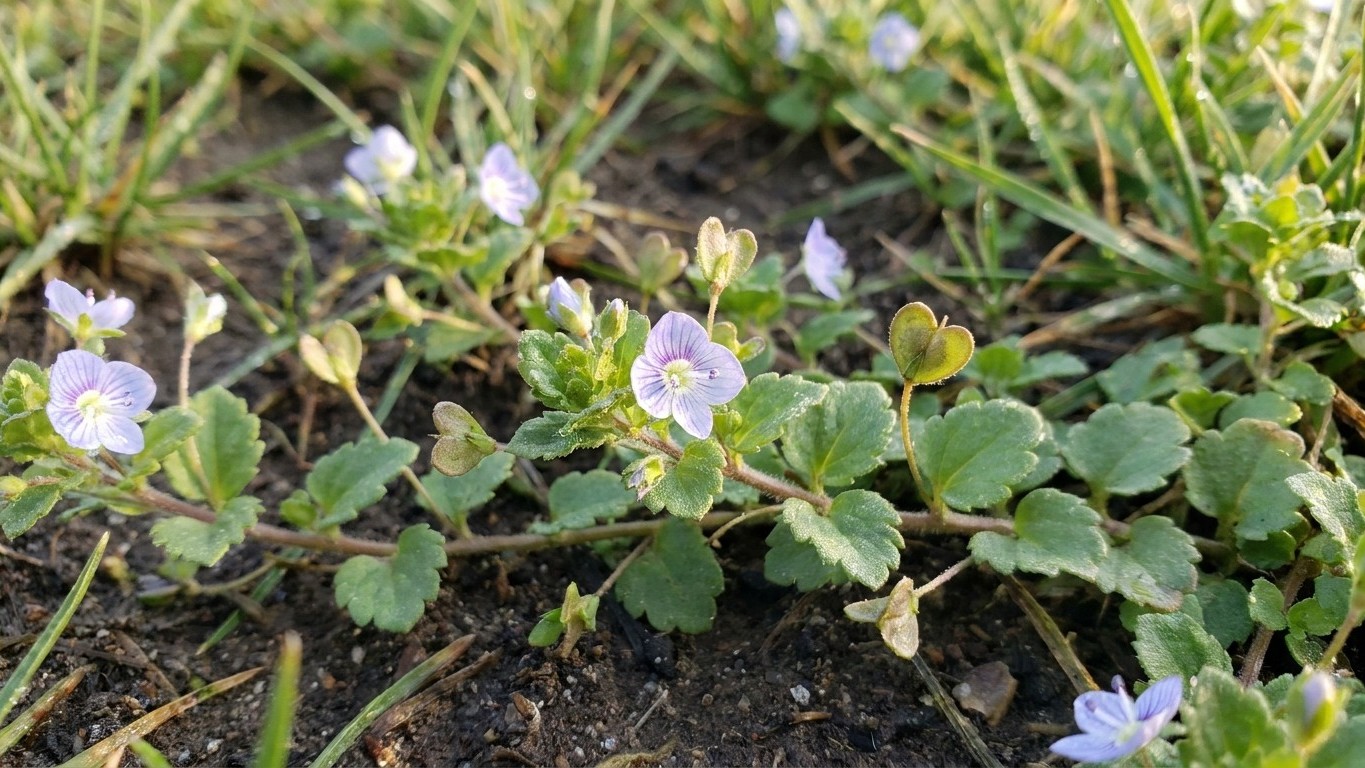

Speedwell is a low, mat-forming weed in the genus Veronica, easy to spot once you know the tell: tiny four-petaled flowers, usually blue or lilac with darker stripes, followed by a seed capsule that’s flattened and notched at the top so it looks like a tiny heart. It spreads fastest in thin, damp turf and is more a sign of a struggling lawn than a plant problem on its own.
How to be sure that is what you have

Speedwell grows low and spreads sideways rather than up. Its stems creep along the soil surface and root wherever a node touches ground, which is how a single plant turns into a dense patch within a season. The leaves sit opposite each other on the stem, are oval to rounded, and usually have a scalloped or slightly toothed edge, rarely bigger than a fingernail. The flower is small, four-lobed, and typically blue to pale lilac with fine purple veining, blooming from early spring into early summer depending on the species and region.
The detail that confirms it is the seed pod, not the flower. After the bloom drops, speedwell leaves behind a flattened, two-lobed capsule that genuinely resembles a tiny heart, a shape almost no other common lawn weed produces. That’s the single most reliable field mark if you’re staring at a patch and second-guessing yourself.
Two lawn weeds get mistaken for it constantly. Ground ivy (also called creeping Charlie) has a similar creeping, mat-forming habit, but its stems are square in cross-section, its leaves are more deeply scalloped and rounder like a tiny lily pad, and crushing the foliage releases a distinct minty smell. Speedwell has round stems and no scent. Chickweed is the other common mix-up, since both are low, opposite-leaved, and appear in the same thin, moist turf. But chickweed’s white flowers have five petals so deeply split they look like ten, and its seed capsule is a small rounded pod, never heart-shaped.
Speedwell shows up most in moist, shaded, or compacted patches, along the edges of garden beds, near downspouts, or under trees where turf is already sparse. Some species behave as winter annuals, germinating in fall and dying back by early summer heat, while others are low perennials that persist and thicken through the cooler months. Either way, a mat that seems to “die” in summer isn’t gone for good if it’s the annual type; it’s simply completed its cycle and will return from seed the following fall.
Why it is in your lawn
A weed patch is usually a symptom of a lawn condition before it’s a plant problem in its own right, and speedwell is a textbook example. It doesn’t invade thick, vigorous turf. It moves into the gaps: soil that stays damp because drainage is poor, ground that’s been compacted by foot traffic or mower wheels, and grass that’s been mowed so short the soil surface is exposed to light and moisture swings.
For cool-season lawns (fescue, bluegrass, ryegrass), the opening usually comes from shade and excess moisture combined with mowing height set too low for the season, which thins the canopy right when speedwell’s cool-weather growth is strongest. For warm-season lawns (bermudagrass, zoysia, St. Augustinegrass), the window is different: these grasses go dormant and brown in winter, leaving bare or thin ground exposed for months, which is exactly when winter-annual speedwell species germinate and get established before the turf wakes back up in spring.
Compacted soil deserves particular blame. When soil is packed down, air and water can’t move through it well, so grass roots stay shallow and the turf can’t compete for space. Speedwell, with its shallow, creeping root system, is built for exactly that kind of surface-level competition. A reader who aerates compacted ground, corrects a drainage low spot, or raises the mower deck by even half an inch is treating the actual cause, and often needs far less herbicide as a result.
Poor drainage compounds all of this. A lawn that holds water after rain, or stays soggy near a downspout or low corner of the yard, is functioning like a nursery bed for speedwell seed. Fixing the water first, through grading, a French drain, or simply redirecting a downspout, does more long-term good than any single herbicide application.
The window that decides everything
Timing matters more than product choice with speedwell, and the timing isn’t tied to a date on the calendar so much as a signal from the plants and soil around you. For crabgrass, a well-known example of this approach comes from Clemson Cooperative Extension’s Home & Garden Information Center (HGIC 1219), which times pre-emergent herbicide applications to forsythia and dogwood bloom rather than a fixed date, because those blooms track soil warming more reliably than the calendar does.
Speedwell runs on a different clock. Many of the species found in home lawns behave as winter annuals, meaning the seed germinates in fall as soil temperatures cool, the plant overwinters as a small rosette or mat, and it flowers and sets that heart-shaped seed the following spring before dying back. That means a pre-emergent herbicide aimed at speedwell needs to go down before fall germination, not in spring alongside a crabgrass application, which is one of the most common timing mistakes homeowners make. By the time you see the blue flowers in spring, the germination window for that year’s plants already closed months earlier.
Post-emergent control, by contrast, works best while the plant is small and actively growing, generally in late fall through early spring in most regions, before it sets seed. Once those heart-shaped capsules form and dry, the plant has already ensured next year’s crop, and spraying at that point does little but clean up the current season’s appearance.
Because fall soil-cooling and spring bloom triggers arrive weeks apart moving from the Gulf Coast to the northern tier of states, there’s no single national date that works. Rather than guess, match your application timing to your own region’s calendar rather than a national average.
Getting rid of it
Hand-pulling is the reasonable first step for small patches, but it comes with a catch tied directly to how speedwell grows. Because the creeping stems root at each node, any fragment left behind in the soil, even a piece an inch or two long, can generate a new plant. Pulling works, but only if you take the whole mat, roots and all, and follow up a few weeks later to catch anything that regrew from a missed piece. For a patch that covers more than a square foot or two, plan on repeating the pull two or three times over a season rather than expecting one pass to finish the job.
Chemical control is worth reaching for only after mechanical removal and lawn-condition fixes haven’t kept pace, and speedwell has a reputation among lawn-care professionals for shrugging off some standard broadleaf mixes. Herbicides built around 2,4-D, dicamba, or mecoprop (MCPP), often sold together as three-way lawn weed killers, can suppress speedwell but frequently need a second application ten to fourteen days later for a patch that’s already established. Triclopyr is another active ingredient sometimes used on tougher broadleaf weeds, but it can injure or kill warm-season grasses like St. Augustinegrass at rates that are safe on cool-season turf, so the grass species in your yard should decide the product, not just the weed on the label.
Chelated iron herbicides (often listed as FeHEDTA) are a gentler option that scorches broadleaf weeds like speedwell without the turf-injury risk that comes with some synthetic actives, though they typically take repeat applications to fully knock back an established mat.
A caution worth repeating: several of these active ingredients, particularly 2,4-D and dicamba formulations, carry state or local restrictions in parts of the country, especially near waterways or in areas with sensitive neighboring crops. Read the label for your specific state before buying, since availability and legal use can differ from what’s sold nationally.
Keeping it out
Thick, dense turf is the only control that lasts, because speedwell simply can’t get a foothold where grass blades already crowd out the light and space it needs to spread. Everything else, pulling, spraying, mulching, only buys time if the lawn underneath stays thin.
Mowing height is the fastest lever most homeowners can pull. Cool-season lawns generally do best kept around 3 to 4 inches, tall enough to shade the soil surface and keep moisture from sitting right at ground level where speedwell seed germinates. Warm-season lawns have their own ideal ranges depending on species, but the principle holds: cutting shorter than the grass wants weakens the canopy and opens the door.
Feeding on the right schedule for your grass type matters just as much as height. Cool-season lawns build their thickest turf from fall feeding, since that’s when they’re actively storing energy in the roots for winter and early spring growth. Warm-season lawns respond best to feeding through late spring and summer, their active growth period, and gain little from fertilizer applied while dormant.
Overseeding thin or bare patches closes the gaps speedwell depends on. For cool-season grasses, fall overseeding lines up with their natural growth surge and gives new grass a head start before winter. For warm-season lawns, spring is the better overseeding window, once soil has warmed and the grass is coming out of dormancy. Either way, a lawn with no bare soil showing is a lawn speedwell has a hard time getting into in the first place.
Common questions
Is speedwell harmful to pets or people?
It isn’t listed among the seriously toxic lawn weeds, and most concern with speedwell is cosmetic rather than a safety issue. If a pet has an unusual reaction after eating a large amount of any plant, that’s a conversation for a veterinarian rather than a guess based on general lawn-weed information.
Will speedwell go away on its own if I just stop mowing over it?
No. Speedwell thrives in undisturbed, shaded conditions, so leaving it alone tends to let the mat thicken and set more seed rather than fade out. The plants that behave as winter annuals will die back on their own in early summer heat regardless of mowing, but that doesn’t stop next fall’s germination from the seed already dropped.
My lawn looks brown right where the speedwell was growing. Is the grass dead?
Not necessarily. Brown turf, especially in a warm-season lawn heading into or coming out of winter, is very often dormancy rather than death, and it typically greens back up on its own once temperatures and moisture cooperate. Bare or thin brown patches that don’t fill back in after a full growing season are a better sign that reseeding or a soil fix is needed.
Can I just mow speedwell flowers off before they seed?
It helps some, but the low, creeping growth habit means a lot of the flowering stems sit below typical mower blade height and get missed entirely. Mowing reduces visible bloom but shouldn’t be relied on as the main control method the way it can be with taller weeds.