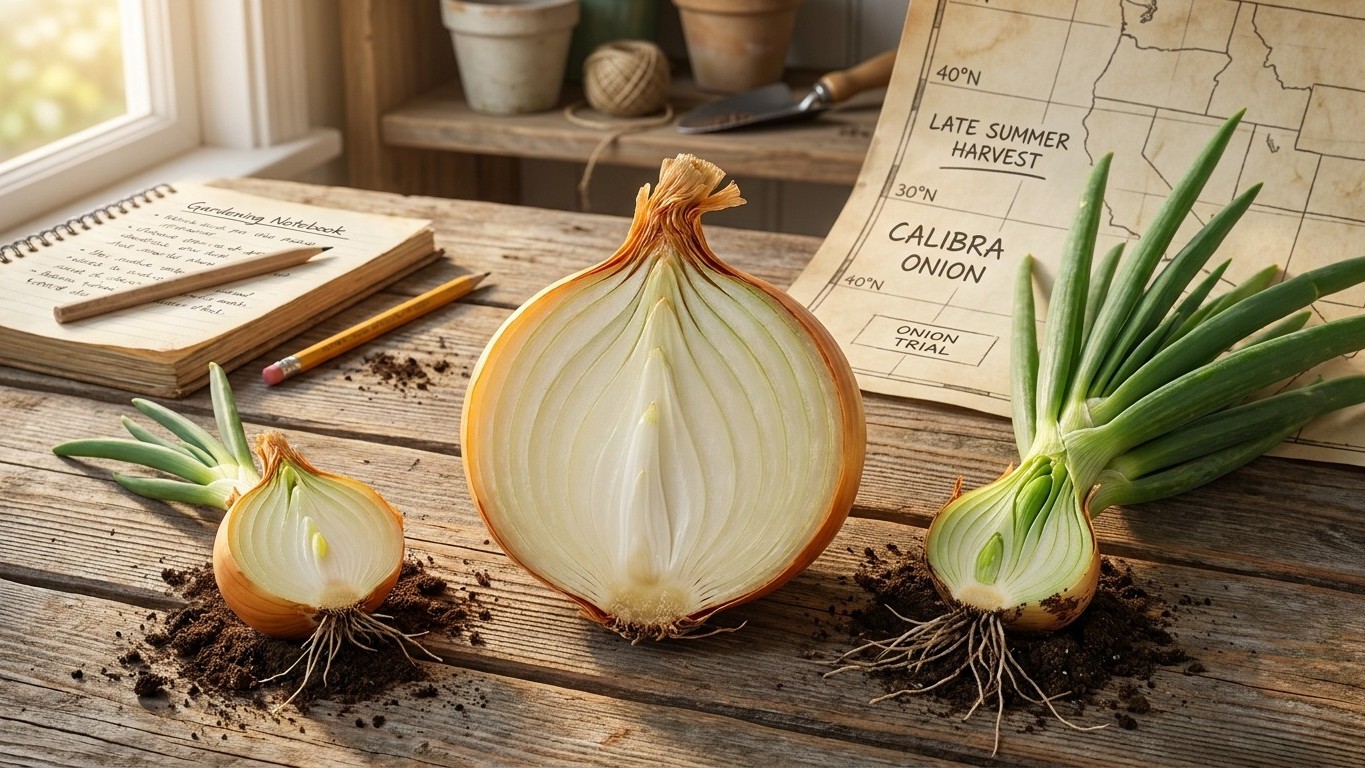

Calibra is an intermediate-day onion, which means it bulbs reliably between roughly 35 and 45 degrees north latitude, matures in about 110 days from transplant, and produces a yellow, sharp-flavored bulb that stores for 6 months or more. Whether it will actually work in your garden depends almost entirely on where you live.
Will Calibra bulb where you are

Latitude is the whole story with this variety. Calibra falls into the intermediate-day group, and it bulbs correctly between 35 and 45 degrees north latitude. That band runs roughly from northern Georgia and central Texas up through southern Nebraska, Ohio, and into the lower reaches of the Great Lakes states. Inside that range, Calibra does what a well-bred onion is supposed to do: it stops putting energy into leaves at the right point in summer and starts swelling a bulb instead.
Outside that range, the outcome is not a smaller onion. It is no onion at all. Plant Calibra too far south, and the days never get long enough to trigger bulbing, so the plant just keeps growing tops, season after season, until it eventually bolts or rots without ever forming a proper bulb. Plant it too far north, and the trigger arrives too early, before the plant has built enough leaf mass, so you get a golf-ball-sized bulb at best.
The mechanism behind this is counterintuitive for most gardeners, who assume warmth drives bulbing the way it drives tomatoes or peppers. It doesn’t. Onions bulb in response to day length, the number of daylight hours their leaves are exposed to, not soil or air temperature. That’s also why long-day onions belong in the far north and not the Deep South: northern summers deliver more daylight hours per day than southern ones, even when southern summers feel hotter. Latitude, not climate, sets the clock.
If your garden sits right at 35 or right at 45 degrees north, you’re in a blurred zone rather than a clear pass or fail. Microclimate, planting date, and even the specific summer’s weather can tip the result either way at the edges of that range. A gardener in central Virginia or southern Michigan should treat Calibra as a reasonable bet worth trying on a small scale first, not a guaranteed success. A gardener in Miami or in northern Minnesota should look at a different day-length group entirely, because no amount of good soil or fertilizer will substitute for the right amount of daylight.
What Calibra is like
Once it bulbs, Calibra delivers a yellow onion that reaches maturity about 110 days after transplanting. That’s a mid-to-long season commitment compared with some quicker varieties, so gardeners need to count backward from their expected harvest window to figure out a realistic planting date, which the next section covers.
The flavor is sharp, and that’s not a flaw, it’s the point. Calibra isn’t bred to be eaten raw on a burger the way a mild sweet onion is. It’s built for the pantry. The reason comes down to chemistry rather than taste preference alone: the same sulfur compounds responsible for an onion’s bite and the tears it draws when you slice it are the compounds that protect the bulb’s tissue from breaking down in storage. A sweet onion has fewer of these compounds, which makes it pleasant fresh and also makes it perishable, often good for only a few weeks before it softens or sprouts.
Calibra sits at the other end of that trade-off. It won’t be the onion you want thinly sliced into a salad tonight, but it will still be firm, sharp, and usable when you reach for it in February. This is a rule that applies across the whole onion world, not just to this one variety: sweetness and shelf life move in opposite directions, and no variety manages to offer both at once. If a catalog or a seller promises a sweet onion that also keeps all winter, treat that claim with skepticism.
In the kitchen, that makes Calibra a workhorse rather than a showpiece. It’s the onion you cook down for soups, stews, and sauces, where its sharpness mellows with heat and its structure holds up through long simmering. Save any onions that bolt or show soft spots for immediate use, since those won’t make it to spring regardless of variety.
Color and days to maturity, side by side
| Trait | Calibra |
|---|---|
| Color | Yellow |
| Days to maturity (from transplant) | 110 |
| Day-length group | Intermediate-day |
| Storage life | 6+ months |
When to plant it
Planting time follows the day-length group, and this trips up a lot of gardeners who move from one region to another and assume onion planting works the same everywhere. It doesn’t. Short-day onions, grown in the mild-winter South, go into the ground in fall and get harvested the following late spring, using the region’s warm winters to build size before short summer days trigger bulbing. Long-day onions, grown in the North, go in as transplants or sets in late winter to early spring, because the ground there is frozen or nearly so all fall and winter.
Calibra’s intermediate-day classification places it in the middle of that spectrum, and it’s grown across the transition zone that spans the middle third of the country, roughly the band between the short-day South and the long-day North. In most of that band, spring planting is the standard approach: transplants or sets go in as soon as the soil can be worked in late winter or early spring, giving the plant enough of the growing season to build leaf mass before day length climbs high enough to trigger bulbing in summer. Gardeners on the warmer, southern edge of Calibra’s range sometimes have the option of a fall planting instead, similar to short-day practice, though spring planting remains the more common and more forgiving choice for this variety.
The date on the calendar matters less than a test you can actually perform in the garden: is the plant big enough before bulbing starts? Day length doesn’t wait for a small, underdeveloped seedling to catch up. Whatever leaf mass the plant has built at the moment day length crosses its trigger point is roughly what determines final bulb size. A transplant that goes in late, or one that’s been stunted by cold, dry soil, or transplant shock, will still bulb on schedule, it just won’t have much leaf area to draw from, and the bulb will be small no matter how good the soil is afterward. Getting transplants in early, with healthy roots and a head start, matters more than hitting an exact calendar date.
Growing it well
Onions are shallow-rooted, and that single fact explains most of what goes wrong with them in the garden. Their root system sits mostly in the top few inches of soil, which makes them poor competitors against weeds and quick to suffer when the soil dries out. A weedy bed doesn’t just look messy around onions, it directly steals the light and moisture the bulb needs to size up, and the result shows up at harvest as a crop of onions noticeably smaller than they should have been. Keeping the bed clean and the soil consistently moist through the bulbing period is less about following a rule and more about protecting the plant’s only real access to water and nutrients.
Bolting is the other issue worth watching for. A plant that sends up a flower stalk redirects its energy into seed production instead of bulb development, and the bulb it does produce won’t store well, since the internal structure that keeping depends on has already started to break down. Cold snaps early in the season, transplant stress, or overly large transplants set out too early can all trigger bolting. There’s no fixing a bolted onion once it happens, but there is a practical response: pull and use bolted plants first, while they’re still edible, rather than setting them aside for storage where they’ll fail early and possibly bring rot to their neighbors in the pile.
Beyond weeding, watering, and watching for bolt-prone plants, the details of spacing and feeding for Calibra specifically aren’t part of the catalogue information available here, and general onion-growing guidance from a state extension service is a better source for those specifics than an estimate would be.
Harvesting and keeping it
The plant tells you when it’s ready, and that signal matters more than any date circled on a calendar. As Calibra approaches maturity around the 110-day mark from transplant, the necks soften and the tops fall over on their own, flopping down at the base rather than standing upright. That collapse is the plant’s own signal that it has finished bulbing and started shifting into dormancy. Pulling earlier, before the tops fall, generally means smaller bulbs and softer necks that won’t cure or store as well.
Curing is the step most home gardeners skip, and it’s the reason so many homegrown onions end up soft or moldy within weeks of harvest despite the variety’s real storage potential. After pulling, the onions need to sit somewhere warm, dry, and well-ventilated, out of direct sun, until the outer skins have dried down and the necks have gone completely papery and tight. That process typically takes a couple of weeks, and skipping it or rushing it leaves moisture trapped at the neck, which is exactly where storage rot tends to start.
Once properly cured, Calibra earns its keep. This variety stores for 6 months or more, which in practical terms means an onion pulled in mid to late summer can still be firm and usable well into the following spring. That’s a meaningful difference from a fast-eaten, short-storage variety that needs to be used up within the season it’s harvested. A household that puts up a full row of cured Calibra bulbs in a cool, dry spot, a basement or unheated pantry works better than a refrigerator for long-term keeping, can realistically be cooking with home-grown onions long after the garden itself has gone dormant for winter.