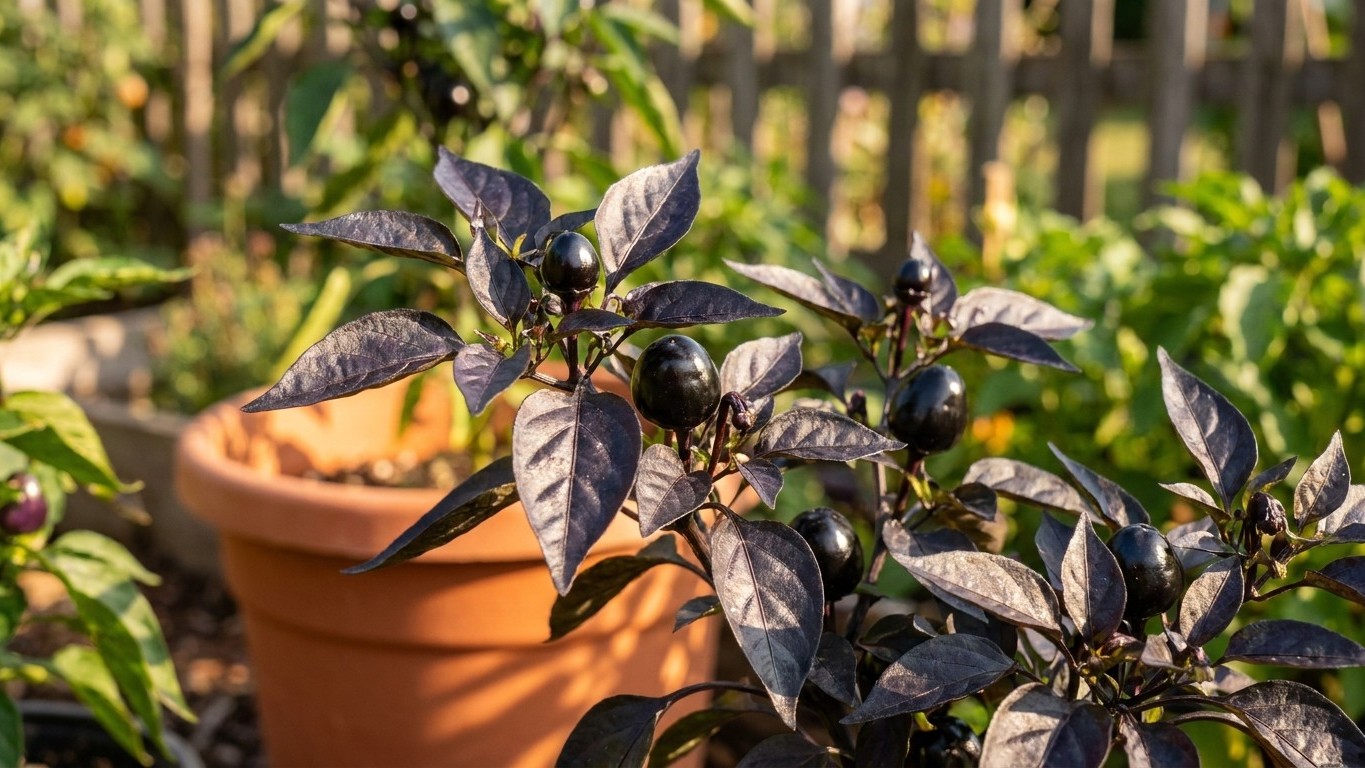

Black Pearl is a pepper grown as much for its foliage as for its fruit. Clemson Cooperative Extension’s list of recommended peppers sorts varieties into bell, banana, jalapeno, habanero, cayenne, and other hot peppers, but Black Pearl doesn’t appear on that list. NC State Extension describes it instead by its leaves: “dark purple almost black leaves in full sun.” The fruit is edible, but no source classifies its type, and none publishes a heat rating for it.
What You Actually Get With Black Pearl
Most pepper profiles start with type, because a bell pepper behaves nothing like a habanero, and a gardener who knows the category already knows the shape, the heat range, and roughly what to do with the harvest. Black Pearl breaks that pattern. Clemson Cooperative Extension’s recommended list is absent every one of those groups for this cultivar. That’s not an oversight worth filling in with a guess; it means the type simply isn’t established by the two university sources behind this page.
What NC State Extension does say is specific, and worth quoting directly: the plant carries “dark purple almost black leaves in full sun.” That single line is the extension’s entire published description of the cultivar, and it points at something other varieties don’t advertise as a selling point, foliage color, rather than fruit size or yield.
Worth saying plainly: no days-to-maturity figure is published for Black Pearl, no fruit size is listed, and no yield estimate appears in either source. A reader who knows that gap exists can plan around it. A reader handed an invented number cannot.
One distinction matters before going further. Decorative pepper plants sold purely for foliage, the kind that show up in fall planters next to mums, are often not food-grade and aren’t meant to be eaten. Black Pearl is not that. It’s an edible cultivar, grown for fruit as well as leaf color, but the confusion between ornamental-only peppers and edible ones is common enough to deserve saying once, clearly.
Just How Hot Is Black Pearl?
Heat in peppers tracks with type first. A bell pepper carries essentially no capsaicin at all. A jalapeno sits in the moderate range, measured at 2,500 to 8,000 Scoville heat units. The Carolina Reaper, the hottest cultivar most extension programs track, averages 1.64 million Scoville units. Those two figures are the only Scoville numbers documented in the sources behind this page.
Black Pearl isn’t sorted into any type group, so there’s no honest way to hand it a number. What NC State Extension does say is more useful than a figure would be anyway: the fruit is edible, “but spiciness is unpredictable in intensity.” That sentence tells growers that the same plant, grown two years running in the same spot, can produce fruit that bites harder one season and barely registers the next.
The mechanism behind that swing is well understood even where exact numbers aren’t published. Capsaicin, the compound responsible for a pepper’s heat, concentrates under stress. A hot, dry stretch that leaves a plant short on water tends to push fruit toward more intensity; a cooler, wetter season with steady watering tends to soften it. Soil fertility, fruit position, and time on the plant before picking all nudge the outcome slightly. None of that adds up to a formula, which is the point NC State is making with that one word: unpredictable.
Growing Habits: What Black Pearl Asks For
Because NC State Extension describes Black Pearl mainly through its foliage, it reads as a cultivar bred at least partly for looks, the kind of pepper plant that earns a spot in an ornamental bed or a mixed container as much as in a dedicated vegetable row. The sun reference matters practically: full sun is what brings out that dark leaf color, so a spot shaded through part of the day will likely produce paler foliage even if the fruit sets fine.
Beyond that single description, the source doesn’t detail disease resistance, container suitability, or a compact growth habit for this specific cultivar. That’s a gap worth naming rather than filling in with a guess.
Days to Maturity: What’s Actually Known
Days to maturity is the question every grower asks next, and here the honest answer is that Black Pearl doesn’t carry a published figure in either source behind this page. Only one pepper in the wider extension record has a documented days-to-maturity number, and Black Pearl isn’t it. The number that will actually matter is the one printed on the reader’s own seed packet, since that figure reflects the specific seed lot and conditions the breeder tested it under.
One thing does apply across every pepper cultivar: peppers are a warm-soil crop, and the clock on maturity doesn’t really start until soil temperature cooperates. Set transplants into cold ground and growth stalls for weeks rather than moving forward on schedule, packet number or not. Readers timing a transplant should check the seed-starting guide and the transplanting timeline for the soil-temperature thresholds that separate a plant that takes off from one that sits and sulks for a month.
Taste and Kitchen Use
Every pepper profile in this series ties flavor back to type, because a bell pepper reads sweet and holds its shape stuffed or roasted, a banana pepper stays mild and pickles well, a jalapeno works in fresh salsa, a cayenne gets dried and ground, a habanero brings a fruity note used sparingly. That link between type and flavor holds across the extension record.
Black Pearl sits outside that framework, because neither Clemson Cooperative Extension nor NC State Extension places it in a type category. That absence carries into flavor too: neither source publishes a taste note, a heat-based flavor description, or a suggested culinary use for this specific cultivar. Inventing one here, a smoky sweetness or a mild kick, would be exactly the kind of confident-sounding detail that isn’t actually backed by anything.
What can be said honestly is narrower. NC State’s description centers on the plant’s foliage color rather than its fruit, which suggests Black Pearl was bred, at least in part, with looks in mind rather than a specific culinary target the way a jalapeno or a banana pepper is. The fruit is edible, per NC State, but how it tastes and where it fits on a plate isn’t spelled out by either source.
For a cook standing over a handful of ripe Black Pearl fruit, the seed packet and a first small taste are the only reliable guide right now. Given NC State’s caution that spiciness is unpredictable in intensity, sampling a single piece before committing a whole batch to a recipe is the sensible move.
Common questions
Is Black Pearl pepper edible?
Yes. NC State Extension describes the fruit as edible, though it notes spiciness is unpredictable in intensity. This is distinct from ornamental-only pepper plants sold purely for foliage, which are not grown as food.
How hot is Black Pearl pepper?
No Scoville figure is published for this cultivar in the sources behind this page. NC State’s own language, that spiciness is “unpredictable in intensity,” is the most accurate answer available, and it points to stress conditions like heat and drought as drivers of a hotter batch.
What type of pepper is Black Pearl?
Clemson Cooperative Extension’s recommended list, which sorts peppers into bell, banana, jalapeno, habanero, cayenne, and other hot peppers, doesn’t include Black Pearl in any of those groups. Its type isn’t established by these sources, which is why heat and flavor can’t be pinned down by category the way they can for a jalapeno or a habanero.
Does Black Pearl pepper have a days-to-maturity number?
No, not in the sources behind this page. Only one pepper in the wider extension record carries a published days-to-maturity figure, and it isn’t this one. The number on your own seed packet is the figure to rely on, alongside the general rule that peppers need warm soil before that clock even starts.