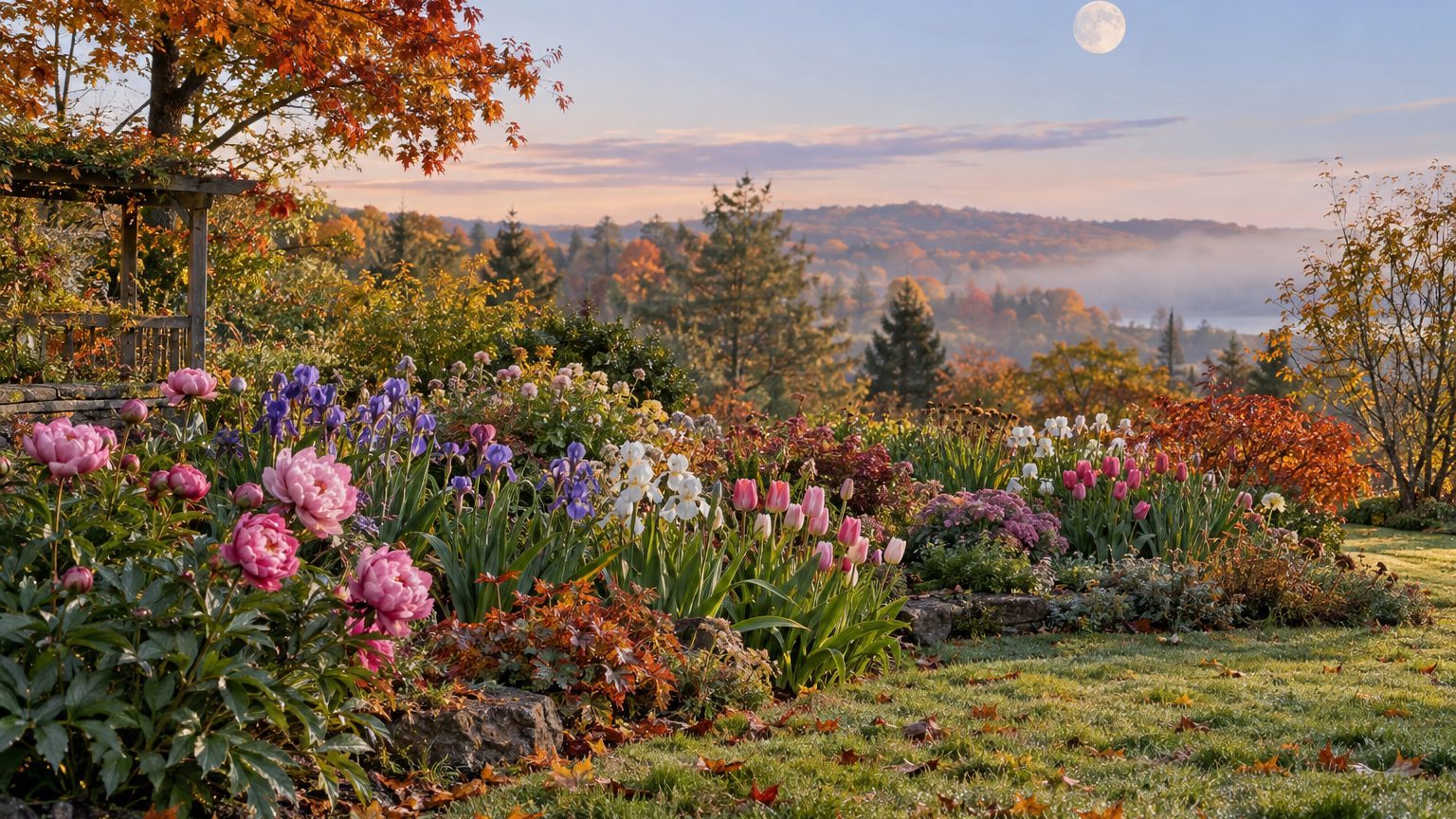

The Flower Moon of 2026 comes twice. The first is on May 1 at 1:23 p.m. ET in Scorpio, and the second is on May 31 at 4:45 a.m. ET in Sagittarius, which makes it a Blue Moon. In 2027 the name returns once, on May 20 at 6:59 a.m. ET, in Scorpio. Gardeners who plant by the Moon follow these dates as almanac tradition, not as proven science.
Flower Moon in 2026 and 2027
A calendar month is longer than the span between two full moons in most months. Once in a while that difference puts two full moons inside the same month, and May 2026 is one of those times. The Old Farmer’s Almanac gives the name Flower Moon to the May full moon, so both the May 1 and the May 31 moons carry it. The second one is also called a Blue Moon, the label for a second full moon in a single calendar month.
| Year | Full moon | Date and time (ET) | Moon sign | Name |
|---|---|---|---|---|
| 2026 | First May full moon | May 1, 1:23 p.m. ET | Scorpio | Flower Moon |
| 2026 | Second May full moon | May 31, 4:45 a.m. ET | Sagittarius | Flower Moon (Blue Moon) |
| 2027 | Only May full moon | May 20, 6:59 a.m. ET | Scorpio | Flower Moon |
All times are Eastern, so readers in other zones should shift the clock time to match their own. The sign is the one the Moon occupies at the moment it turns full. In 2027 there is a single May full moon, so the name goes back to one per month.
The other name that moves around is the Harvest Moon, which the almanac gives to the full moon nearest the September equinox. In 2026 that is the September 26, 12:49 p.m. ET moon, which comes after the September 22, 8:05 p.m. ET equinox. In 2027 it is the September 15, 7:03 p.m. ET moon, which comes before the September 23, 2:01 a.m. ET equinox. So the Harvest Moon lands after the equinox in one year and before it in the next, while the Flower Moon stays in May both years.
Where the name comes from and what it marks
The Old Farmer’s Almanac publishes a list of full moon names, one for each month, and credits them to a mix of Native American, colonial American and European sources. Flower Moon is the May entry. The idea behind it is simple: May is when spring blooms, so the full moon of that month got the label. That is the whole story of the name. It describes a season, and it carries no claim about people or luck.
The names work as a sequence, and seeing the neighbors helps. In 2026 the Pink Moon is the April 1, 10:11 p.m. ET full moon. The Flower Moon follows on May 1, and the Strawberry Moon comes on June 29 at 7:56 p.m. ET. In 2027 the same trio reads Pink Moon on April 20 at 6:27 p.m. ET, Flower Moon on May 20, and Strawberry Moon on June 18 at 8:44 p.m. ET. The Flower Moon always sits in the middle of the three.
It also sits inside astronomical spring. In 2026 the season runs from the March equinox on March 20 at 10:45 a.m. ET to the June solstice on June 21 at 4:24 a.m. ET. In 2027 it runs from the March 20 equinox at 4:24 p.m. ET to the June 21 solstice at 10:10 a.m. ET. Both May full moons of 2026 and the single one of 2027 fall well within those limits, which is why the almanac pairs the name with spring.
The 2026 double does shift one thing. Because the name belongs to the month and not to a single moon, the almanac treats May 1 and May 31 as Flower Moons, and only the second gets the extra Blue Moon label. The same rule explains why a moon at the very start of a month and one at the very end can share a name.
A name is a calendar label, nothing more. It does not tell you what is blooming in your yard, and that differs a great deal from one state to another. For what can go in the ground and when, your state’s planting guide is the reference to use. The Moon’s name was never meant to replace it.
The Flower Moon in the garden
The planting-by-the-Moon tradition divides the lunar cycle into quarters. According to almanac tradition, the stretch after the full moon, known as the third quarter, is the traditional window for crops that form below ground, such as root crops. The days after the last quarter, up to the new moon, are traditionally a rest from sowing. Gardeners who plant by the Moon often use that period to pause. Here are the third-quarter windows that follow each Flower Moon:
- 2026, first Flower Moon: from the afternoon of May 1 (1:23 p.m. ET) to the afternoon of May 9 (5:10 p.m. ET, last quarter).
- 2026, second Flower Moon: from the morning of May 31 (4:45 a.m. ET) to the morning of June 8 (6:00 a.m. ET, last quarter).
- 2027: from the morning of May 20 (6:59 a.m. ET) to the morning of May 28 (9:57 a.m. ET, last quarter).
That is the tradition, and it needs a plain caveat: the effect of the Moon on crops has not been proven. Nothing here promises a result, and no almanac rule should be read as a guarantee of germination or yield.
One more point on priorities. Frost dates and soil temperature decide whether a crop can go in the ground at all, and the Moon never overrides the calendar of your place. Anyone who follows the lunar tradition only uses it to choose among days that are already suitable for planting. Check your state’s planting guide first, then look at the Moon if you want to.
For the bigger picture, the guide to planting by the moon explains how the quarters and signs fit together. You can also browse every full moon name in the almanac list. The month-by-month dates are in the full moon calendar 2026 and the full moon calendar 2027.
Questions
Is there a Blue Moon in May 2026?
Yes. The second May full moon, on May 31 at 4:45 a.m. ET in Sagittarius, is a Blue Moon. It is still named the Flower Moon, because the almanac assigns the name by month.
What is the Flower Moon date in 2027?
May 20, 2027, at 6:59 a.m. ET, with the Moon in Scorpio. It is the only full moon that May. Its last quarter follows on May 28 at 9:57 a.m. ET, and the next full moon is the Strawberry Moon on June 18 at 8:44 p.m. ET.
Does the Flower Moon tell me when to plant?
No. The almanac tradition links certain quarters to certain kinds of crops, but the effect is unproven, and local frost dates and soil temperature come first. Treat the Moon as an optional way to pick among days that your state’s planting guide already allows.