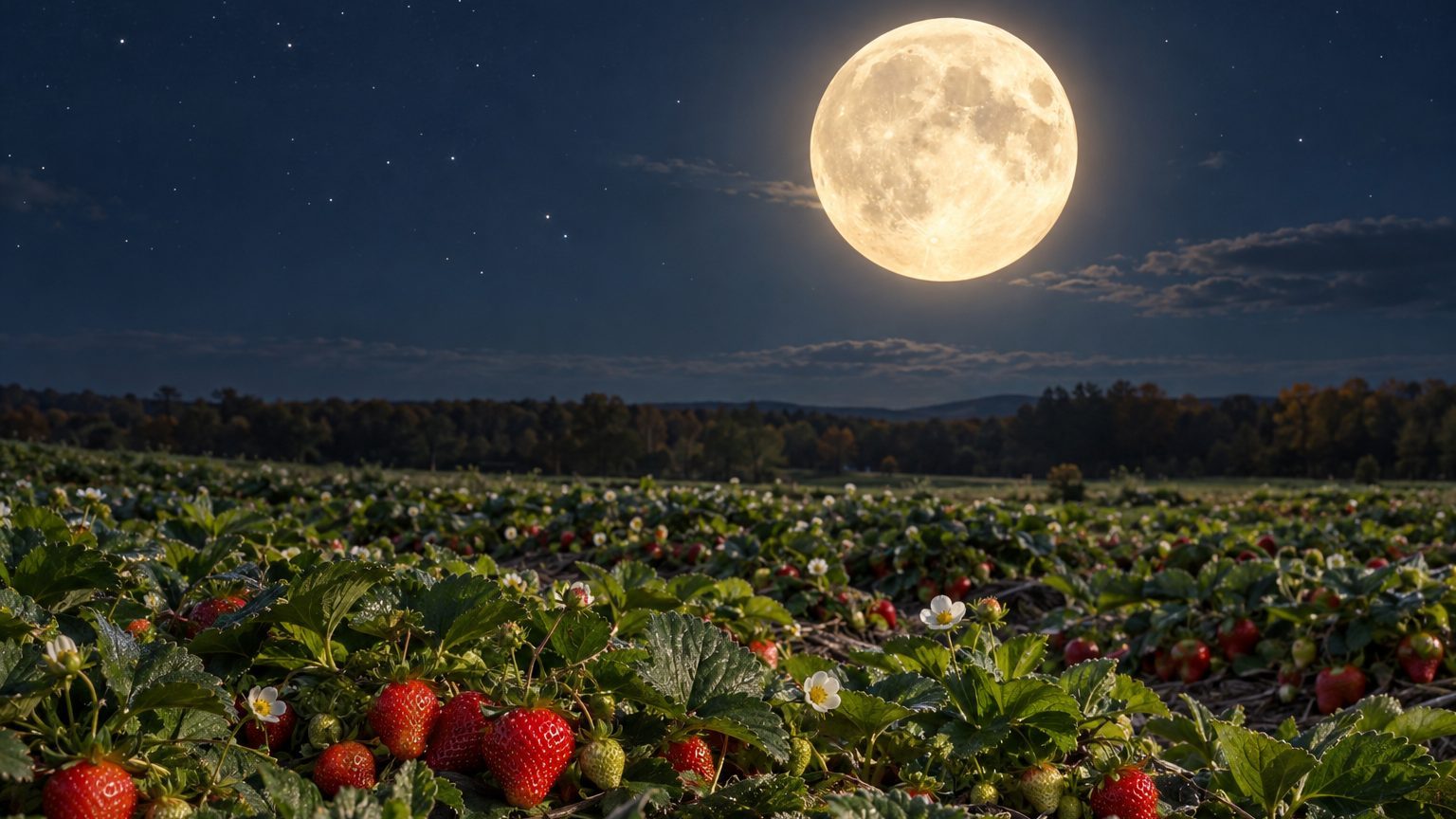

The Strawberry Moon falls on June 29, 2026, at 7:56 p.m. ET, with the Moon in Capricorn. In 2027 it falls on June 18, at 8:44 p.m. ET, with the Moon in Sagittarius. The name is the Old Farmer’s Almanac label for the June full moon, tied by tradition to the wild strawberry season. It marks a spot on the lunar calendar and does not tell anyone when to plant.
Strawberry Moon in 2026 and 2027
A full moon is a single instant, the moment the Moon sits opposite the Sun as seen from Earth. That instant is the same everywhere on the planet. Only the clock reading changes, which is why every time below is given in Eastern time. The sign is the zodiac position the almanac convention assigns to the Moon at that moment.
| Year | Full moon date | Time (ET) | Moon sign | Name that year |
|---|---|---|---|---|
| 2026 | June 29 | 7:56 p.m. ET | Capricorn | Strawberry Moon |
| 2027 | June 18 | 8:44 p.m. ET | Sagittarius | Strawberry Moon |
The two dates sit on opposite sides of the June solstice. The 2026 full moon arrives after the solstice of June 21, 4:24 a.m. ET. The 2027 full moon arrives before the solstice of June 21, 10:10 a.m. ET.
The name does not move in either year. Strawberry Moon stays with the June full moon, and each year has only one full moon in June. The name that does shift is Harvest Moon, which the almanac gives to the full moon nearest the September equinox, whether that falls in September or October. In 2026 the equinox is September 22 at 8:05 p.m. ET, and the Harvest Moon is September 26 at 12:49 p.m. ET. In 2027 the equinox is September 23 at 2:01 a.m. ET, and the Harvest Moon is September 15 at 7:03 p.m. ET. Both years it lands in September, so Hunter’s Moon takes the October full moon each time.
Where the name comes from and what it marks
The Old Farmer’s Almanac credits the name to Algonquin and other Native American peoples, who tied the June full moon to the ripening of wild strawberries. Almanacs carried the name into general North American use. It is a seasonal label, a way of saying which part of the year a full moon belongs to. It does not describe how the Moon looks.
The Moon is not pink or red. A full moon sits opposite the Sun, so near the June solstice it travels a low path across the sky for viewers in the Northern Hemisphere. Light from a low Moon passes through more atmosphere, and the Moon can look amber or orange near the horizon. That is an effect of the sky and has no link to the name.
Some European traditions used other names for the same June full moon:
- Rose Moon
- Honey Moon
The almanac’s practice is to give every full moon of the calendar year a name, one per month. Our list of full moon names covers the whole sequence. The Strawberry Moon sits between two neighbors each year. In 2026 it follows the Flower Moon of May 31 at 4:45 a.m. ET (a second full moon in its month, so also labeled a Blue Moon) and precedes the Buck Moon of July 29 at 10:35 a.m. ET. In 2027 it follows the Flower Moon of May 20 at 6:59 a.m. ET and precedes the Buck Moon of July 18 at 11:44 a.m. ET.
In the tradition the name marks the berry season, and that is all it claims. What is going into the ground or coming out of it in June depends on your state and your own local conditions. For that, use the state planting guides.
The Strawberry Moon in the garden
Gardeners who plant by the Moon split each lunar month into four quarters. The almanac rule is that the third quarter runs from the full moon to the last quarter, and that root crops belong to that stretch, along with other crops that grow below ground. Some followers also treat the first hours around the full moon itself as a pause, a time for rest or tidying rather than sowing. Customs vary from one almanac to the next.
For the Strawberry Moon, the third-quarter window under this convention is:
- 2026: from the evening of June 29 (7:56 p.m. ET) to the afternoon of July 7 (3:28 p.m. ET)
- 2027: from the evening of June 18 (8:44 p.m. ET) to the early hours of June 27 (12:54 a.m. ET)
Nobody has proven that the Moon affects crops. Everything above is almanac tradition, offered as a way to organize a garden calendar, with no promise about germination, growth or harvest. The Moon never overrides the calendar of your place. Frost dates and soil temperature decide whether a crop can go in the ground at all. A gardener who follows the Moon only chooses among the days the local calendar already allows. Your state’s planting guide is where those dates live.
To see the full run of phases, see the full moon calendar 2026 and the full moon calendar 2027. For the method behind the quarters and signs, start with the guide to planting by the moon.
Questions
Is the Moon in the same sign for the Strawberry Moon every year?
No. The Moon passes through the signs in turn, so a June full moon lands in a different one from year to year. It is Capricorn on June 29, 2026, and Sagittarius on June 18, 2027.
What time is the Strawberry Moon in my time zone?
The moment is the same everywhere, but the clock reading depends on where you are. The times here are Eastern: 7:56 p.m. ET in 2026 and 8:44 p.m. ET in 2027. Convert them to your own zone and check whether the date holds in your area.
Does the name mean strawberries should be planted under this moon?
No. The name refers to the wild strawberry season in the tradition behind it. It is not a planting instruction, and the effect of the Moon on crops is not proven. Frost dates and soil temperature in your state decide what can go in the ground.