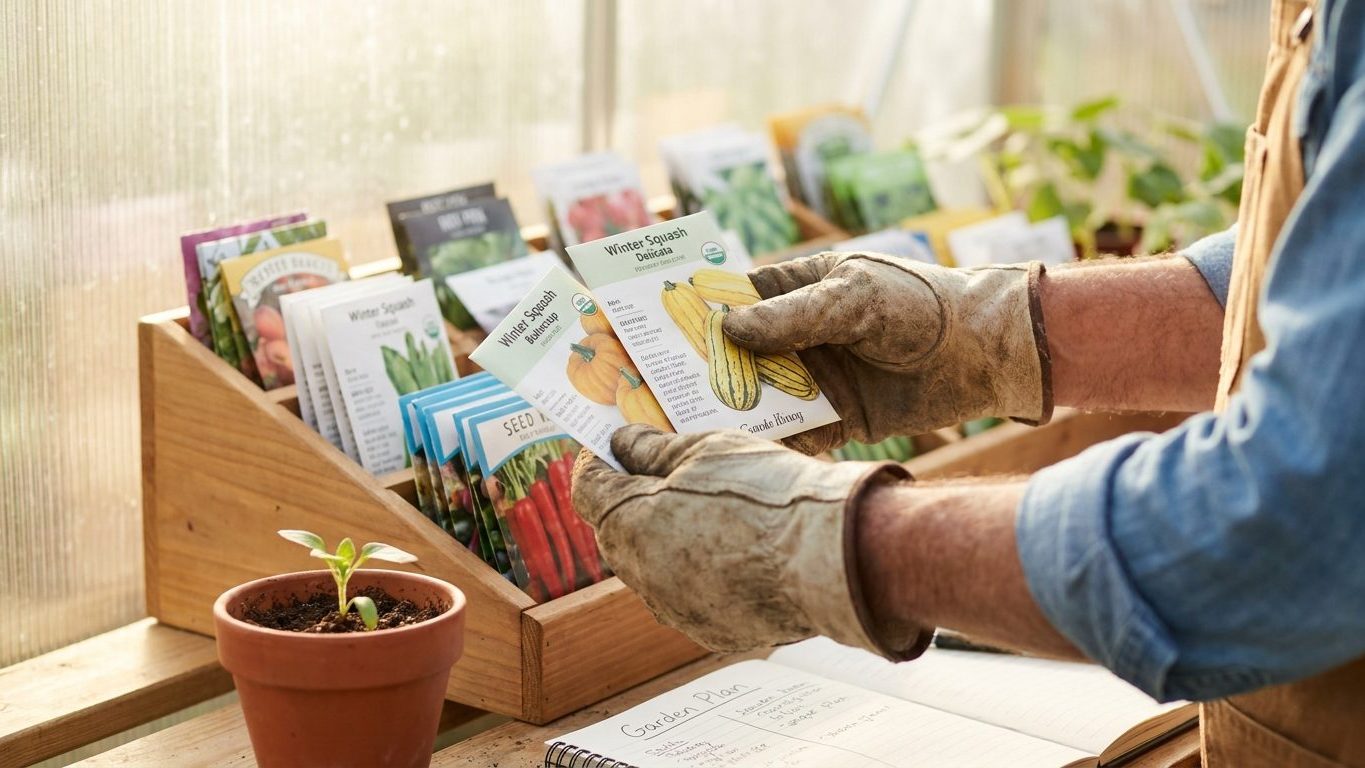

In a short growing season, winter squash succeeds or fails long before the vines ever spread across the garden. The fix isn’t a trick played out in July, it’s a decision made at the seed rack in spring: pick a type built for a compressed season, then use technique to protect the head start you’ve bought yourself.
What is actually going on

The thing to understand here is days to maturity. Among winter squash, the spread between the earliest types and the latest is enormous, far wider than any row cover, black plastic, or clever transplant date can bridge on its own. Some types are bred to size up and cure in a compressed window. Others need a long, steady stretch of warm weather and simply won’t finish reliably where summer arrives late and leaves early. No amount of good technique turns a long-season type into a short-season one. Technique buys you weeks. Genetics decide whether those weeks are enough.
This matters more for winter squash than for almost any other garden vegetable, because the whole point of a Winter Squash is what happens after harvest. You’re not eating it green off the vine the way you would a zucchini. You’re waiting for the rind to harden, the sugars to concentrate, and the flesh to reach the density that lets it store through winter. A squash pulled early because frost is coming has none of that. The rind is still soft, the flavor is thin, and it won’t keep no matter how carefully you cure it. So the real short-season question isn’t “can I get a squash off this vine before frost,” it’s “can I get a mature squash off this vine before frost.” Those are very different targets.
It’s worth being clear about what winter squash actually is, because the term gets muddled every fall. A carving pumpkin is grown for its shell: thick walls, a certain shape, a stem that holds up for decoration. If your interest is really about jack-o’-lanterns and fall displays, the pumpkin-specific guides on this site cover that timeline and those techniques directly.
For a short-season garden, the practical takeaway from all this is simple to state and easy to skip: shop by type first, not by flavor or by the picture on the packet. A hard squash, an acorn-type, or a delicata-type generally asks less of the season than a big storage hubbard or a long-vined butternut. Your state extension service publishes trial results for varieties grown in your actual climate, and that list is worth finding before you buy a single seed.
In the garden
Once the type is chosen, the rest of the season is about protecting and extending the warmth that squash needs to grow fast. Below is the stack that short-season growers lean on, roughly in order of how much it matters, along with what tends to go wrong when a step gets skipped.
| Step | What to do | What happens if you skip it |
|---|---|---|
| Start indoors | Sow seed inside a few weeks before the last expected frost, in pots large enough to avoid root disturbance, then move plants out once the soil has warmed. | Direct-seeding into cold spring soil delays germination by days to weeks, and those are days the squash won’t get back before fall frost. |
| Warm the soil first | Lay dark plastic mulch or landscape fabric over the bed a week or two before transplanting to raise soil temperature. | Transplants set into cold soil sit and sulk instead of growing; a stalled plant in June rarely catches up by September. |
| Pick a sheltered, sunny site | Choose a spot with full sun and some wind protection, ideally with a slight south-facing slope or a windbreak nearby. | Cold air pools in low spots and wind chills young plants; both slow growth at exactly the stage when speed matters most. |
| Keep the plant growing without checks | Water evenly, feed appropriately for fruiting crops, and manage cucumber beetles and squash bugs by scouting and hand-removal or targeted timing rather than a blanket spray schedule. | A drought stress or a pest setback in midsummer can cost the plant a week of growth it never recovers, pushing harvest past your first frost. |
| Use row cover early, remove it at flowering | Cover transplants with floating row cover for the first few weeks to trap heat and block early pests, then uncover once flowers appear so pollinators can reach the blossoms. | Leave the cover on too long and no bees reach the flowers; no pollination means no fruit, no matter how healthy the vine looks. |
Notice what isn’t on that list: a magic fertilizer, a specific brand of cover, or a guaranteed date. The stack is about protecting time, and every one of those five steps either buys time at the start of the season or protects the time you’ve already banked. Drop the first two steps and even a fast type struggles. Drop the last one and a fast type still fails to set fruit. They work together, not as a menu to pick from.
What it depends on where you are
Everything above is general because winter squash growing genuinely isn’t the same job in every state. Season length is the obvious variable, but it’s not the only one. Summer heat matters just as much: some regions have a short frost-free window but intense, steady heat inside it, which pushes squash along quickly. Others have a longer window on the calendar but cooler, cloudier summers that slow growth even without a frost threat. Rainfall patterns shift the picture again, since a wet, humid summer brings different disease pressure than a dry one, changing how closely you need to watch for foliar problems as the season goes on.
That’s the honest limit of what a national guide can tell you. What it can tell you is where to find that information reliably: your state’s Cooperative Extension Service. These offices publish frost-date maps, variety trial results grown specifically in your state’s conditions, and pest and disease bulletins updated through the season, all free of charge and all built for your climate rather than a national average.
State-level pages exist for the same reason, to translate the general rules into something closer to your actual backyard. If you haven’t checked whether your state has one, it’s worth doing before you finalize a planting plan, because a type that performs well two states over may behave quite differently once it’s dealing with your particular combination of season length, heat, and rainfall.
The mistake that costs the most
The single costliest mistake in a short-season garden isn’t planting too late or forgetting to water. It’s choosing a squash type based on flavor, keeping reputation, or a nice-sounding description on the seed packet, without first checking whether that type’s maturity window actually fits inside a realistic frost-free stretch for your area. Growers do this every spring: they fall for a storage squash known for keeping well into winter, plant it with the same enthusiasm as anything else in the garden, and then watch fall frost arrive while the fruit is still pale, thin-walled, and nowhere near cured.
The damage isn’t just a smaller harvest. An immature winter squash doesn’t ripen further once it’s off the vine the way a tomato might. What you pick is close to what you get, and if the rind hasn’t hardened and the stem hasn’t dried, that squash has poor odds of storing at all. It’s tempting to bring in everything before frost and hope for the best, but hope isn’t an inspection method. Before storing anything, check every squash individually: the rind should resist a fingernail press, the stem should be dry and firm rather than green and soft, and there should be no soft spot, no weeping patch, and no mold at the stem end. Any one of those signs means that squash gets used soon, not stored, because none of them improve with time in a basement or root cellar.
The fix is upstream of the harvest, not at it. Match the type to the season before you buy the seed. If your frost-free window is on the shorter side, favor the types your extension service lists as reliable finishers in your region, and treat the longer-season storage types as a bonus to attempt once you’ve got a season or two of shorter types under your belt. A modest harvest of squash that actually matured beats a heavier-looking harvest that never really finished.