
Ohio’s winters run cold enough to satisfy nearly every classic spring bulb, but timing and rodent pressure decide whether that cold actually turns into flowers. Columbus averages 22°F on the coldest nights of January, well past the chill threshold tulips and daffodils need, so the real work here is planting on the right calendar and picking varieties that match your county’s zone.
When to plant bulbs in Ohio

The planting window opens once the soil has cooled from summer heat but closes before the ground locks up hard. In Ohio, that means aiming for roughly six weeks before the average first fall frost, which lands between October 5 and October 15 across zone 6a, according to Ohio State University Extension’s Gardening Calendar. Working backward from that date puts most of the state’s ideal bulb-planting stretch in mid-September through late October, with colder pockets in the northeast finishing earlier and the Ohio River valley running later.
Plant too early and you invite trouble. Bulbs going into soil that’s still warm from summer can push top growth before winter arrives, and that tender green tissue gets killed by the first hard freeze. The bulb survives, but it’s spent energy it needed for spring, and the following bloom often comes in stunted or skipped entirely.
Plant too late and the problem flips. Bulbs need several weeks of root growth in cool soil before the ground freezes solid. Skip that window and the bulb sits dormant with no root system to draw on when spring warmth arrives. The result is a weak, short-lived flower, or in a hard winter, no flower at all because the bulb never anchored itself before the freeze-thaw cycles began.
Treat the frost date as a guess, not a guarantee
That October window is an average built from decades of weather data, which means roughly half of all years fall on one side of it or the other. A gardener who plants exactly on October 10 every year will still hit an early frost some autumns and a mild, late one in others. The safer approach is to treat the six-weeks-before-frost rule as a target range rather than a single date, and to get bulbs in the ground on the earlier side of that range if the extended forecast shows an early cold snap building.
Whether your winter is cold enough
Spring bulbs aren’t just decorative seeds waiting for warmth. Most need a sustained cold period, typically twelve to fourteen weeks with soil temperatures below about 45°F, to trigger the internal chemistry that builds a flower stem inside the bulb. Skip that cold exposure and the bulb often still sends up leaves, but the flower stays undeveloped or the stalk is too short to see above the foliage. This is the same principle that gardeners rely on when Forcing Spring Bulbs Indoors in Ohio, chilling bulbs in a refrigerator to mimic winter and coax blooms weeks ahead of the outdoor season, and it’s the same cold requirement that governs whether a fruit tree sets blossoms or an onion bulbs up.
Columbus’s coldest month averages a daily minimum of 22.0°F, according to NOAA’s Climate Normals for 1991-2020. That’s not a record low, it’s the typical overnight temperature through the coldest stretch of winter, and it sits far below the 45°F ceiling that starts the bulb’s clock. Ohio’s soil holds temperatures under that mark for well over the twelve-to-fourteen-week requirement most bulbs need, which means the state clears the bar with room to spare. That margin matters: it’s what allows nearly the full range of classic spring bulbs to be planted directly in the ground here with zero pre-chilling required.
Where Ohio gardeners run into trouble isn’t a shortage of cold. It’s choosing bulbs bred for warmer climates, ones that either won’t get the dormancy break they expect or will get more cold than they can tolerate without rotting in heavy, wet clay soil. The table below shows how the state’s cold supply stacks up against what common spring bulbs actually require.
| Bulb | Weeks of cold required (below 45°F) | What Ohio delivers | Verdict |
|---|---|---|---|
| Tulips | 14-16 weeks | Well over 14 weeks in most Ohio counties | Plant directly, no pre-chilling needed |
| Daffodils | 12-14 weeks | Comfortably exceeded statewide | Reliable, often naturalize for years |
| Hyacinths | 12-14 weeks | Comfortably exceeded statewide | Reliable in all but the wettest, low-lying beds |
| Crocus | 8-15 weeks depending on species | Exceeded, even in a mild winter | Reliable, among the earliest to bloom |
| Alliums | 10-14 weeks | Comfortably exceeded statewide | Reliable, low rodent pressure |
| Tender bulbs bred for zone 8-10 (freesia, ranunculus) | Little to no cold requirement; damaged by hard freezes | Far too cold for these to overwinter outdoors | Dig and store indoors, or treat as annuals |
For anyone tempted to try a bulb outside its comfort zone, pre-chilling is the workaround, but it has to be done right. That means twelve weeks in a refrigerator held near 40°F, kept away from apples, pears, or any ripening fruit, because the ethylene gas those fruits give off will kill the flower bud developing inside the bulb before it ever reaches soil. Skipping that precaution, or shorting the twelve weeks, wastes the money spent on the bulb. A gardener who plants tulips expecting a spring show without either the region’s natural cold or a proper chill cycle has planted a leaf, not a flower.
Which bulbs suit Ohio
Ohio’s hardiness zones run from 5b to 6b, according to the USDA Plant Hardiness Zone Map’s 2023 update. Most classic spring bulbs are rated hardy well within or below that range, meaning the state’s winters aren’t a risk factor for them, they’re a requirement the bulbs are built to expect.
- Tulips (zones 3-7): thrive statewide, though many hybrid types perform best as a strong first-year show rather than a permanent perennial.
- Daffodils (zones 3-8): among the most reliable naturalizers in Ohio, often multiplying for a decade or more untouched.
- Crocus (zones 3-8): early, cold-hardy, and dependable even in a harsh winter.
- Hyacinths (zones 4-8): hardy throughout the state, though they can rot in heavy clay that stays soggy through winter.
- Alliums (zones 3-8): hardy and largely ignored by digging animals.
- Snowdrops (zones 3-7): well suited to Ohio’s cold, among the earliest bloomers of the season.
- Grape hyacinth / Muscari (zones 4-8): hardy and reliably perennial across the state.
The bulbs that disappoint in Ohio are almost always ones rated for zone 8 or warmer, varieties bred for milder winters in the Pacific Northwest or the Southeast. Anemone coronaria and ranunculus, for example, aren’t built to handle Ohio’s freeze-thaw cycles, and planted directly in the ground they’ll either rot over winter or come up as foliage only, with no flower to show for it the following spring. A gardener who’s tried one of these once usually remembers the empty bed the following April better than any catalog description.
Zone ratings aren’t a hard line, though. A tulip rated hardy to zone 7 might survive in a sheltered, south-facing bed against a foundation wall in southern Ohio, while the same variety planted in an open, wind-exposed spot in the state’s colder northeast corner could fail outright. Microclimate matters as much as the zone map.
What digs them up here
Squirrels and voles are selective, and the pattern isn’t random luck, it’s chemistry. Daffodils and other members of the onion family contain compounds that make them bitter or mildly toxic to most digging animals, so they get left alone. Tulips and crocus have no such defense and are treated as a food source the moment they’re detected underground.
- Bulbs squirrels and voles dig up: tulips, crocus
- Bulbs squirrels and voles leave alone: daffodils, alliums, hyacinths, snowdrops, grape hyacinth
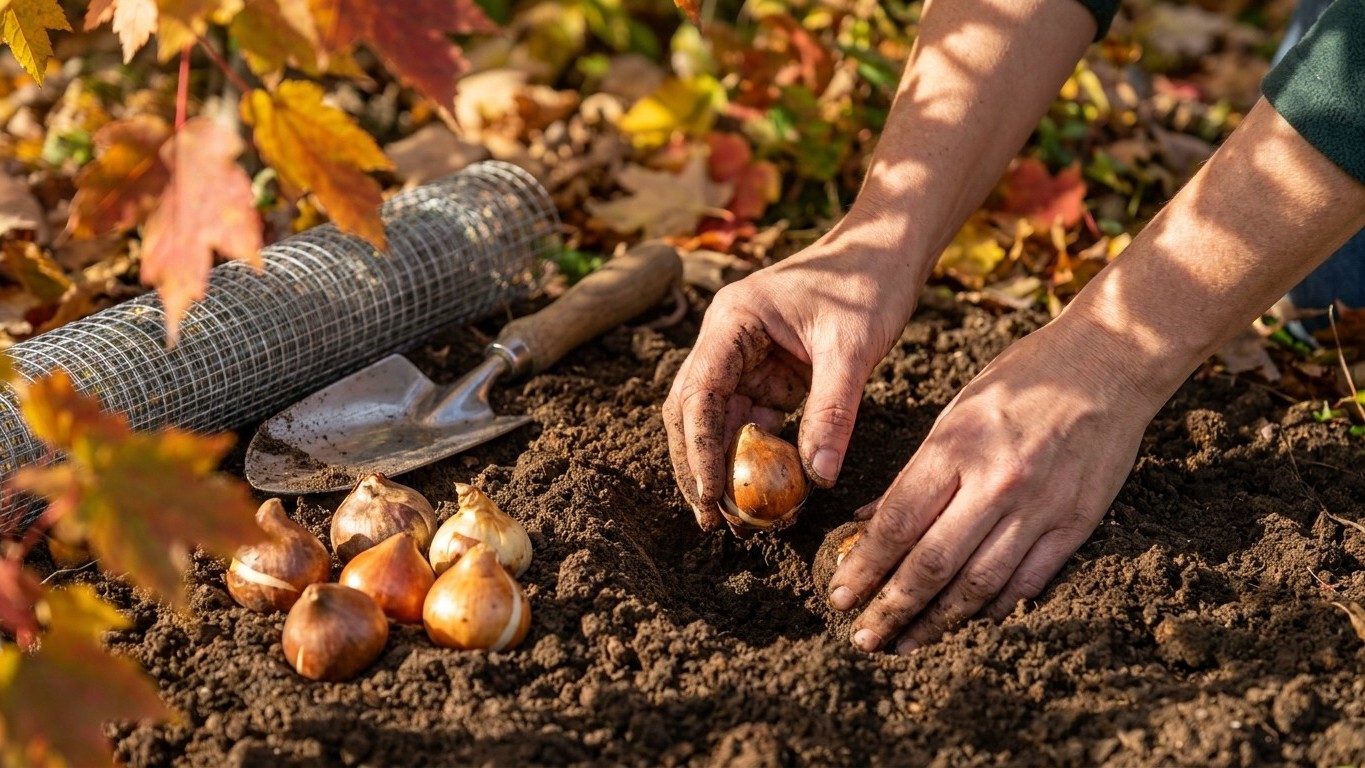
For anyone planting tulips or crocus anyway, the one measure that consistently works is laying galvanized wire mesh directly over the planting area and pinning it down until the ground freezes solid, at which point digging animals lose interest. Repellent sprays and granules get marketed heavily every fall, but they wash off with the first rain or irrigation and need constant reapplication to do anything at all, which makes them a poor match for a bulb bed you plant once and forget for months.
Where to check for your own county
Every figure above, the frost date, the hardiness zone, the coldest-month minimum, is anchored to Columbus and the broader zone 6a-6b band. Ohio stretches across enough latitude that a planting date built for the state capital can run three weeks off at either edge of the map, with the Lake Erie shoreline cooling later in fall than the Ohio River valley to the south.
Ohio State University Extension maintains county-level offices across the state, and each one tracks local frost dates, soil conditions, and zone variations specific to its area. Checking with your county office before finalizing a planting date is the difference between a guide written for the whole state and one written for your own backyard.