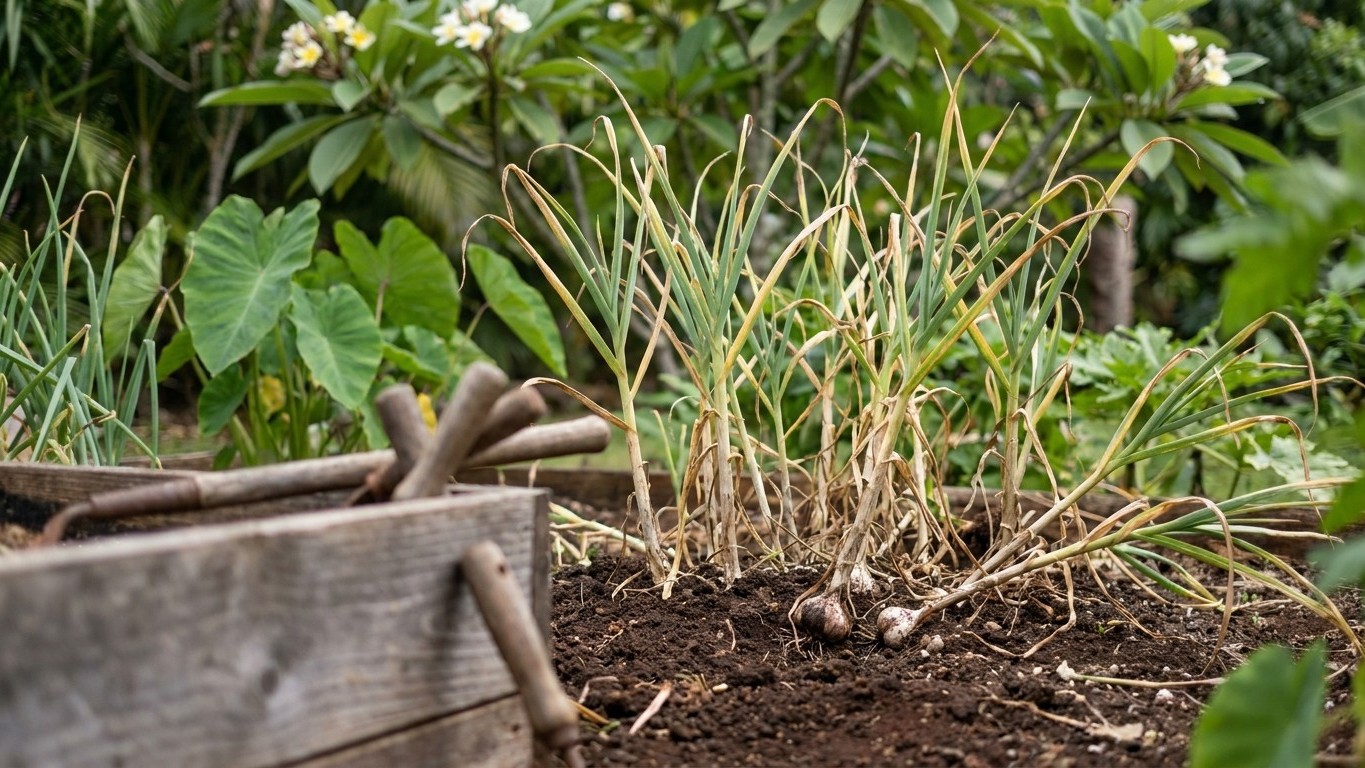

Softneck garlic is the one to plant here — hardneck simply won’t divide into cloves without a real cold snap, and Hawaii doesn’t give it one. At sea level, the Honolulu-area climate record shows no days at or below freezing all year, so a hardneck bulb just stays a solid, undivided clump instead of forming heads. Pick a softneck like Early Red Italian, Inchelium Red, Italian Late or Lorz Italian for your beds, and save any hardneck experiments for the coolest upland spot on your property.
The short answer for Hawaii

Garlic splits into cloves and forms a scape in response to a period of cold. Hardneck types (Bavarian Purple, Blue Music, Chesnok Red, Duganski, Fall Festival, Georgian Crystal, Georgian Fire, German Red, German White, Ivan) carry that chilling requirement built into the bulb. Lowland Hawaii, where NOAA’s 1991-2020 normals record zero days at or below freezing at the Honolulu-area station, almost never delivers it. Plant a hardneck at sea level here and the usual result is a single round, undivided clump instead of a true head with distinct cloves.
Softneck garlic never needed that chill to begin with, which is why it dominates the world’s warm-winter garlic regions and why it’s the starting variety group for a Hawaii garden. Growing Garlic in Hawaii at all means working around rainfall, elevation and sun exposure rather than a frost calendar, since true frost in this state only forms on the summits of Mauna Kea, Mauna Loa and Haleakala, never where anyone actually gardens. If you haven’t sorted out bed prep and irrigation yet, Growing Garlic in Hawaii covers that ground first.
| Variety | Type | Note for a Hawaii planting |
|---|---|---|
| Early Red Italian | Softneck | No chilling requirement. Reliable at low elevation. |
| Inchelium Red | Softneck | Mild, large bulbs. A common warm-climate first choice. |
| Italian Late | Softneck | Later softneck, still no cold requirement. |
| Lorz Italian | Softneck | Long-keeping softneck, good braiding neck. |
| Bavarian Purple | Hardneck | Needs sustained cool nights to divide. Upland only. |
| Blue Music | Hardneck | Porcelain type, large cloves. Same cold limitation. |
| Chesnok Red | Hardneck | Popular roaster, but bulb formation is inconsistent below elevation. |
| Duganski | Hardneck | Rocambole, poor keeper even where it grows well. |
| Fall Festival | Hardneck | Large marbled bulbs, needs the same chill hardnecks all require. |
| Georgian Crystal | Hardneck | Porcelain type, few oversized cloves per bulb. |
| Georgian Fire | Hardneck | Spicy, decent keeper for a hardneck. Still cold-dependent. |
| German Red | Hardneck | Rocambole, robust flavor, short storage life. |
| German White | Hardneck | Porcelain, large bulbs, easy to peel where it bulbs at all. |
| Ivan | Hardneck | Porcelain type, same limitation as the rest of this group. |
Working it out for your own garden
There’s no frost date to count back from here, so the arithmetic that matters in Hawaii is disease pressure by month, not chill hours. UC IPM’s Pest Management Guidelines for onion and garlic (UC ANR Publication 3453) publish temperature ranges for the four pathogens that matter most in this crop, and you can hold your own garden’s typical monthly temperatures up against them.
What the Honolulu-area numbers show
| Disease | Published range | Months in range (Sept-July, Honolulu-area station) |
|---|---|---|
| Fusarium basal rot | 59-90°F | 11 of 11, including 6 at the pathogen’s optimum |
| White rot | 50-75°F | 4 (December, January, February, March) |
| Pink root | 75-85°F optimum | 7 (September, October, November, April, May, June, July) |
| Southern blight | 86-95°F optimum | 0 (optimum not reached, but not impossible) |
Three things to keep in front of you before you treat that table as a forecast. First, UC IPM’s thresholds are soil temperatures, and the figures above are air temperatures, so soil will lag behind and swing less than the air does. Second, a monthly mean is not a month spent inside that range: a month averaging 65°F still has days that touch 50 and days that touch 80. Third, these counts come from one reference station near Honolulu, and a state spread across eight islands and sea level to 13,000 feet does not share one climate.
To redo this for your own plot, get a sense of your site’s typical monthly temperatures, either from your own thermometer log over a season or from data through the extension service, and compare them to the same four ranges. A site that runs cooler than Honolulu, because it sits at higher elevation, stretches the white rot and fusarium windows longer and pulls further from the pink root and southern blight optimum. A site that’s drier and lower, especially on a leeward coast, can cut the white rot window down regardless of temperature, because When to Plant Garlic in Hawaii: Counting Back From the First Frost matters less here than simply keeping garlic out of saturated soil during the wet months.
What changes across Hawaii
Windward and leeward exposure moves garlic outcomes more than almost anything else in this state. Windward districts like Hilo and the Hamakua coast on Hawaii Island carry far more rainfall through the cool months, and that extra soil moisture during the same stretch UC IPM lists for white rot’s 50-75°F range is exactly the combination Sclerotium cepivorum favors. Leeward districts such as Kona and Waimea on the dry side of the same island run drier by comparison, and a drier bed is a real advantage for garlic no matter which variety you’ve planted.
Elevation is the other lever. Upcountry ground like Kula on Maui and the higher stretches around Waimea on Hawaii Island runs cooler at night than coastal gardens, which is the closest thing this state offers to a hardneck-friendly microclimate, though even there it is nothing like a temperate winter. A gardener at that elevation is the one person in this article who has a real shot at Bavarian Purple, Chesnok Red or German White dividing into a proper head rather than staying whole.
None of this is measured from a NOAA station on every island. The Honolulu-area figures in this piece describe one location, and a gardener in Hilo, Kula or Waimea is working from a different climate entirely, even if the general rule (no lowland frost, cooler ground at elevation, wetter windward soil) holds statewide.
The mistakes this climate punishes
The single costliest mistake in this climate is planting a full bed of hardneck seed stock at low elevation expecting mainland results. Without sustained cool nights, the crop doesn’t fail outright, it just doesn’t divide, and a season’s growing time goes into a bulb you can’t use as seed the following year.
Signs to catch before they spread
The second mistake is planting into wet, poorly-drained windward soil during the coolest months, right when UC IPM’s white rot range overlaps with saturated ground. Sclerotium cepivorum sclerotia can persist in soil for years once introduced, usually on infected seed cloves or contaminated tools, and there is no in-season fix once it’s established. Watch for:
- Yellowing and dieback of leaf tips well before harvest is expected
- Soft, water-soaked tissue at the base of the bulb
- White, fluffy fungal growth at the root plate when you pull a suspect plant
The third mistake is treating Fusarium basal rot as an occasional problem rather than a constant one. UC IPM’s 59-90°F range covers essentially the whole growing season at the Honolulu-area station, which means basal rot pressure is background noise here, not a special weather event. Clean seed stock and free-draining beds do more than any in-season treatment.
The fourth is leaving bulbs in the ground too long, into the warm months that match pink root’s 75-85°F optimum. Harvest once the lower leaves begin to yellow and dry rather than waiting for a date borrowed from a mainland guide, since Hawaii’s whole cycle runs on a rainfall calendar, not a frost one.
Checking this against your county
Every figure in this article comes from one reference station near Honolulu, and Hawaii County, Maui County and Kauai each run their own rainfall and elevation patterns that can shift these numbers by weeks in either direction. The University of Hawaii’s College of Tropical Agriculture and Human Resources runs county extension offices that can speak to conditions on your specific island rather than a single statewide average. That’s the office to call before committing a full bed to a hardneck variety on the strength of an elevation guess.
Common questions
Can I grow hardneck garlic in Hawaii at all?
Only at real elevation, where nights run consistently cooler than the coast. Even there, treat it as a trial planting alongside your softnecks rather than your main crop, since bulb division is inconsistent without sustained cold.
Do I need to refrigerate my seed cloves before planting like some mainland growers do?
Some gardeners in warm-winter climates chill hardneck seed cloves in a refrigerator for a stretch before planting, to substitute for missing field cold, with mixed results. None of the softneck varieties in this list need that step at all, which is one more reason they’re the simpler choice here.
Why did my garlic come up as one big clove instead of splitting?
That’s the classic sign of a hardneck that didn’t get enough cold to divide, or of a clove planted too small or too late to size up properly. Check which type you planted and where, since the same variety behaves differently at sea level than it does upcountry.
Is Fusarium basal rot something I should expect every year?
Treat it as a standing risk rather than a rare event, since the temperature range it favors covers nearly the entire growing season at the Honolulu-area station. Clean, disease-free seed cloves and a well-drained bed matter more here than any single fungicide application.