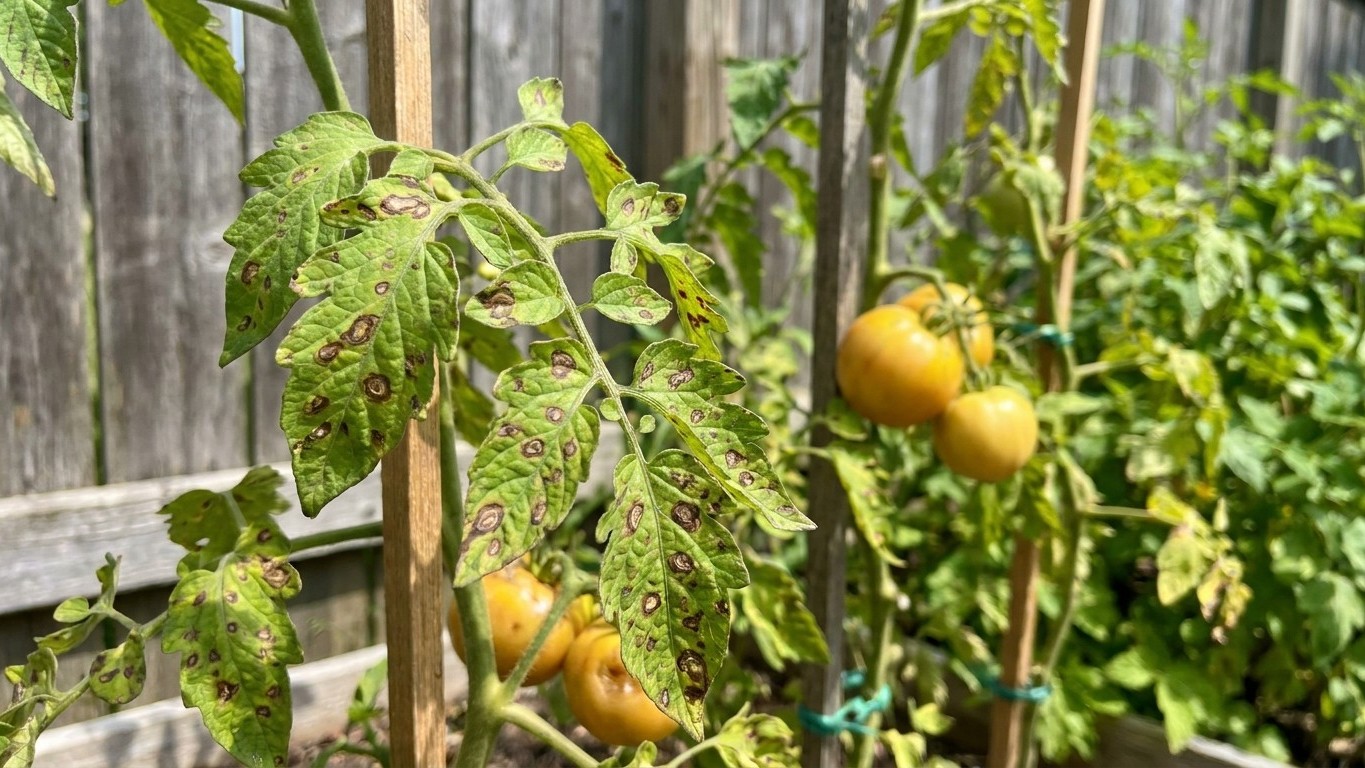

Tomato diseases show up as a fairly small set of recognizable patterns: leaf spots with rings, yellowing that climbs the plant, wilting on one side, or a leathery patch at the fruit’s blossom end. Once you know which pattern you’re looking at, you can usually name the cause without sending anything to a lab. Start by walking your rows every few days and turning over a few of the lowest leaves, because most of these diseases announce themselves there first.
Why this matters
Catching a disease at the leaf-spot stage, rather than at the whole-plant-wilting stage, is the difference between losing a few leaves and losing the plant. Fungal diseases like early blight and septoria leaf spot start low and climb upward one leaf at a time. If you spot the pattern while it’s confined to the bottom third of the plant, you can strip those leaves, adjust watering, and the plant keeps producing. Wait until the disease has reached the upper canopy and you’re managing decline, not prevention.
Skipping regular checks also costs you at the fruit level. A plant losing leaves to disease has less foliage to shade and feed the fruit, which raises the risk of sunscald and undersized tomatoes even if the fruit itself never shows a spot. Some pathogens, including the ones behind Fusarium Wilt on Tomatoes: When One Side of the Plant Goes First, Verticillium Wilt on Tomatoes: The Slow Wilt That Comes Back Every Year, Southern Blight, Bacterial Canker, Bacterial Speck, and Anthracnose on Tomatoes, persist in the soil for years once established, so a diseased plant this season can shape which varieties you’re able to grow in that bed for several seasons after. Others, like Tomato Spotted Wilt, are spread by thrips rather than soil contact, which changes how you manage them from one season to the next, while Tomato Mosaic Virus spreads through contact with contaminated tools, hands, or plant debris instead. Leafhoppers carry a different threat entirely: Curly Top: The Plant That Stops Dead While Its Neighbours Grow On, a disease that can halt one plant’s growth completely while the rest of the row carries on unaffected. If you’re still working through the basics of keeping plants alive at all, the main How to Grow Tomatoes guide covers the growing conditions that make disease pressure worse or better in the first place.
When to do it
Disease scouting isn’t a one-time task tied to a date. It runs from the week after transplanting straight through harvest, because different diseases show up at different stages. Early on, watch for damping-off and early leaf spotting near the soil line. Once the plant sets its first flowers and starts putting energy into fruit, watch the lower leaves specifically, since that’s where Early Blight on Tomatoes: The Ringed Spots That Climb From the Bottom and Gray Mould on Tomatoes and Septoria Leaf Spot: The One People Mistake for Blight both begin. Any stretch of humid, wet or unusually cool weather is a trigger to check more often, not less, since most fungal spores need moisture on the leaf surface to infect.
Fruit set is also when blossom-end rot becomes visible, usually on the first cluster of fruit rather than later ones, because early fruit sets before the plant’s water and calcium uptake has evened out. This is also the stretch of wet weather when you’re most likely to spot Bacterial Spot and Speck on Tomatoes: Small Dark Lesions, Wet Weather forming on both leaves and young fruit. By the time you’re picking ripe fruit, your job shifts from prevention to triage: pull anything visibly rotten before it touches healthy fruit, and if a plant is failing fast to something like Late Blight on Tomatoes: How to Recognise It Before It Takes the Whole Row, get the still-green fruit off it and let it finish ripening elsewhere rather than leaving it to rot in the garden, a process covered in Harvesting Tomatoes: When to Pick, and Ripening the Rest Indoors.
How to do it

Work the same way every time you scout: start at the soil line and move upward, turn several leaves over to check the underside, and note whether the pattern is spots, yellowing, wilting, or something on the fruit itself. Matching what you see to a known pattern is most of the diagnosis.
Early blight

Look for dark, ringed spots on the oldest leaves first, each one roughly a quarter to half inch across with a yellow halo around it. Left alone, the spots merge, the leaf yellows entirely and drops, and the disease works its way up the plant. Removing affected leaves as soon as you see them and improving airflow around the base slows it considerably.
Septoria leaf spot

This one produces smaller, more numerous spots than early blight, gray-tan with a dark brown rim and a tiny black speck visible in the center of each one. It spreads fast in wet conditions and via splashing water, so mulching to stop soil from splashing onto lower leaves during watering or rain is the single most effective prevention step.
Late blight

Watch for large, irregular, water-soaked blotches, greenish-black, that can cover a leaf within days in cool damp weather. Stems develop dark, greasy-looking streaks and the whole plant can collapse within a week or two once conditions favor it. Late blight moves faster than any other common tomato disease, and there is no cultural fix once it’s established, only removal.
Fusarium wilt

This shows up as yellowing and wilting on one side of the plant, or on a single branch, while the rest looks fine. Slice a lower stem lengthwise and look for brown streaking in the tissue, which confirms it’s vascular rather than a watering problem. There’s no treatment for an infected plant, only prevention through resistant varieties and rotation.
Blossom-end rot

Not a disease at all, but it’s mistaken for one constantly. It’s a flat, leathery, sunken patch at the bottom of the fruit caused by uneven water and calcium delivery, not a pathogen, and it doesn’t spread to other fruit or other plants. Consistent watering does more to prevent it than any product marketed for the purpose.
Beyond identifying what you’re looking at, a handful of practices reduce disease pressure across the board:
- Water at the base of the plant, not overhead, and do it in the morning so foliage dries by evening
- Mulch under plants to stop soil-borne spores splashing onto lower leaves
- Space and stake or cage plants for airflow, a step covered in Staking and Caging Tomatoes: Choosing a Support and Installing It in Time
- Remove and dispose of infected leaves and plants promptly rather than letting them sit
- Rotate the bed so tomatoes and their relatives aren’t grown in the same soil year after year
What goes wrong

The most common error is treating symptoms too late, after a fungal disease has already moved past the lower third of the plant, at which point removing leaves does little because the spores are already established elsewhere on the plant. A close second is overhead watering in the evening, which leaves foliage wet overnight and gives fungal spores exactly the conditions they need to germinate.
The mistake that looks like extra care but isn’t is over-pruning healthy foliage in an attempt to “clean up” the plant. Stripping leaves that are simply aging, rather than diseased, reduces the plant’s ability to photosynthesize and shade its fruit, and doesn’t actually reduce disease pressure since the pathogen wasn’t in those leaves to begin with. Only remove leaves that show the actual symptom, not leaves that just look tired.
Composting diseased plant material is another common misstep. A home compost pile rarely reaches the sustained heat needed to kill pathogens like the ones behind fusarium wilt or late blight, so material that goes in infected often comes out infected, ready to reintroduce the problem the next time that compost is used in the garden. Bag it and put it in the trash instead, and check local yard-waste rules if you’re unsure whether it can go in municipal collection.
Doing it differently
Container-grown tomatoes generally see less soil-splash disease because there’s no bare garden soil to splash spores upward, but containers dry out and rewet faster than garden beds, and that inconsistency stresses the plant in ways that make it more vulnerable to disease pressure once it does show up. Steady watering matters even more in a pot than in the ground.
Greenhouse growing cuts down on rain-driven diseases like late blight almost entirely, since the pathogen needs free moisture on the leaf to spread, but the trapped humidity favors different problems, particularly gray mold on stems and fruit. Ventilation is the trade you’re making, and a greenhouse without airflow can end up worse off than an open bed.
Raised beds drain faster than native soil, which helps with root diseases tied to waterlogging, but they don’t solve fusarium or verticillium wilt if the fill soil or transplants brought the pathogen in with them. Variety choice matters here too. Seed packets and catalogs mark disease resistance with letter codes after the variety name, commonly V for verticillium wilt, F for fusarium wilt, N for nematodes, T for tobacco mosaic virus and A for early blight (alternaria). A tag reading “VFN” means resistance to all three of those, and choosing a resistant cultivar for a bed with known disease history is a genuine fix, not just a preference.
Common questions
Can I eat tomatoes from a plant that has early blight on the leaves?
Yes, as long as the fruit itself is unaffected. Early blight lives on foliage and stems, and fruit from an infected plant is generally safe to eat once you’ve cut away any spot that has actually reached the tomato.
Does spraying baking soda or Epsom salt actually stop tomato disease?
Baking soda solutions have a mild preventive fungicidal effect on some leaf spot diseases when applied before infection, but they don’t cure a plant that’s already showing symptoms. Epsom salt addresses magnesium deficiency, not disease, and spraying it on a diseased plant does nothing for the pathogen.
Do I need to pull the whole plant if I see late blight?
In most cases, yes. Late blight spreads faster than you can prune it away, and leaving an infected plant in place risks the whole planting. Remove the plant, bag it rather than composting it, and pick any usable green fruit first to ripen indoors away from the disease, following the approach in Harvesting Tomatoes: When to Pick, and Ripening the Rest Indoors.
Why do my tomatoes look fine on the plant but rot a few days after I pick them?
That’s usually a storage problem rather than a field disease, especially if the rot starts soft and spreads from a bruise rather than showing the ringed or streaked patterns described above. Refrigerating tomatoes accelerates this kind of breakdown, which is covered in Storing Tomatoes: Why the Fridge Ruins Them, and What to Do Instead.