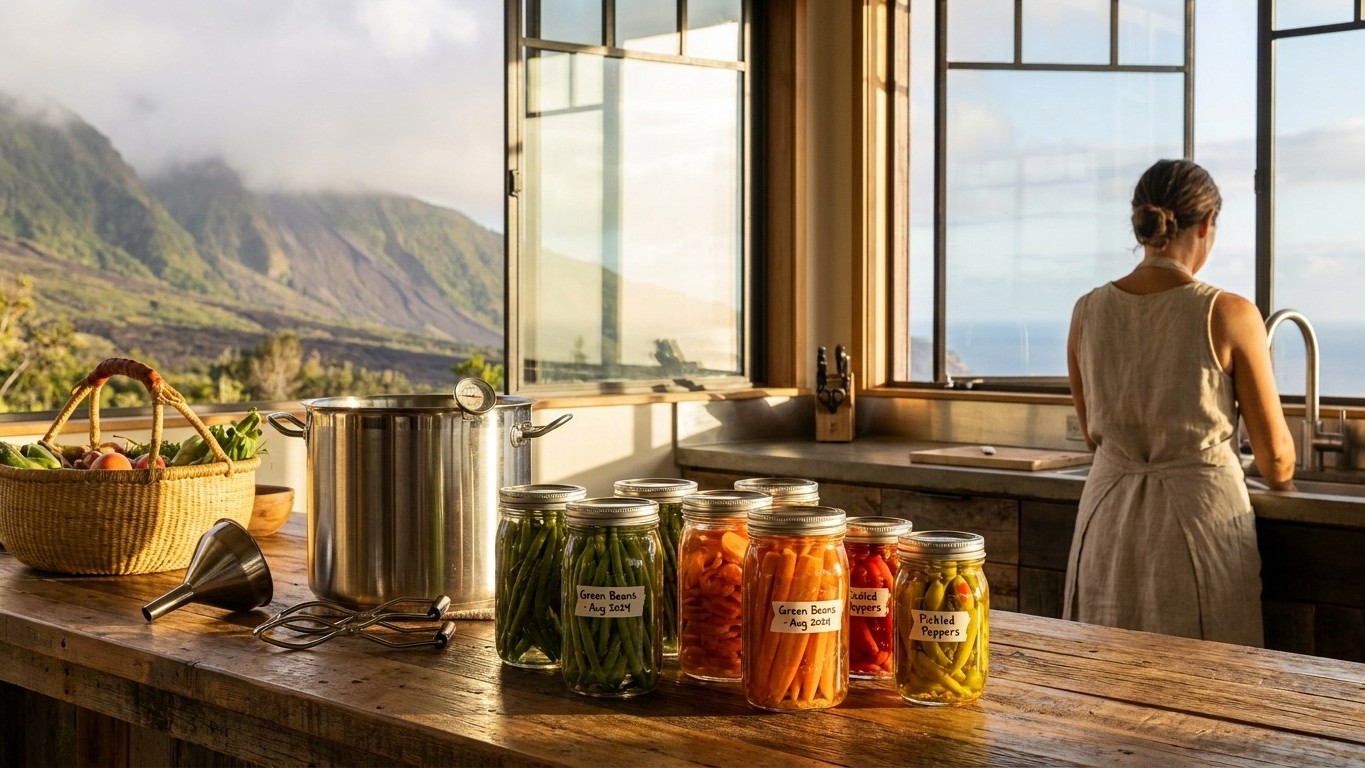

Honolulu sits at just 16 feet above sea level, where water boils somewhere between 208°F and 212°F, essentially true sea-level conditions. If that’s where you can, no altitude adjustment applies to your process. But Hawaii is a state built by volcanoes, and its interior slopes climb into elevations where that same boiling temperature drops enough to matter, and your jar of green beans needs a different process than the one on the recipe card.
The short answer

Honolulu, the reference city for this figure, sits at 16 feet of elevation. At that height, published boiling temperatures for water run between 208°F and 212°F, according to the USDA Complete Guide to Home Canning as published by the National Center for Home Food Preservation. That’s a difference so small it doesn’t register as a canning problem. Honolulu falls within the 0 to 2,000 foot elevation band, the range published as needing no altitude adjustment for canning at all.
If you live near sea level anywhere on Oahu, or in the coastal flats of most Hawaiian towns, that’s your answer: process your jars exactly as the tested recipe states, no correction needed.
But a state is not a point on a map
Here’s where it gets specific to Hawaii in a way that doesn’t apply to a flatter state. Hawaii’s islands are volcanic peaks, and their interior slopes rise from sea level to elevations that are dramatically higher, well outside that 0 to 2,000 foot band. A kitchen on the Big Island’s upper slopes, in Volcano or along the Saddle Road corridor, or a homestead partway up Haleakala on Maui, sits at a genuinely different elevation than Honolulu’s harbor front. The 16-foot figure describes one city. It says nothing about where you actually stand when you’re filling jars.
That distinction matters because canning guidance is built around the boiling point of water at your location, not at the state capital or the biggest city. A recipe tested at sea level and followed without adjustment at a meaningfully higher elevation isn’t a smaller version of the same process. It’s a different, weaker process wearing the same instructions. The rest of this guide walks through why that happens and what to do about it, without ever telling you a specific number to dial in, because that number depends on the food you’re canning and belongs in the tested recipe, not in a general explainer.
Why a lower boil is a weaker process
Water boils at a lower temperature as elevation increases. That’s a basic fact of atmospheric pressure: less air pressing down means water molecules escape into vapor at a cooler temperature. At sea level, water boils at 212°F. Climb high enough, and that same rolling boil happens at 194°F. The water is still boiling. It just isn’t as hot while it does it.
For home canning, that difference is the entire problem. A boiling-water canner relies on the temperature of boiling water to destroy molds, yeasts, and enzymes in high-acid foods like fruit and pickles. A pressure canner relies on the higher temperature reached inside a sealed, pressurized pot to destroy Clostridium botulinum spores in low-acid foods like green beans, meat, and most vegetables. Both methods assume a specific temperature is being reached and held for a specific time. Change the temperature, and the same clock no longer buys the same safety margin.
This is where a common instinct leads people wrong. If the water isn’t hot enough, why not just crank up the heat and boil it harder? Because boiling water cannot get hotter than its boiling point, no matter how vigorously it boils. A rolling, violent boil at 194°F is still 194°F. Turning up the burner makes more steam, not more heat in the water itself. It’s a natural response to a problem that heat alone can’t fix, and it’s why altitude adjustments exist in the first place.
What actually compensates for a cooler boil is time and, for pressure canning, additional pressure. In a boiling-water canner, tested recipes add processing minutes as elevation increases, giving the lower temperature more time to do the work a hotter temperature would have done faster. In a pressure canner, the fix runs the other direction: rather than extending time, the canner is run at a higher pressure, which raises the internal temperature back up to where it needs to be regardless of the outside boiling point. Both are exact, tested adjustments tied to specific elevation bands, and both are printed on the food-specific recipe, not derived on the fly in your kitchen.
Finding your own elevation
Because the number that matters is yours, not Honolulu’s, and not any other reference point in this guide, the next step is simply figuring out where your kitchen actually sits.
- Start with your street address or the nearest town center, since elevation can shift noticeably even within a few miles on Hawaii’s steep volcanic terrain.
- Use the National Center for Home Food Preservation’s “Find Your Elevation” tool, built specifically so home canners can look up a number instead of guessing.
- Enter your city or zip code and read the elevation in feet above sea level, the same unit used throughout canning guidance.
- Round to the nearest elevation band listed in your tested recipe rather than trying to interpolate between bands yourself.
- Recheck your elevation if you move, even locally, since a shift from a coastal lot to a hillside address in the same town can cross an elevation threshold that changes your process.
Skipping this step and borrowing a number from a friend across town, or from a city you visited once, is one of the easiest ways altitude mistakes creep into an otherwise careful canning session.
What goes wrong
- An under-processed jar that looks perfectly normal. A jar canned at the sea-level time despite sitting at a higher elevation can seal, seal tightly, and sit on the shelf looking exactly like a safe jar. There’s no visual, smell, or taste cue that distinguishes it. The remedy is procedural, not sensory: match your process to your actual elevation before you can, not after.
- A recipe pulled from a sea-level source without checking its elevation assumptions. Family recipes, older cookbooks, and recipes shared from friends at lower elevations often assume sea-level boiling without saying so. Before using any canning recipe, confirm it comes from a tested source that publishes elevation adjustments, and apply the adjustment for your own elevation band rather than assuming the recipe already accounts for it.
- A pressure gauge read as if elevation didn’t exist. Weighted and dial gauges both need elevation-specific pressure settings, and treating every pressure canner load the same regardless of where you live undermines the entire safety margin the gauge is supposed to provide. Check your specific canner’s gauge type against the pressure listed for your elevation band in the tested recipe, every time.
Where the exact adjustment comes from
This page deliberately stops short of giving you a processing time or a pressure setting, because the correct adjustment depends on the specific food you’re canning, the jar size, and your exact elevation, and that combination is only published inside a tested recipe. The National Center for Home Food Preservation, at the University of Georgia, maintains those tested recipes along with the elevation adjustment tables that go with them.
The reason to be strict about this isn’t caution for its own sake. Clostridium botulinum, the organism a correct process is designed to destroy, produces a toxin with no taste and no smell. A jar that’s under-processed because the elevation adjustment was skipped or guessed at gives no warning sign before it’s opened and eaten. Look up your food, your jar size, and your elevation band on the National Center for Home Food Preservation’s site, and use the number printed there.
Common questions
Does Honolulu’s low elevation mean nowhere in Hawaii needs an altitude adjustment?
No. Honolulu’s 16-foot elevation is a reference point for one city, not for the state. Hawaii’s volcanic interior climbs to elevations well outside the 0 to 2,000 foot band that Honolulu falls into, and canners on those slopes need the adjustment that matches their own elevation, not the capital’s.
Can I just process everything a little longer to be safe, regardless of elevation?
Adding random extra time isn’t the same as following a tested adjustment. Tested recipes pair specific times and pressures with specific elevation bands and specific foods; guessing at “a little longer” skips the calculation that actually makes the process safe and can still leave a jar under-processed.
Does altitude affect water-bath canning and pressure canning the same way?
The underlying mechanism, a lower boiling point at higher elevation, is the same for both. The fix differs: boiling-water canning compensates with added time, while pressure canning compensates with added pressure rather than added time.
Where do I find my exact elevation if I’m not sure whether I’m in the 0 to 2,000 foot band?
Use the National Center for Home Food Preservation’s “Find Your Elevation” tool with your city, town, or zip code, and match the result to the elevation bands listed in your specific tested recipe.