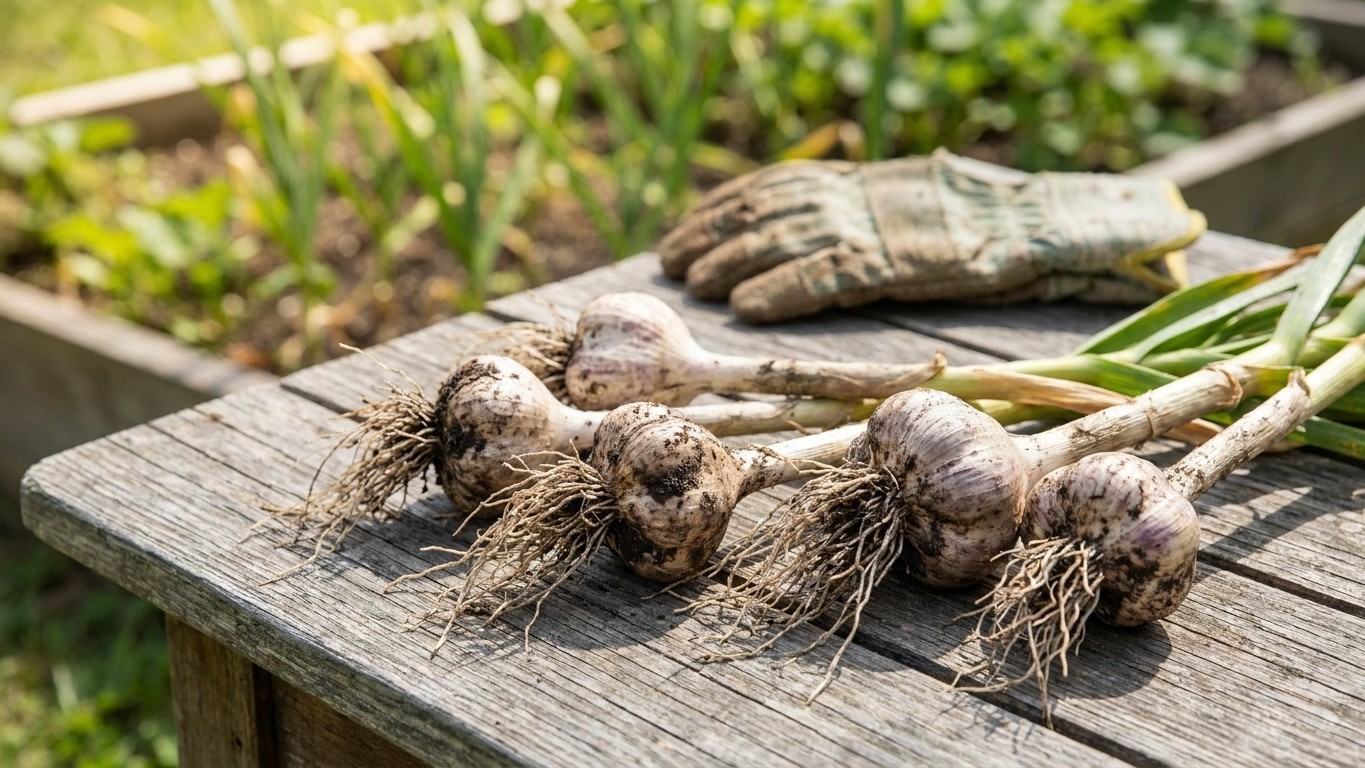

Garlic planted in Hawaii the previous autumn is typically ready to lift in early to mid summer, once the lower third to half of the leaves have yellowed and dried back. There’s no frost date to work backward from here. Instead, timing hinges on rainfall, elevation, and how quickly the soil dries between waterings. Curing then takes several weeks in a shaded, breezy spot before the bulbs go into storage.
When garlic is ready to lift in Hawaii
Mainland guides lean on frost windows to time garlic. That approach doesn’t apply here. NOAA’s 1991-2020 Climate Normals for station USW00022521 show zero days per year at or below 32°F, and every freeze percentile at 32°F and 36°F comes back not-computable. Frost happens only on the summits of Mauna Kea, Mauna Loa, and Haleakala, thousands of feet above anywhere a garden bed exists. So instead of counting weeks from a fall freeze, growers here have to read the plant and the ground.
The bulb itself gives the clearest signal. Once outer leaves start browning from the bottom up, growth has stopped feeding the cloves and they’ve sized up as much as they’re going to. Pull too early and you get small, undifferentiated bulbs with papery layers that haven’t formed. Wait too long, especially through a wet spell, and the wrapper leaves rot away underground, leaving bulbs exposed to soil moisture and prone to splitting.
Elevation and rainfall change the calendar
Garlic planted at higher, cooler elevations tends to bulb more slowly than garlic grown at sea level in warmer, more humid conditions. Windward sites with steady rain hold soil moisture longer into the season, which can push maturity later and raise the risk of rot right at harvest time. Leeward and drier sites tend to dry down faster and often reach lifting stage sooner. Because these variables shift from one valley or slope to the next, there isn’t a single statewide date that works for every garden. The University of Hawaii CTAHR Extension is the resource to check for guidance specific to your island and elevation before you commit to a lift date.
A practical habit: stop watering a week or two before you expect to lift. Drier soil at the finish line firms up the wrapper leaves and makes for a cleaner pull, with less soil clinging to the bulb and less risk of bruising the skin as you dig.
Curing it, and where to hang it here
Curing is the step that turns a freshly dug bulb into something that will actually keep. Freshly lifted garlic is still roughly three-quarters water by weight in the neck and outer layers. Curing drives that moisture out slowly, sealing the neck and tightening the skins so the bulb can survive weeks or months in storage without rotting or sprouting early.
The setup that works best is shade, airflow, and low humidity, in that order of importance. Direct sun on curing garlic can scald the outer layers and actually cook the bulb rather than dry it. A carport, an open-sided lanai, or a shaded porch with a fan running gives garlic what it needs: moving air and no direct sun. Bundling stalks loosely and hanging them, or spreading bulbs in a single layer on a screen or wire rack, both work as long as air can circulate on all sides.
Hawaii’s humidity is the real obstacle
This is where curing in Hawaii diverges most from curing in a dry mainland climate. High ambient humidity slows the drying process considerably, and in wetter regions of the islands, garlic left to cure in still air can mold before it ever finishes drying. A fan isn’t optional in a humid spot; it’s often the difference between a bulb that cures properly and one that rots on the rack. Checking bulbs every few days for soft spots or mold lets you pull and use any bulb that’s struggling before it spreads spoilage to its neighbors.
Curing generally continues until the outer wrapper feels papery and dry and the neck has tightened down firmly, with no give when you squeeze it. In a humid location that can take longer than it would in a drier climate, so patience matters more than a fixed number of days. Once the necks are dry and tight, trim roots and stalks, brush off loose soil without washing the bulbs, and they’re ready to move into storage.
Storing it through a Hawaii winter
Once garlic is cured, the goal shifts to holding it in conditions cool enough and dry enough to slow sprouting and rot. That’s a harder target in Hawaii’s climate than in a temperate one, since even the cooler months rarely bring the low humidity that garlic prefers for long storage.
A dark, well-ventilated space away from direct sun and away from the kitchen stove is the starting point. Heat and steam from cooking push moisture right back into stored bulbs, undoing weeks of curing. Mesh bags, loosely woven baskets, or open crates let air move around each bulb, which matters more indoors in a humid house than it would in a dry climate where sealed containers pose less risk.
Watch the bulbs, not the calendar
- Check stored garlic every couple of weeks for soft or sprouting bulbs, and pull those out to use first.
- Keep storage away from onions, which release moisture and gases that shorten garlic’s storage life.
- Avoid the refrigerator for whole bulbs; the cold, humid environment there tends to trigger sprouting faster than a cool, dry cupboard.
- Set aside your best, largest bulbs as seed stock for the next fall planting rather than storing them for eating all winter.
Because Hawaii’s indoor humidity runs high most of the year, don’t expect the same storage length you’d get from garlic cured and stored in a dry mainland pantry. Bulbs here are more likely to soften or sprout sooner, which is part of why many growers plan to use their stored garlic steadily through the fall rather than banking on it lasting into the following spring.
What goes wrong here
Rot is the most common failure, and it usually traces back to one of two points: garlic left in wet soil too long before lifting, or garlic cured without enough airflow. Both problems trap moisture where it shouldn’t be, and once mold sets into a bulb’s wrapper it tends to spread to any bulb touching it.
Pests are a smaller but real factor. The University of Hawaii CTAHR Extension documents several pests relevant to island vegetable growers, including aphids, beet armyworm, cabbage webworm, Chinese rose beetle, leafminers and bean fly, melon fly, Southern green stinkbug and mites, and whiteflies. Garlic isn’t the primary target for most of these, but a garden bed shared with other vegetables can see pressure from this list spill over, particularly aphids and mites, which can build up on stressed or damaged plants. Keeping garlic beds weeded and checking nearby crops for early infestations helps limit how much these pests move into the garlic itself.
Skipping the cure entirely
The other common mistake is impatience: pulling garlic, brushing it off, and storing it right away without curing. Uncured garlic has a soft neck and moisture-heavy skin, and it will mold in storage within days rather than weeks. Given how much longer curing already takes in a humid climate, cutting the process short defeats the purpose of curing at all. If a bulb still smells sharp and feels heavy with moisture, it isn’t ready for the pantry yet, no matter how long it’s been hanging.
Common questions
Does Hawaii ever get a real frost that affects garlic timing?
No. NOAA’s climate data for the islands’ populated station shows zero days per year at or below 32°F, with freeze percentiles not computable at either 32°F or 36°F. Frost occurs only on the summits of Mauna Kea, Mauna Loa, and Haleakala, well above any garden. Garlic timing here follows rainfall and soil drying, not a frost calendar.
How long does garlic take to cure in Hawaii’s climate?
There’s no fixed published timeframe for Hawaii specifically, but humidity slows the process compared to a dry mainland climate. The practical marker is the bulb itself: wait until the neck feels tight and dry and the outer skin is papery, checking every few days rather than counting toward a set number.
Can I store garlic in the refrigerator instead of a pantry?
It’s better to avoid it for whole, cured bulbs. The cold and humidity inside a refrigerator tend to encourage sprouting faster than a cool, dark, dry cupboard or well-ventilated storage area.
Which pests should I watch for on garlic in Hawaii?
University of Hawaii CTAHR Extension documents aphids, beet armyworm, cabbage webworm, Chinese rose beetle, leafminers and bean fly, melon fly, Southern green stinkbug and mites, and whiteflies as pests relevant to island vegetable gardens. Aphids and mites are the ones most likely to affect stressed garlic plants directly.