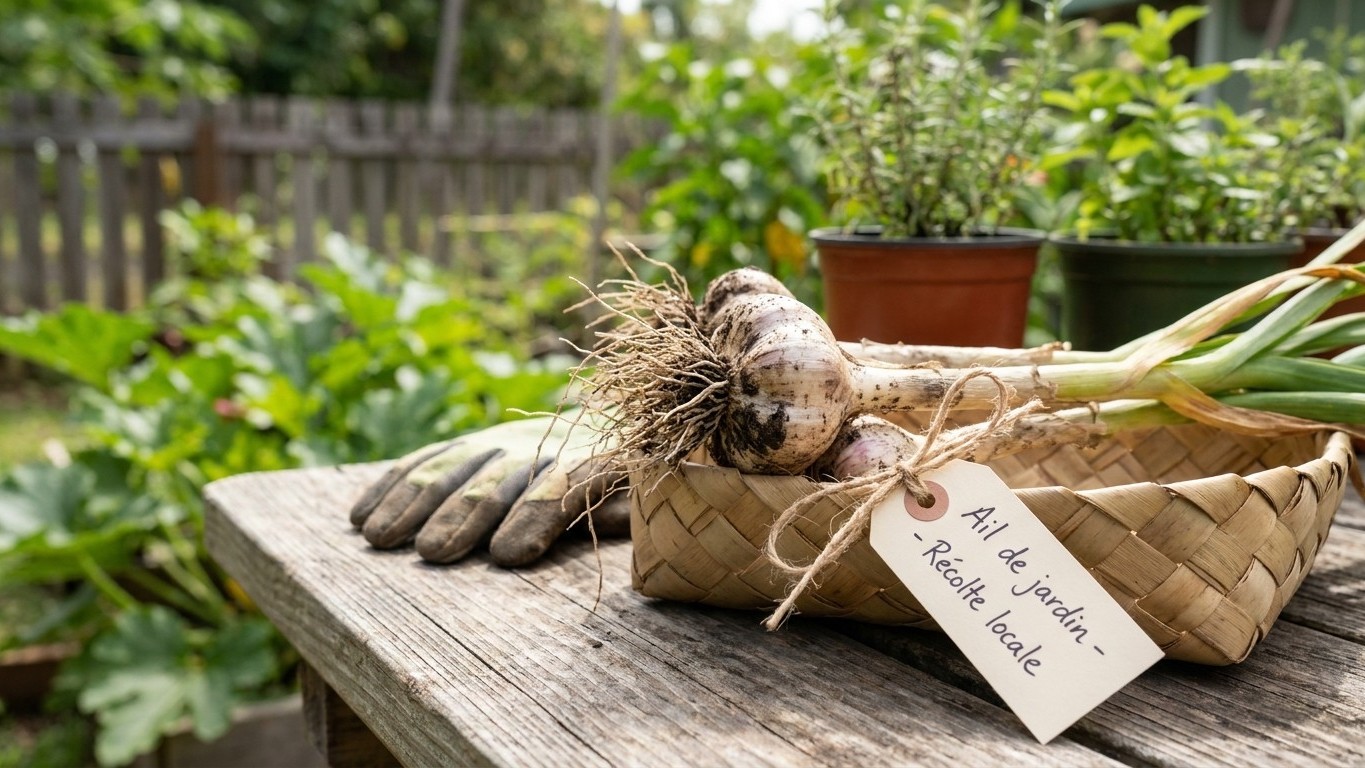

Garlic grown in most of Hawaii will not split into a full head of cloves, because the crop needs a real run of cold after planting and the state’s inhabited elevations do not supply one. NOAA’s 1991-2020 climate normals for the station near Honolulu record zero days at or below 32°F, and the same dataset cannot even compute a threshold for 36°F, which tells you sustained cold air is essentially absent at the elevations where people garden. The one thing to do before you order cloves: plan to refrigerate them for several weeks before planting, or pick a softneck variety bred for mild winters.
Will garlic get the cold it needs in Hawaii

Garlic bulbs from a single clove, not from seed, and that clove has to be tricked into dividing. The trigger is cold. University of Georgia Extension publication C854 puts the requirement at six to eight weeks of temperatures below 40°F after planting, and without it the plant grows on as a single round bulb instead of a head of separate cloves. Gardeners call that a “round,” and it is edible but it is not what anyone means by a bulb of garlic, which is why choosing from the Garlic Varieties That Suit Hawaii Winters matters so much.
Hawaii’s lowlands do not deliver that stretch. NOAA’s 1991-2020 normals for the Honolulu-area station show no measurable freeze at all, and given that even the 36°F threshold could not be computed for lack of qualifying days, sustained air temperatures below 40°F are not something the state’s coastal and low-elevation gardens experience in any given winter. Compare that to a state like Oklahoma, where growers can generally count on that cold arriving on its own each year without doing anything to force it, as described in our guide to growing garlic in Oklahoma. Hawaii gardeners are working from the opposite starting point, which is exactly why knowing When to Plant Garlic in Hawaii matters more here than in colder states.
The two workarounds
That does not mean garlic is off the table here, only that you have to substitute for the cold instead of waiting for it.
- Refrigerate the cloves before planting, separated but still in their papery skins, for roughly the same six-to-eight-week span UGA gives for field cold. A produce or vegetable crisper drawer, not the freezer, is the right compartment.
- Grow a softneck type instead. Softneck garlic needs far less chilling to divide reliably and is the variety group bred for mild-winter regions in the first place.
Elevation changes the picture somewhat. Gardens well up the slopes of Maui or the Big Island run cooler at night than coastal Honolulu, and growers there sometimes get enough of a chill that pre-refrigeration matters less. There is no published local figure for how much cooler, so treat that as a reason to experiment on a small bed rather than a guarantee, and ask your county extension agent what neighbors at similar elevation have actually harvested.
When to put the cloves in
Garlic is an autumn-planted, early-summer-lifted crop everywhere, Hawaii included, but the usual way of dating that planting does not apply here. On the mainland the rule is to plant close to the first fall frost, giving the clove time to root before the ground freezes without pushing so much top growth that a hard freeze burns it back. Hawaii’s inhabited elevations do not have a first fall frost to plant around. NOAA’s normals for the Honolulu-area station record no freeze in a typical year, so there is no frost anchor to plant against in this state, and any date given as a safe planting day here would be invented, not measured.
What replaces the frost anchor is the seasonal shift itself. Hawaii’s growing year runs on rainfall and temperature drift rather than a hard freeze line: the cooler, wetter months of the year are when local growers put cloves in, because that is when soil temperatures start easing down from summer highs and rooting conditions improve without the clove being pushed into rapid leaf growth by heat. The clove still needs to root in before it puts on much top growth, the same logic as anywhere else, just without a frost date to count backward from.
Elevation, windward exposure and rainfall all move that window around more than they would in a state with a real winter. A garden on the windward side of Oahu or the Big Island gets rain and cooler air earlier in the season than a leeward garden a few miles away. A high-elevation plot cools faster than a coastal one at the same latitude. None of that is captured by a single statewide date, and your county office of the state extension service is a better source for what local growers are actually doing than any calendar figure.
Which types suit Hawaii
Hardneck and softneck garlic are not interchangeable, and in Hawaii the choice is mostly made for you. Hardneck varieties evolved in places with a real winter and use that cold to trigger both bulb division and the flower stalk, called a scape, that hardnecks send up. Ask a hardneck to grow through a winter with no sustained cold and you get poor division, a weak scape, or both. Softneck varieties need much less chilling, which is exactly why they are the type sold in supermarkets from California‘s Central Valley and other mild-winter growing regions.
Softneck varieties for Hawaii
Softneck is the reliable choice for a Hawaii garden, and several catalogue varieties are worth naming specifically rather than just pointing at the category.
| Variety | Type | Notes for Hawaii |
|---|---|---|
| Inchelium Red | Softneck | Low chilling need, large cloves, good storage bulb |
| Lorz Italian | Softneck | Reliable division without much cold, vigorous grower |
| Early Red Italian | Softneck | Adapted to mild-winter regions on the mainland |
| Italian Late | Softneck | Slower to mature but tolerant of warm winters |
Softneck bulbs also braid, which matters for curing and storing garlic through Hawaii’s humid summer, since braided bulbs hang with airflow around every bulb rather than sitting stacked in a bin.
Hardneck: only at elevation, and only as a trial
If you garden well up a Maui or Big Island slope and want to try a hardneck anyway, German Red and Chesnok Red are two catalogue varieties worth a small trial bed rather than a full planting, since neither has a track record of dividing reliably without a real winter behind it. Treat any hardneck planting in Hawaii as an experiment on a few square feet, not the main crop.
Soil and bed preparation
Garlic sits in the same patch of soil for the better part of a year in Hawaii, through whatever rain the wet season brings, and drainage matters more here than almost anywhere else it is grown. A clove that sits in saturated soil for even a few days can rot before any disease organism gets near it. Raised beds or mounded rows, four to six inches above the surrounding grade, are worth the extra work in any garden that gets heavy winter rain, and they cost nothing but labor and maybe a few boards to hold the edge.
Work compost or other well-rotted organic matter into the bed before planting, both for fertility and for the structure it gives Hawaii’s volcanic soils, which range from fast-draining cinder on younger flows to dense, clay-heavy ground on older ones. A soil that drains too fast dries the clove out between rains, a soil that drains too slowly drowns it, and you will not know which you have without digging into it by hand.
Break up any compacted layer and remove rocks and old root mats down to at least six inches, since garlic roots deeper than its shallow planting depth would suggest and shallow planting on top of hardpan just concentrates whatever water does sit there right at the clove. Weed the bed thoroughly before planting rather than after: garlic’s narrow upright leaves compete poorly with anything that gets a head start, and there is no good way to hoe between garlic rows once the crop is up without nicking bulbs.
What the climate here favours, and what it does not
Disease pressure in garlic tracks soil temperature, and the closest data available is air temperature at a reference station, so treat everything below as a tendency rather than a diagnosis. The published thresholds are soil temperatures, and the figures here are air temperatures, which lag and swing less than the air above them. A monthly mean inside a disease’s range does not mean every day of that month favored it, only that the average sat inside the window.
Using the temperature thresholds published by UC IPM’s Pest Management Guidelines for Onion and Garlic, UC ANR Publication 3453, the picture for a Hawaii growing season (September through July) breaks down as follows.
| Disease | Published range | Months in range this season |
|---|---|---|
| Fusarium basal rot | 59-90°F | 11 of 11, including 6 at the published optimum |
| Pink root | 75-85°F (optimum) | 7 of 11, all at the published optimum |
| White rot | 50-75°F | 4 of 11 (December through March) |
| Southern blight | 86-95°F (optimum) | 0 of 11 |
What stays quiet here
Southern blight‘s optimum never lines up with a Hawaii growing-season mean by this measure, which is real reassurance, not proof of safety. Sclerotium rolfsii, the fungus behind it, does not vanish just because the average month runs cooler than its favored range. It can still show up on infected planting stock or in a warm microclimate that the reference station does not capture, so buy clean seed garlic and rotate beds regardless of what the averages say.
Fusarium basal rot is the one to watch hardest, since its wide 59-90°F published range overlaps nearly the entire Hawaii growing season, with six months landing right at the published optimum. Pink root’s 75-85°F optimum also lines up with most of the state’s warmer months. Neither of those figures means an infection is coming, only that the climate here does not work against these two fungi the way a cold, dry season would on the mainland. White rot gets a narrower four-month window in the cooler part of the year, and it is a soil-persistent disease once introduced, so a clean start matters more than any seasonal timing.
Getting it through the winter
Hawaii’s mild winters change what mulch is for. On the mainland, mulch goes down heavy enough to insulate the clove against a hard freeze and to stop repeated freeze-thaw cycles from heaving a shallow-planted clove halfway out of the ground, a real problem for growers in a state like Idaho where the ground can freeze and thaw several times over a winter, as covered in our guide to growing garlic in Idaho. Hawaii’s lowland gardens do not freeze at all, so heaving from freeze-thaw is not something this climate produces.
Mulch still earns its keep here, just for different reasons. A two-to-three-inch layer of straw or another loose organic mulch, laid soon after planting, keeps soil moisture more even through Hawaii’s wet-to-dry seasonal swing, suppresses weeds that compete hard with garlic’s narrow leaves, and cuts down on rain splashing soil-borne fungal spores up onto young leaves. In a wet stretch, pull mulch back slightly from directly over the clove so the crown does not sit in a damp pocket, since rot is the bigger winter risk here, not cold.
Plant cloves at the standard depth, pointed end up, and firm the soil around them well. A shallow-planted clove is more exposed to drying out between rains in Hawaii than to being pushed out of the ground by frost heave, so err toward the deeper end of the usual planting depth rather than the shallow end if your bed drains fast.
Harvest and curing here
Read the plant, not the calendar, for harvest timing. Garlic tells you it is close when the lower few leaves have browned and dried back while the upper leaves are still green, generally somewhere around five to six green leaves remaining. Pull a test bulb or two and check that the cloves have filled out and the wrapper skins are starting to separate into distinct layers before you commit to lifting the whole bed.
Curing in a humid climate
Curing is where a lot of otherwise good garlic gets lost, and Hawaii’s humidity makes it harder than in a dry-summer state. Garlic needs to dry down with good airflow around every bulb for the outer skins to seal and the neck to close, and in a humid stretch that airflow matters more than in a dry one, since moisture in the air slows evaporation from the bulb itself. Hang or lay bulbs in a single layer, out of direct sun, with a fan running if the space is at all still, and check regularly for any bulb that feels soft or smells off. Pull and discard any bulb that shows soft rot during curing rather than leaving it near the rest of the crop, since rot spreads by contact and by the moisture it releases into the surrounding air.
Expect curing to take longer in a humid summer than the few weeks often quoted for dry-climate growers, and judge it by the neck and outer skins rather than by a fixed number of days: the neck should feel dry and tight, not soft or green, before you trim and store the bulbs.
Local help
County-level planting practice, soil testing and pest identification are all better sourced locally than from any statewide figure. The University of Hawaii’s CTAHR extension service is the right first call for a soil test before you commit a bed to garlic, and for whatever county-specific timing local growers near you have actually settled on.
Common questions
Can I just plant grocery store garlic in Hawaii?
You can, but it is a gamble. Grocery store garlic is usually softneck, which suits Hawaii’s mild winters, but it is often treated to prevent sprouting and may carry disease that a certified seed source screens out. If it sprouts and grows, treat the harvest as a trial, not your main seed stock for next year.
Why did my garlic bulb up as one round clove instead of a head?
That is the classic sign of not enough cold. The single clove grew but never got the chilling signal to divide into a multi-clove bulb. Refrigerating your seed cloves before planting, or switching to a low-chill softneck variety, addresses this directly.
Do I need to cut the scape on garlic grown in Hawaii?
Only if you are growing a hardneck type, since scapes are a hardneck trait and most Hawaii-suited varieties are softneck and do not send one up. If you are trialing a hardneck at higher elevation, cut the scape once it curls to push the plant’s energy back into the bulb.
How much water does garlic need through a Hawaii winter?
Enough that the bed never dries out completely, but not so much that it sits wet, since standing water is the bigger risk in this climate. Check soil moisture by hand rather than by a fixed schedule, and lean on the drainage work you did at planting time to keep excess rain from pooling around the bulbs.
Can I grow garlic in a container in Hawaii instead of a bed?
Yes, and it can actually help with the drainage concerns this climate raises, since a container drains faster than open ground and lets you control the soil mix directly. Use a pot at least eight inches deep, choose a softneck variety, and water more often than you would an in-ground bed since containers dry out faster between rains.