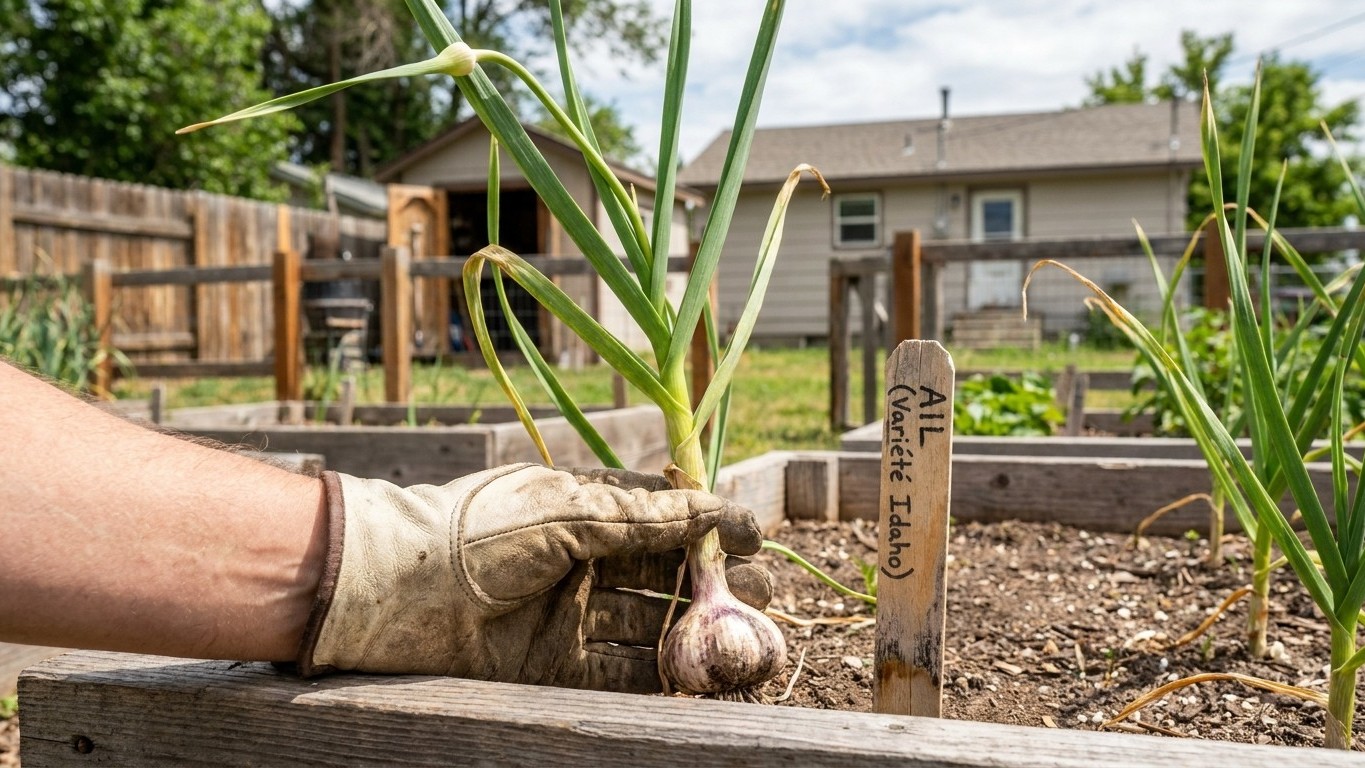

When’s the right time to put garlic in the ground in Idaho? Mid to late September, for almost everyone standing on a home garden plot from the Treasure Valley on out. That’s the stretch of soil-still-warm, frost-still-weeks-away weather that lets cloves grow roots before winter locks things down. Look up your area’s average first fall frost date, count back three to four weeks from it, and pick a planting day inside that window this week rather than waiting for the weather to make the decision for you.
The short answer for Idaho

For gardeners in and around the Treasure Valley, garlic cloves go into the ground in mid September to late September. That holds for softneck types like Inchelium Red and Lorz Italian and for hardneck types like German Red and Chesnok Red alike. Neck type changes storage life and cold hardiness after harvest, not when you plant in the fall. If you haven’t settled on a variety yet, Garlic Varieties That Suit Idaho Winters walks through the differences in flavor and keeping quality between the two groups.
Why mid to late September
The date is anchored on Boise’s first fall frost, which NOAA’s 1991-2020 Climate Normals put at October 7 to October 21 for station USW00024131 in the Treasure Valley. Growers count back three to four weeks from that window because garlic needs time to grow roots before the soil chills hard, but not so much time that top growth pushes through the surface and gets caught by an early hard freeze. This assumes the bed is already prepped, a step covered in Growing Garlic in Idaho.
Treat the frost date as a midpoint
A first-frost figure built from thirty years of data is a midpoint, not a promise. In roughly half of those years, the first freeze at the Boise station arrived after October 21, and in the other half it arrived before October 7. Planting inside the mid-to-late-September window gives cloves a buffer on both sides of that spread, rather than gambling on the average holding true this particular year.
Working it out for your own garden
The arithmetic behind Idaho’s planting window is simple once you have a local frost date: take the average first fall frost for your area and count back three to four weeks. That’s the same math behind the mid-September-to-late-September range used for every cultivar on this list, from Bavarian Purple to Georgian Crystal, because it’s built from the local frost window, not from the plant itself.
The count-back arithmetic
Boise’s figure comes from NOAA’s 1991-2020 Climate Normals at station USW00024131, sited in a low valley in the Treasure Valley. Most of Idaho sits at higher elevation and colder than Boise, with a shorter growing season, so a grower on the Palouse or in a mountain valley should expect their own count-back date to land earlier in September, not on the same week as the Boise range. Confirm your own area’s first-frost figure before you count back, since a date built on someone else’s climate isn’t a date at all.
Local factors that shift the count
A single state figure never describes every garden in it. The table below lists the factors that push a local frost date earlier or later than a regional average, and what each one means for a planting decision.
| Local factor | Typical effect on fall frost timing | What it means for your planting date |
|---|---|---|
| Elevation gain | Higher ground cools faster and holds less heat overnight | Count back closer to four weeks, and check soil temperature in early September rather than waiting for mid-month |
| Large lake nearby (Pend Oreille, Coeur d’Alene) | Open water releases stored heat and can delay the first freeze | Shoreline gardens can often hold to the later half of a local planting window |
| Valley floor or cold-air drainage | Cold air pools in low spots on clear, calm nights | A garden at the bottom of a slope frosts before one higher up on the same property |
None of these effects come with a single published adjustment size for the whole state, so use the Boise-based window as a reference point rather than a rule, and check county-level figures through the extension service before locking in a date.
What changes across Idaho
Idaho’s growing conditions are not one climate stretched over a large map. The Snake River Plain, running from Twin Falls through Boise to Idaho Falls, holds the state’s lowest elevations and its longest frost-free stretch, and it’s the closest match to the Boise-based window used above.
Where the season runs longer
North Idaho’s Panhandle, around Coeur d’Alene and Sandpoint, sits close to large lakes that moderate temperature swings through fall. That tends to soften the timing of the first hard freeze compared with inland valleys at a similar latitude, though growers there should still confirm timing locally rather than borrowing the Treasure Valley figure.
Where it runs shorter
Idaho’s mountain valleys, Stanley and the Sawtooth basin among them, sit at far higher elevation and are known for some of the coldest overnight lows in the country even in midsummer. Garlic in these pockets should go in on the early edge of any count-back window, since a hard freeze can arrive well before the state’s lower valleys see one. Eastern Idaho, around Idaho Falls and Rexburg, also sits higher than Boise on the eastern edge of the Snake River Plain and typically runs colder overnight through fall. Growers in these districts should plan toward the early half of a locally confirmed window, not the late half.
The mistakes this climate punishes
Some garlic mistakes cost a little vigor. In Idaho’s fall-to-freeze window, a few of them cost the whole crop.
Timing and depth
Planting too late is the most common failure. A clove set into ground that has already cooled hard doesn’t have time to grow the root system it needs before winter, and it comes up weak and small the following summer, or not at all. Waiting for an actual frost as the signal to plant is waiting too long, since roots should already be established well before top growth appears.
Planting too shallow is the second. Idaho’s dry, exposed winter soil pulls moisture out of a shallow-set clove faster than one buried a few inches deep under mulch. Freeze-thaw cycles common on the state’s clay and silt soils can heave a shallow clove partway out of the ground over winter, and skipping mulch entirely in the coldest districts, mountain valleys like Stanley in particular, compounds both problems at once.
Disease risk from seed stock
Disease is the mistake that doesn’t show up until the following summer, and it usually starts with the seed garlic itself. According to UC IPM’s Pest Management Guidelines for Onion and Garlic (UC ANR Publication 3453), white rot, caused by the fungus Sclerotium cepivorum, is active across a published soil temperature range of 50 to 75°F. Boise’s mean air temperature falls inside that range across five months of the growing season, including September and October, the exact months garlic goes into the ground and starts rooting. Fusarium basal rot, caused by Fusarium oxysporum f. sp. cepae, has a published range of 59 to 90°F, and Boise’s mean air temperature falls inside it across four months, including September.
These are air-temperature counts measured against soil-temperature thresholds, and soil lags air by weeks and swings less than air does, so treat the overlap as a sign that conditions can support disease, not a forecast that it will appear. The reverse is also true: a month outside either range doesn’t mean the disease can’t take hold, since infected seed garlic carries both pathogens into any soil regardless of the calendar. Boise’s figures also come from one reference station in one valley, and a colder mountain garden will see a different overlap, though the underlying risk from infected planting stock doesn’t change with elevation. The real defense is starting with certified, disease-free seed garlic and skipping any clove saved from a bed that showed stunted or yellowing plants the year before.
Checking this against your county
Every figure above is built from one weather station in the Treasure Valley, and Idaho’s climate doesn’t hold still across the state. For a planting window matched to your own county, contact University of Idaho Extension, which maintains county offices with local frost and soil data more specific than any single statewide figure can be. Use their county contact to confirm your own first-frost range before counting back the three to four weeks that sets your planting date.
Common questions
Can I still plant garlic if I missed the mid to late September window?
You can plant into early October in the lower valleys and still get roots established before Boise’s typical frost window of October 7 to October 21, NOAA’s 1991-2020 Climate Normals. Past that, expect weaker root development and a smaller bulb the following summer, especially at higher elevations where the season closes sooner.
Does it matter if I plant hardneck or softneck earlier or later within the window?
No, both types follow the same count-back window, since planting time is set by soil temperature and root growth, not by neck type. Hardneck and softneck garlic differ in cold hardiness and storage life after harvest, not in when the clove needs to go into fall ground.
What happens if I plant garlic too early, before mid September?
Cloves planted while soil is still warm can push up green top growth before winter, and that growth is vulnerable to being damaged once a hard freeze does arrive. It doesn’t usually kill the plant outright, but it wastes energy the clove needed for root and bulb development instead.
Do I need to mulch garlic after planting in Idaho?
Mulch is worth adding in most of the state, and especially in colder districts, because it buffers the freeze-thaw cycles that can heave a shallow-set clove out of the ground over winter. A few inches of straw or shredded leaves after planting is enough for most home gardens.
Some gardeners also time this by the Moon: when to plant garlic by the moon, as almanac tradition rather than fact.