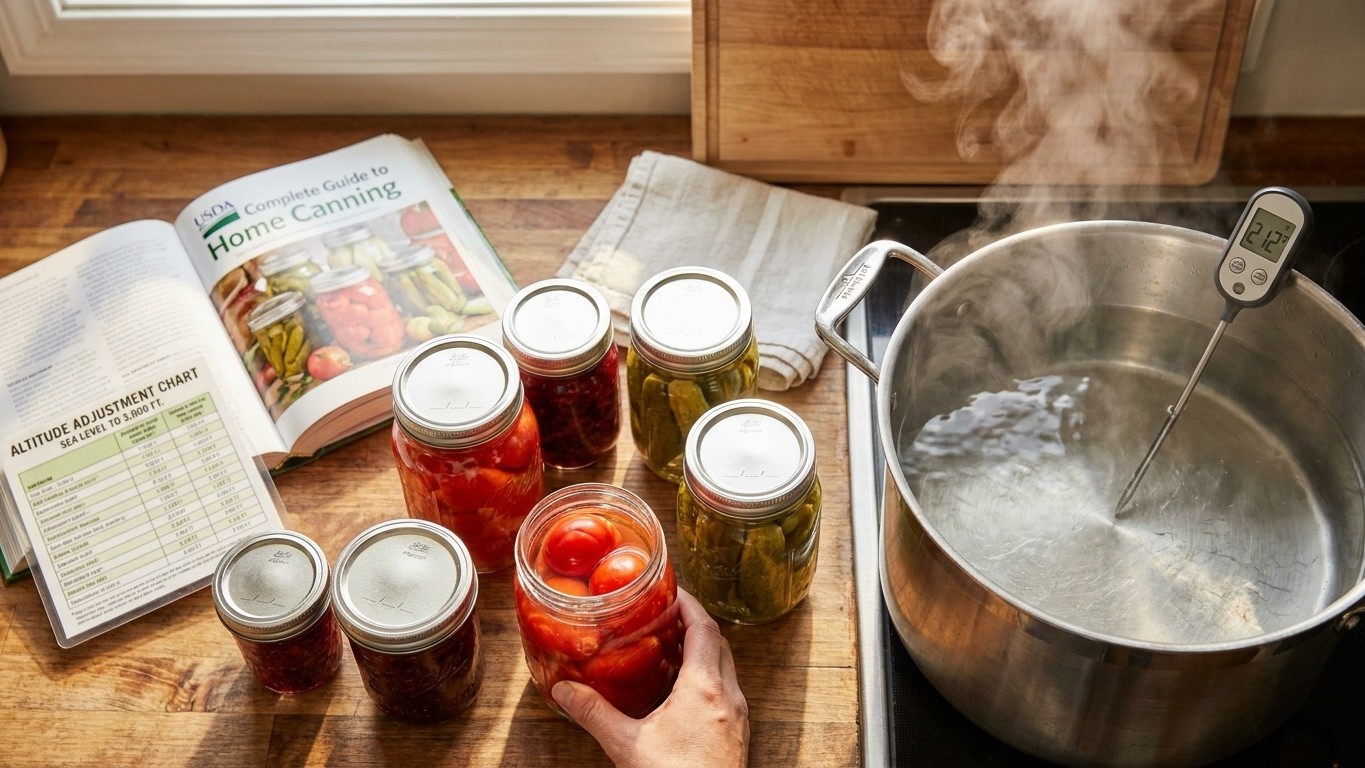

Michigan spans lowland shorelines and higher inland ridges, but for canning purposes what matters is your own kitchen’s elevation, not a statewide average. Most of the Lower Peninsula sits low enough that standard boiling-water and pressure canning guidance applies without any adjustment. Higher pockets of the state change the math, and the only way to know which category you fall into is to check your own number.
The short answer

Detroit sits at roughly 600 feet of elevation. At that height, water boils somewhere between 208°F and 212°F, according to the USDA Complete Guide to Home Canning as published by the National Center for Home Food Preservation. That range brackets the 600-foot mark because the guide publishes boiling points in bands rather than at every single foot of elevation, and 600 feet falls inside the 0 to 2,000 foot band where the standard process times and pressures given in tested recipes apply as written.
That’s the reference point, not the rule for every kitchen in the state. Detroit is named here because it’s a large, well-known city with a documented elevation, useful as an anchor for readers trying to picture where they stand. But Michigan is not one elevation. The Keweenaw Peninsula, the higher terrain around parts of the northern Lower Peninsula, and pockets of the Upper Peninsula all sit at different heights than the Detroit metro area, and some of them cross into the next altitude band where canning guidance changes.
What “changes anything” actually means
For a boiling-water canner, the 0 to 2,000 foot band is the baseline: the times printed in a tested recipe are the times you use, full stop. Cross above 2,000 feet and the guidance shifts, because water boiling at a lower temperature processes food less aggressively, so the time has to stretch to compensate. For a pressure canner, the shift happens even at modest elevation gains, because pressure canning guidance often starts adjusting above 1,000 feet depending on the gauge type.
So if your home sits near sea level or in that 0 to 2,000 foot band like the Detroit reference point, the answer is simple: follow the recipe as written. If you’re higher, even by a few hundred feet past that threshold, the answer changes, and the rest of this guide walks through why and what to do about it.
Why a lower boil is a weaker process
Water’s boiling point drops as elevation climbs. At sea level it’s 212°F. Climb to 10,000 feet and it drops to 194°F. That’s not a rounding error, it’s an 18-degree gap, and every degree matters when the entire purpose of canning is heating food hot enough, long enough, to destroy the organisms that make it unsafe.
Here’s the part that trips people up: boiling water harder doesn’t make it hotter. Once water reaches its boiling point at a given elevation, cranking the burner to a rolling boil instead of a gentle one changes nothing about the temperature. Water at a vigorous boil in Denver is exactly as hot as water at a lazy boil in Denver. The energy just goes into producing more steam, not a higher temperature. That single fact undoes a lot of kitchen instinct, because “boil it harder” feels like it should help. It doesn’t.
A cooler boil is a weaker process because heat is what does the work of destroying Clostridium botulinum spores and other organisms in low-acid and acidified foods. A jar processed at 194°F for the same length of time as one processed at 212°F has received meaningfully less lethal heat, even though both sat in “boiling” water for the identical number of minutes. The water was boiling in both cases. It just wasn’t boiling at the same temperature.
Two things compensate for that gap, and tested recipes build them in once you tell them your elevation. In a boiling-water canner, the fix is more time. The jars stay in the boiling water longer, because more time at a lower temperature can deliver the equivalent heat treatment the recipe was designed to achieve. In a pressure canner, the fix is more pressure. Raising the pressure inside the canner raises the temperature the steam reaches, letting the process hit the correct internal temperature even though the surrounding air pressure outside the canner is lower. Neither fix is optional, and neither one is something to estimate by feel. They come from published tables matched to your specific elevation band, not from adding a few extra minutes because it seems safer.
Finding your own elevation
The Detroit figure above is a reference point, not a stand-in for your address. Before touching a canning recipe, find your own elevation using these steps in order.
- Start with the National Center for Home Food Preservation’s “Find Your Elevation” page, built specifically for canners who need this number and don’t know it offhand.
- Enter your city, town, or zip code as prompted rather than guessing based on a nearby landmark, since elevation can shift noticeably within a few miles, especially near lakeshores or river valleys.
- Note the figure in feet, not meters, since every canning table in USDA and NCHFP guidance is published in feet.
- Round up if your number falls near a band boundary. If you’re at 1,950 feet, treat yourself as being in the higher band rather than assuming you just squeaked under it. Elevation tools carry some margin of error, and canning safety isn’t the place to bet on the low side.
- Write that number down somewhere you’ll actually see it again, next to your canning recipes or on the inside of a cabinet door. You’ll need it every time you can, not just once.
This step takes less time than washing a single jar, and it’s the one piece of information every tested recipe needs before it can tell you anything useful about how long to process or how much pressure to run.
What goes wrong
- An under-processed jar that looks perfect. A jar sealed at the wrong altitude adjustment can look, smell, and taste completely normal, seal included, while still harboring live spores. The fix isn’t a visual check, it’s using the correct time or pressure for your elevation band from the start, every time, no exceptions for jars that “seem fine.”
- A recipe pulled from a sea-level source. Family recipes, older cookbooks, and recipes shared from friends in coastal states are often written for the 0 to 1,000 foot range and never mention altitude at all. The fix is treating any recipe without an elevation note as incomplete, and cross-referencing it against a current NCHFP or USDA table before using it above 1,000 feet.
- A pressure gauge read as if elevation didn’t exist. Dial gauges and weighted gauges both need elevation-specific pressure settings, and a canner set to sea-level pressure at a higher-elevation home will process food incorrectly even if the gauge needle looks steady and correct on the dial. The fix is checking the pressure table for your specific elevation and gauge type before you seal the lid, not adjusting by habit from a canner you used somewhere else.
- Assuming a small elevation gain doesn’t count. Some canners assume altitude adjustments only matter in mountain states, and skip the check entirely in a state like Michigan. The fix is checking regardless of how “flat” the state feels, since local terrain, not state reputation, determines your actual number.
Where the exact adjustment comes from
This page won’t hand you a processing time or a canner pressure, and that’s deliberate. The correct adjustment depends on the specific food, the recipe, the jar size, and your elevation together, and that combination only lives inside a tested recipe published by an authority that has actually validated it under lab conditions.
For that, go to the National Center for Home Food Preservation and match your food, your elevation band, and your canner type to the table built for that exact combination. The reason this matters more than it might seem: botulinum toxin has no taste and no smell. A jar that’s under-processed for its elevation gives you no warning sign at all, which is exactly why the adjustment has to come from a tested source rather than a guess, a family habit, or a recipe that never mentioned altitude in the first place.
Common questions
Does Michigan count as a high-altitude state for canning?
No single answer covers the whole state. Most of the Lower Peninsula, including the Detroit reference point at 600 feet, falls within the 0 to 2,000 foot band where standard sea-level guidance applies. Some higher inland and Upper Peninsula locations sit high enough to need the adjusted times or pressures used above that band.
Do I need to adjust water-bath canning the same way as pressure canning?
Both need adjustment as elevation rises, but the thresholds differ. Boiling-water canning typically starts adjusting above 2,000 feet, while pressure canning guidance often begins adjusting at a lower threshold depending on the gauge type, so check both separately rather than assuming one covers the other.
What if my elevation falls right between two bands?
Treat yourself as belonging to the higher band. Elevation-finding tools carry some margin of error, and using the lower band’s shorter time or weaker pressure when you’re actually in the higher band risks an under-processed jar with no visible sign of the problem.
Can I just add a few extra minutes to be safe instead of looking up the exact adjustment?
No. Guessing at extra time doesn’t reliably compensate for the actual temperature gap at your elevation, and it isn’t tested the way the published tables are. The safe path is matching your specific elevation and food to the corresponding NCHFP or USDA table, not estimating a buffer.