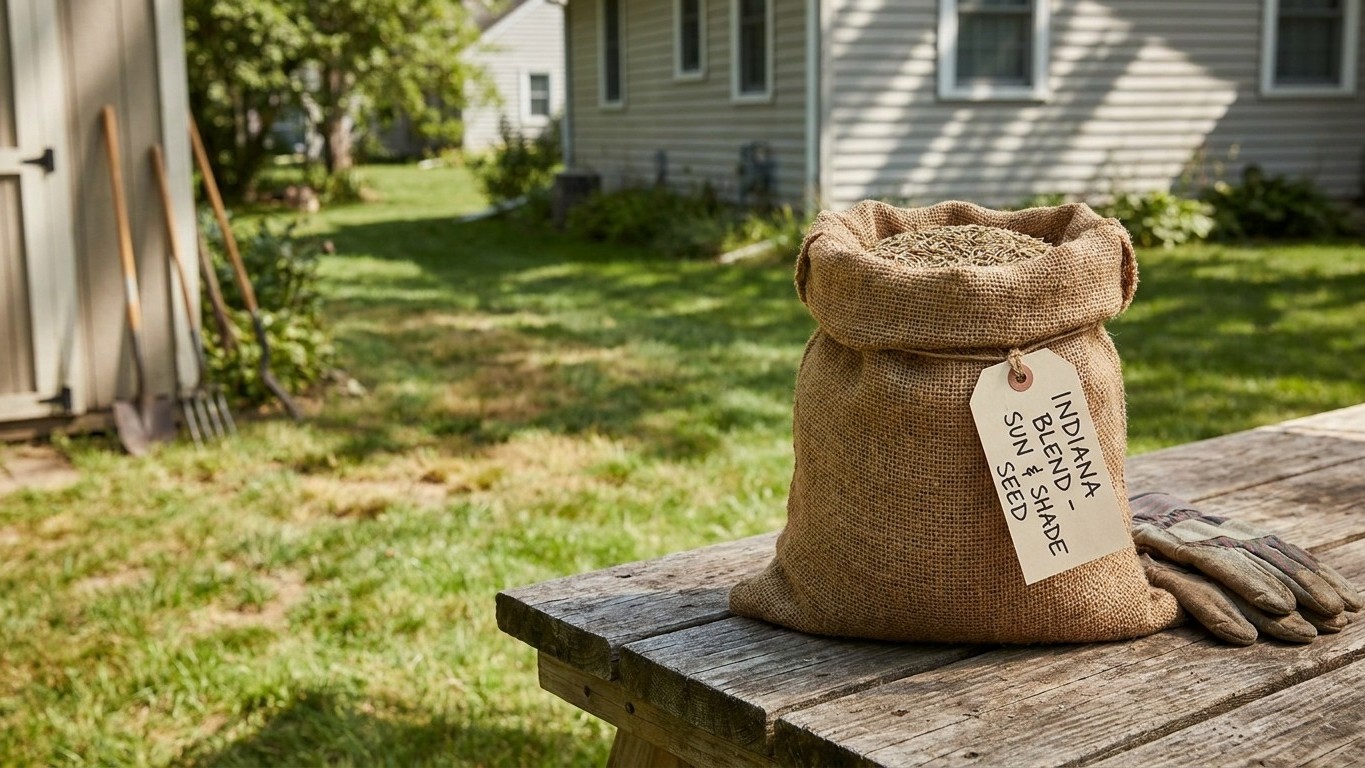

Indiana’s lawn problem starts with the zone: it’s cool-season country, full stop, so nothing labeled for a Georgia or Texas yard belongs in your bag, no matter how good the photo on the front looks. The seed that actually takes here is some combination of Kentucky bluegrass, tall fescue, perennial ryegrass, fine fescue, or rough bluegrass — five grasses, not one, and which of them carries your lawn depends on how much sun it sees and how hard it gets walked on. Go stand in your yard and check both before you buy anything.
The short answer for Indiana
Indiana falls in the cool-season turf zone, a label read off the Indianapolis climate normals against the season tolerances published by Clemson Cooperative Extension (HGIC 1214). That points to five workable species: Kentucky bluegrass, tall fescue, perennial ryegrass, fine fescue, and rough bluegrass, the same list Clemson and Penn State Extension both give for a climate with cold winters and a hot, often dry midsummer. A warm-season lawn built on bermudagrass, zoysia, or centipede simply does not hold through an Indiana winter, so none of those belong in this answer.
Which of the five cool-season species you actually want depends on what the lawn has to put up with. A yard in full sun that takes heavy foot traffic does best with a bluegrass-heavy blend or a turf-type tall fescue. A yard shaded by mature trees leans toward fine fescue or rough bluegrass instead. Most bagged mixes sold at Indiana garden centers already combine two or three of these species for exactly that reason, so a single bag rarely contains just one grass.
Indianapolis is a reference point, not a guarantee for the whole state. The zone assignment can shift toward either end of Indiana or near Lake Michigan, which the section below on regional differences covers directly. Once the species is chosen, the ongoing feeding and mowing routine that keeps it alive is covered in Indiana Lawn Care.
Working through the year

None of the five cool-season species is a single “best” pick for Indiana. Each buys you something and costs you something else, and the trade lands differently depending on sun, soil, and how much time you want to put into the lawn.
| Species | Sun/shade | Wear tolerance | Drought tolerance | Establishment |
|---|---|---|---|---|
| Tall Fescue | Full sun to light shade | High | Best of the five | Slower, bunch-type |
| Kentucky Bluegrass | Full sun | Moderate, self-repairs | Low without irrigation | Slow to germinate |
| Perennial Ryegrass | Full sun | Moderate | Weak | Fastest of the five |
| Fine Fescue | Shade tolerant | Low | Moderate | Moderate |
| Rough Bluegrass | Deep shade, wet soil | Low | Weakest of the five | Moderate, spreads by stolons |
Tall Fescue

Tall fescue is the workhorse choice for a lawn that gets real use. It carries the deepest root system of the cool-season group and holds up best through the dry stretch of an Indiana summer. It grows in clumps rather than spreading by rhizome, so a lawn seeded from a single tall fescue variety thickens slowly and benefits from yearly overseeding to fill in bare patches. Clemson Cooperative Extension’s Tall Fescue Maintenance Calendar (HGIC 1219) lays out mowing height, nitrogen timing, and overseeding windows month by month for this exact species, and the same rhythm applies to a tall fescue lawn in Indiana since Clemson publishes its calendars by species, not by state; the month-by-month version worked out against Indiana’s own frost dates is in The Indiana Lawn Care Calendar, Month by Month.
Kentucky Bluegrass

Kentucky bluegrass spreads by underground rhizomes, so it self-repairs after wear in a way tall fescue cannot, and it is behind the classic dense, dark green home lawn look. The trade is water. Bluegrass goes dormant and browns quickly once a dry spell sets in, and it wants more irrigation than tall fescue to stay green through midsummer. Seed also germinates more slowly than the other four, often taking several extra weeks to show a full stand.
Perennial Ryegrass

Perennial ryegrass is the fastest-germinating cool-season species by a wide margin, which makes it useful as a nurse grass mixed into a bluegrass or fescue blend to hold soil while the slower species come in. On its own it has weak heat and drought tolerance and thins out over an Indiana summer, so it is rarely the whole lawn, just part of the bag.
Fine Fescue

Fine fescue is really a group of related species, including hard fescue, chewings fescue, and creeping red fescue, and it is the most shade-tolerant grass on this list along with having the lowest fertility needs. It does not hold up to heavy foot traffic or Indiana’s humid midsummer stretch as well as tall fescue does, so it earns its place under trees rather than on a play lawn.
Rough Bluegrass

Rough bluegrass, also sold as Poa trivialis, is a specialist for wet, deeply shaded spots where little else will hold, spreading by above-ground stolons into a thin, light green turf. It has the weakest drought tolerance of the five and will not survive as a general lawn grass out in open Indiana sun.
What changes across Indiana
The cool-season zone assignment above is read off Indianapolis, and the rest of the state does not move in lockstep with it. Northern Indiana, near Lake Michigan around Michigan City and South Bend, gets a lake-effect boost of humidity and snow cover that keeps soil temperatures colder into spring and tends to push the fall seeding window a little earlier than the Indianapolis dates. Southern Indiana, toward the Ohio River counties, runs the other direction. NOAA’s climate normals note that southern Indiana’s frost dates fall earlier in spring and later in autumn than the north, often by two weeks or more, which stretches the safe fall-seeding window by roughly that same margin.
That regional spread matters most for two decisions: when to put seed down in fall, and how much drought stress a lawn takes in July and August. A southern Indiana lawn gets a longer autumn to establish tall fescue or bluegrass before winter, and also tends to face a hotter, longer dry stretch in summer, which tips the choice further toward tall fescue’s deeper roots over bluegrass’s shallower ones. A northern Indiana lawn works on a tighter fall calendar but usually gets a milder summer in return.
None of this is elevation-driven the way it would be in a mountain state. Indiana’s spread comes from latitude and the lake, not altitude. Treat the Indianapolis dates as a starting point and shift the calendar earlier near the lake or later near the Ohio River. Local soil shapes the picture too: heavier clay soils common across central Indiana hold moisture and cool more slowly in fall than the sandier soils found in parts of the north, which nudges the best seeding day within the general window already given, not outside it.
The mistakes this climate punishes
The single most common error in Indiana is seeding a cool-season lawn in late spring instead of fall. Seed put down in May germinates fine in the mild weeks that follow, but the young roots have only a few weeks to establish before real summer heat arrives, and a thin, patchy stand by July is the usual result. Fall seeding, timed against NOAA’s 1991-2020 Indianapolis frost window of October 21 to October 30, gives roots the whole autumn and much of a mild winter to establish before the seedlings ever face summer stress.
A close second is planting a warm-season species like zoysia or bermudagrass on the assumption it needs less water. Both go brown at the first hard frost, which is normal dormancy for a grass built for a warm-season climate, but neither is a species that will reliably survive an Indiana winter, and the damage shows the following spring as bare ground that never greens back rather than turf simply breaking dormancy.
Cutting a cool-season lawn too short during a hot, dry stretch is the third recurring mistake. Scalping removes the leaf tissue the plant needs to shade its own crown and roots, and the damage shows within one to two weeks as a lawn that browns faster and recovers slower than a neighbor’s cut higher through the same dry spell.
- Spring-seeded cool-season lawn: thin and patchy by the first hot week of summer
- Warm-season grass planted in Indiana: bare, dead turf the spring after its first hard winter
- Scalped mowing in a dry summer: browning and slow recovery within one to two weeks
Checking this against your county
Every figure above is measured at or near Indianapolis, and a county at either end of the state, or close to Lake Michigan, can run a week or two ahead or behind it in either direction. Before buying seed or setting a fall date, check the county-level guidance from Purdue Extension, which keeps local frost data, soil test information, and species recommendations specific to each Indiana county. If a lawn is already established and it is just the next step you need, Indiana Lawn Care covers the routine that keeps whichever species you seeded alive from one year to the next.
Common questions
Can I overseed in spring instead of waiting for fall?
You can put seed down in spring, but it germinates into weaker turf than fall seeding because the roots have only a short window before summer heat sets in. Fall seeding against the Indianapolis frost window gives cool-season grass a full autumn and a mild winter to establish first.
Why does my new grass look thin and pale all winter?
A first-year cool-season lawn, especially tall fescue, often looks sparse through its first winter because the plant is still building roots below ground rather than leaf above it. That thin look is not a sign of failure on its own, and a lawn seeded on schedule usually fills in by the following spring.
Will zoysia or bermudagrass work anywhere in Indiana?
Not reliably as a general lawn choice. Indiana sits in the cool-season zone based on the Indianapolis climate normals, and a warm-season grass planted here typically fails to survive winter rather than simply going dormant. Check with Purdue Extension for your specific county before betting a lawn on a warm-season species this far north of its usual range.
My lawn turned brown in August. Is it dead?
Probably not. Cool-season grasses like Kentucky bluegrass and tall fescue often go dormant and brown during a dry midsummer stretch as a survival response, not death, and they typically green back up once rain returns. A lawn that stays brown well into fall, after temperatures have cooled and rain has returned, is the one worth digging into further.