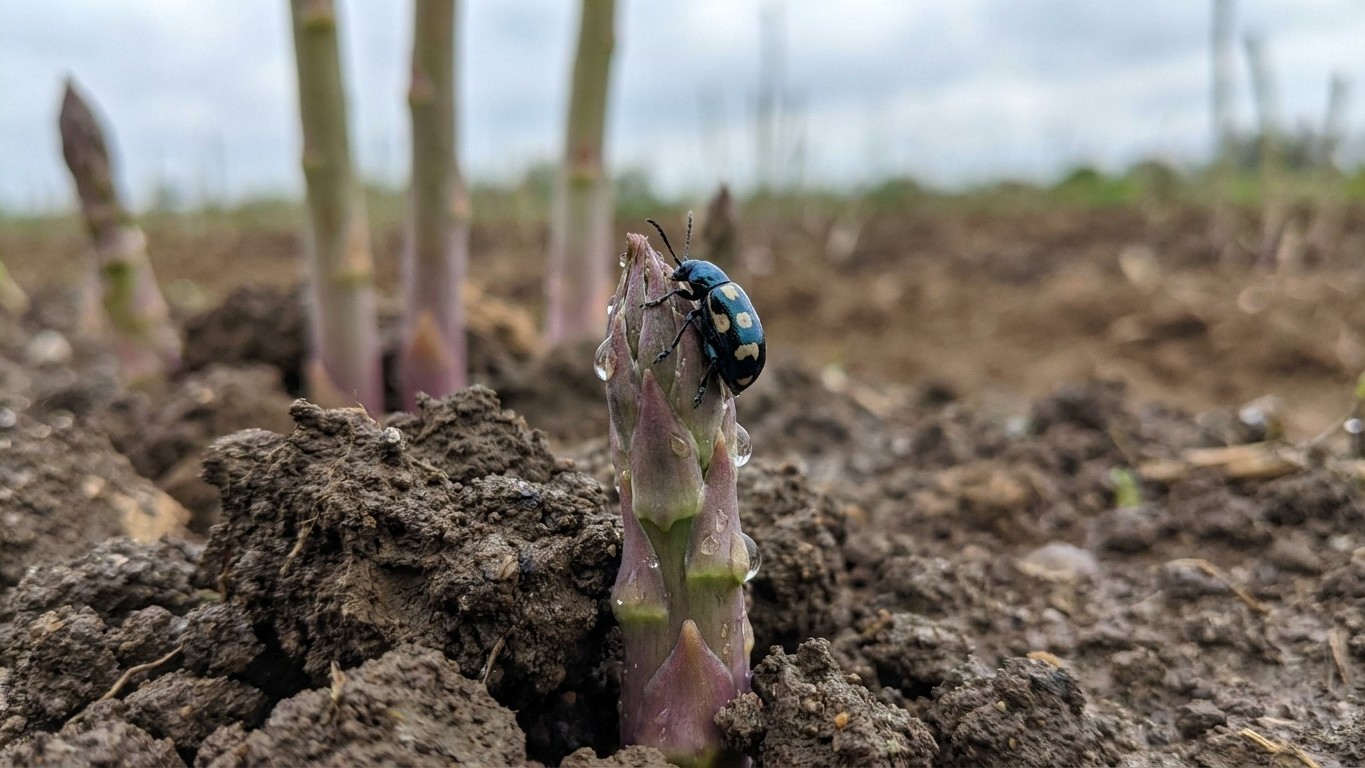

Asparagus beetle shows up in Indiana gardens right as the first spears push through the soil, typically late April into early May, and it keeps feeding on foliage clear through summer. Row covers, hand-picking, and fall cleanup stop it cold if timed to soil temperature rather than the calendar.
When Asparagus beetle turns up in Indiana

Purdue Extension Entomology tracks this pest directly and gives it a specific window: asparagus beetle emerges late April to early May, arriving right alongside cabbage maggot as one of the season’s earliest visitors. That timing lines up with the moment asparagus crowns send their first spears above ground, which is exactly the food source the overwintered adults are waiting for.
A season that runs long, not short
The broader pattern Purdue lays out for Indiana vegetable gardens runs from late April through September, and asparagus beetle sits at the front end of that stretch. Once adults find spears, they lay eggs almost immediately, and a second generation typically follows before the season winds down. That means a garden clear of beetles in May can still see a fresh wave by midsummer, feeding on the fern-like foliage that develops once spear harvest ends.
Purdue’s publication doesn’t hand out a single-day arrival date, and neither should any gardener trust one. The late April to early May window is a range because spring itself is a range in Indiana. A cold snap that lingers into the first week of May pushes emergence back; a warm March that softens soil early can bring beetles out before most gardeners have even checked their asparagus bed. Treat the window as a planning tool, not a countdown.
Reading the calendar from your last frost
Indianapolis sees its last spring frost somewhere between April 9 and April 21, based on NOAA’s 30-year climate normals for that station. That range matters here because asparagus beetle answers to soil warmth, not to a date on a wall calendar. An early frost-free stretch warms the crown and triggers spear emergence sooner, which pulls beetle activity forward with it. A late, cold spring does the opposite.
Why “weeks after transplanting” doesn’t quite apply
Most vegetable-pest timing gets measured in weeks after transplanting, but asparagus isn’t replanted each year the way tomatoes or peppers are. A bed established from crowns keeps producing for over a decade, so the relevant marker isn’t transplant day, it’s spear emergence day. Once spears break the surface, that’s the signal to have covers ready, not a fixed number of weeks counted from any single date.
Purdue adds a caution worth keeping in mind on the early edge of the frost range: there’s still roughly a 10% chance of a 32-degree freeze event after the published last-frost date. A gardener who uncovers a bed on April 10 because the calendar says spring has arrived may still get caught by a cold snap, and so might the beetles, whose activity slows right along with the cold soil. South of Indianapolis, spring arrives earlier and this whole window shifts forward by two weeks or more; north of the city, expect the opposite lag.
What it attacks, and what the damage looks like
Asparagus is the only crop this beetle bothers in an Indiana vegetable garden, but the damage shows up in two very different forms depending on when in the season you’re looking. Early in spring, harvested spears develop scarred, brownish patches and small notches where adults have fed directly on the tender tissue meant for the table. That cosmetic damage alone can make spears unmarketable even when the plant itself is fine.
The foliage stage does more lasting harm
Later in the season, once spears have grown out into their feathery, fern-like foliage, the damage shifts to defoliation. Leaves take on a lace-holed, skeletonized look, and in heavy infestations entire fronds can turn gray-green and die back. That matters more than it sounds, because asparagus ferns aren’t decorative, they’re the plant’s solar panels, rebuilding the root reserves that produce next year’s spears. Strip the foliage repeatedly and the bed’s future harvests shrink along with it.
Both adults and larvae feed on the plant, but they favor different life stages of the asparagus itself. Adults target the fresh spears in spring, doing the cosmetic scarring gardeners notice first. Larvae, which hatch from eggs the adults glue to spears and foliage, do the bulk of the defoliation on the ferny growth that follows. Knowing which stage caused which damage matters because a gardener who spots scarred spears in early May is dealing with adults, while lace-holed foliage in July points to larvae already at work, and the two call for different responses timed to different points in the beetle’s life cycle.
How Indiana sits in this pest’s range

Asparagus beetle is documented in 2 territories on this site, and Purdue Extension Entomology serves as the direct, named source for Indiana’s guidance rather than data borrowed from a neighboring state. With only two territories currently covered, there isn’t enough of a spread here to describe Indiana’s position within a wider regional pattern, and no ranking or severity comparison can honestly be drawn from that count.
What can be said is narrower and more useful: Purdue’s own publication ties asparagus beetle emergence to Indiana’s specific spring conditions, late April to early May, rather than pointing to guidance developed elsewhere and applied here after the fact. That’s a distinction worth noticing, since so many home-garden pest calendars get borrowed from a neighboring state’s extension service and stretched to fit. This one didn’t need to be.
What actually works against it
The cheapest defense is timing the harvest window itself, since a few well-timed steps do more than any spray.
- Fall cleanup of old fern debris: because adults overwinter in old plant debris and become active as soon as spears emerge, clearing dead fern growth out of the bed each fall removes a big share of their winter shelter before the first frost even locks in, and it costs nothing but an afternoon while directly cutting the population that shows up the following April.
- Row covers timed to spear emergence: covers work by physically blocking adults from reaching emerging spears and laying eggs on them, but the mechanism only holds while the cover stays sealed at the edges and goes on before beetles arrive, since once adults or eggs are already inside the cover stops helping and can even trap the problem with the plant.
- Daily hand-picking during peak emergence: this remains effective specifically because both the adults and the slug-like larvae feed in plain sight on the outside of spears and foliage, unlike borers that tunnel into stems where nothing short of removing the plant reaches them, so a daily walk-through knocking beetles into a bucket keeps numbers down at almost no cost, though it demands consistency rather than a one-time pass.
- Sanitation in place of crop rotation: because asparagus beds stay in place for ten to fifteen years or longer with no annual replanting to rotate, the practical substitute is pulling and destroying fern debris each fall and avoiding letting volunteer asparagus seedlings sprout uncontrolled at the bed’s edges, since those seedlings give beetles an easy early foothold before the main planting even breaks dormancy.
Common questions
Does asparagus beetle damage the roots or crowns?
No. Feeding by both adults and larvae stays on the spears and foliage above ground. The crown and root system aren’t directly attacked, though repeated defoliation weakens the plant’s ability to rebuild root reserves for future seasons.
Can I still eat spears with beetle scarring?
Scarred spears are safe to eat; the damage is cosmetic surface feeding, not contamination. Many gardeners simply trim the marked portion before cooking rather than discarding the spear.
Why does asparagus beetle come back every year in the same bed?
Because adults overwinter locally in garden debris close to the bed itself, an established asparagus planting that stays in one spot for over a decade gives the beetle a stable, undisturbed place to spend the winter unless that debris gets cleared out each fall.