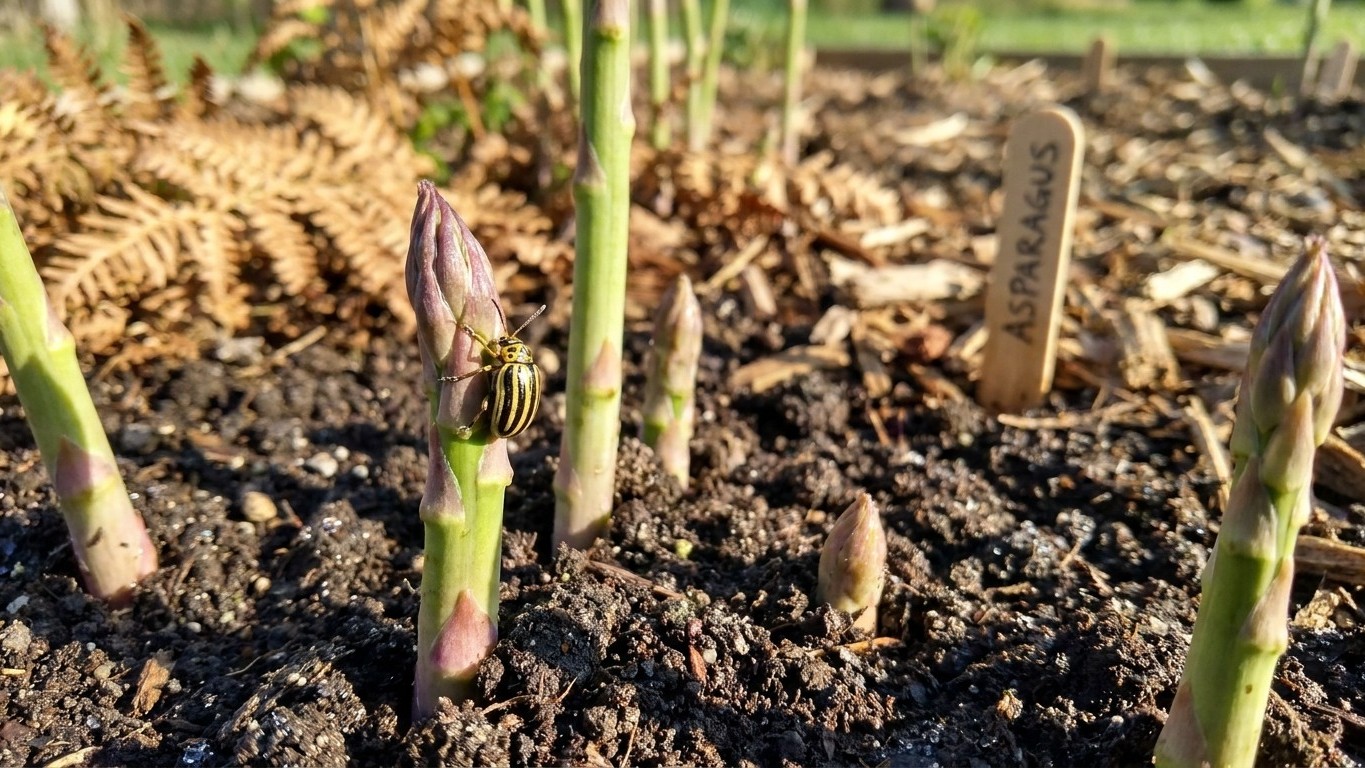

Asparagus beetles show up in Wisconsin gardens as soon as the spears start pushing through the soil in spring, and they keep coming back for a second round on the fern later in summer. Timing your first inspection to spear emergence, and clearing bed debris each fall, stops most of the damage before it starts.
When Asparagus beetle turns up in Wisconsin

The University of Wisconsin-Madison Division of Extension publishes a general activity window for home vegetable garden insects running from April through September, with a note that most corn pests don’t build up until mid-August and that squash vine borer damage shows by late July. That guidance, from A2088 Managing Insects in the Home Vegetable Garden, doesn’t spell out a separate calendar window specifically for asparagus beetle. So rather than invent a Wisconsin-specific date range for this one species, the honest answer is that the local extension service doesn’t publish one, and gardeners are left to work from the general pattern the insect follows everywhere it’s found.
That general pattern is straightforward. Adult asparagus beetles overwinter in plant debris, old fern stalks, and loose mulch left in or near the bed. When soil warms enough in spring to push spears above ground, the adults become active and move onto the first spears to feed and lay eggs. A second generation typically develops on the fern foliage later in the season, once the plant has finished producing harvestable spears and been allowed to grow tall. That means Wisconsin gardeners should expect two separate windows of activity in a single year rather than one short outbreak, the spring spear-feeding period and the summer foliage-feeding period.
Because the broader April-through-September window covers the entire active season for garden insects in the state, it’s reasonable to treat it as the outer boundary for asparagus beetle activity too, even without a dedicated citation. What falls inside that boundary, spring emergence versus summer foliage feeding, depends more on local spring warm-up than on the calendar page.
Reading the calendar from your last frost
Wisconsin’s last spring frost, per NOAA’s 1991-2020 climate normals for station USW00014839, falls between April 16 and April 29. That’s a range, not a single day, and it reflects the 30 to 70 percent freeze-probability band for the station, so treat it as a normal to plan around rather than a guarantee for any given year.
Asparagus beetles don’t check a calendar. They respond to soil temperature, and so does the asparagus crown itself. A warm early spring can push spear emergence, and beetle emergence with it, ahead of that April window; a cold, slow spring delays both. That’s why the frost date matters more as an anchor than as a prediction: it tells you roughly when soil is reliably warming, not exactly when the first beetle will appear on a spear tip.
For a newly planted or recently divided asparagus bed, visible feeding damage on the earliest spears tends to show up within the same stretch of days that the spears themselves break the surface, since the overwintering adults are already positioned nearby and simply walk or fly to the new growth as soon as it’s available. There’s no dependable interval to count forward from planting, because the crowns themselves don’t send up spears on a fixed schedule either; both respond to the same soil-warming cue. Practically, this means any physical barrier, like a floating row cover, needs to go on before spears break ground in that April-to-May stretch, and needs to come off again once harvest begins, since asparagus doesn’t get pollinated under cover and the fern needs open air to grow out properly later in the season.
What it attacks, and what the damage looks like
Asparagus beetle attacks exactly what its name suggests: asparagus, and nothing else in the vegetable garden. That narrow host range actually makes identification easier than for most garden pests, since if you’re seeing this kind of damage anywhere else in the yard, it’s not this insect.
What a gardener sees first
The symptom usually arrives before the insect gets noticed. On young spears, look for scarring, brownish-gray discoloration, or a tip that bends over in a shepherd’s-crook shape instead of standing straight. Damaged spears often look dried out or scorched at the tip even though the rest of the plant is green and healthy. Later in the season, once the harvested spears have been left to grow into tall, feathery fern, the damage shifts: instead of scarred tips, you’ll see foliage stripped down to bare stems, with the fine needle-like leaflets chewed away in patches.
Two different life stages cause these two different symptoms. Adult beetles, dark-colored with pale markings on their wing covers, do most of the direct feeding damage on the spears themselves in spring. The larvae, soft-bodied grayish grubs that hatch from eggs laid on the spears and later on the fern, do the bulk of the foliage stripping in summer. Because both stages feed out in the open, on the surface of the spear or the foliage, rather than tunneling inside the stem or root, physical removal by hand stays a workable option at almost any point in the season, which isn’t true for pests that bore into plant tissue.
How Wisconsin sits in this pest’s range

This pest is documented on two territories tracked on this site. That’s a narrow footprint compared to the widespread pests covered elsewhere in this series, and it puts Wisconsin near one edge of the range this site has data for, rather than sitting comfortably in the middle of it. A narrow range like this changes what the data can tell a gardener: with a genuinely widespread pest, the difference between one state and the next is mostly a matter of timing, when in the season the insect shows up, not whether it’s present at all. With a narrow range, presence itself is the more open question, and local extension guidance tends to be thinner as a result, which matches what A2088 shows: broad seasonal coverage for garden insects generally, but no dedicated Wisconsin-specific calendar entry for this particular beetle.
Practically, that means a Wisconsin asparagus grower is better served leaning on the general biological pattern (spring spear-feeding, summer foliage-feeding, overwintering adults in debris) than searching for a locally calibrated outbreak date that simply hasn’t been published. The state’s own extension service, University of Wisconsin-Madison Division of Extension, remains the right first stop for anyone who spots unfamiliar damage and wants a local read on it, even where the published material treats this insect as part of the broader home-garden pest picture rather than as a standalone entry.
What actually works against it
The cheapest, most effective steps against asparagus beetle rely on the same trait that makes it vulnerable: nothing it does happens hidden inside the plant.
- Fall and early-spring sanitation. Cutting down old fern stalks and clearing dead debris and mulch from around the bed removes the exact hiding spots overwintering adults use to survive the Wisconsin winter, so fewer adults survive to move onto spears the following spring.
- Hand-picking adults and crushing egg clusters on spears and foliage is slow, but genuinely effective here in a way it isn’t for pests that tunnel into stems or roots, because the beetle feeds and lays eggs out in the open, letting a gardener who checks every few days during spear emergence and again during summer foliage knock the population back both times, even after eggs hatch into still-visible larvae.
- Row covers over emerging spears block adults from reaching the plant in the first place, though only during the window before harvest starts, since they must come off once spears are cut for the table and again when the fern needs open access for growth and eventual pollination.
- Choosing a new, distant location when establishing a fresh asparagus planting stands in for crop rotation, which isn’t practical in a permanent perennial bed, and instead avoids reusing ground with a known beetle history.
None of these measures require identifying larvae hidden inside stems, because this species never gets there; the exposed feeding habit is the one consistent advantage a home gardener has against it.
Common questions
Does asparagus beetle damage kill established plants?
Rarely outright, but repeated foliage stripping over several seasons weakens the crown by cutting into the fern’s ability to photosynthesize and store energy for next year’s spears, which can reduce yield over time even if the plant survives.
Can I still eat spears that show feeding scars?
Scarred or discolored spear tips are typically trimmed off and discarded for appearance and toughness, but the damage itself doesn’t make the rest of the spear unsafe to eat.
Is it worth spraying young asparagus beds preventively before any beetles appear?
Sanitation and hand-removal address the population at its source, in overwintering debris and on exposed spears and foliage, which is why extension guidance for home gardens generally favors those cultural steps over routine preventive applications timed to a calendar rather than to actual sightings.