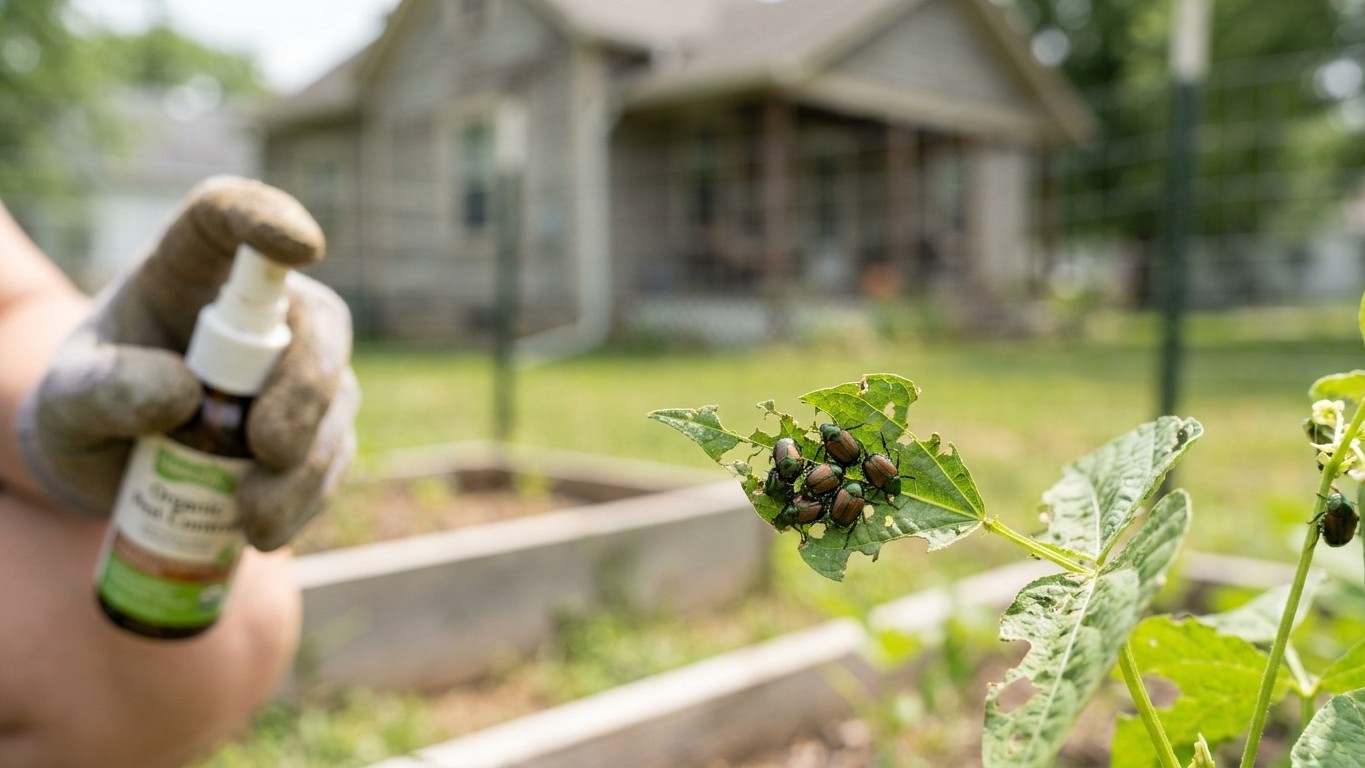

Indiana gardens deal with ten pests that Purdue Extension’s home vegetable garden bulletin flags as the ones worth watching, from Colorado potato beetle to brown marmorated stink bug. Purdue Extension puts the active season, measured near Indianapolis, at late April through September, with timing shifting earlier or later elsewhere in the state. Walk your rows twice a week starting in late April, checking the undersides of leaves, before reaching for any spray.
What Indiana gardens actually deal with

What’s actually eating your garden depends on the week you’re standing in it, but in Indiana the short answer is: ten insects do almost all the damage, and most of them announce themselves on the underside of a leaf before you ever see the harm on top. Colorado potato beetle, the Striped cucumber beetle in Indiana that growers watch for, the Squash bug in Indiana that turns up on vine crops, the Seedcorn maggot in Indiana that gardens see in cold wet springs, the Cabbage looper in Indiana that gardeners find on brassicas, the Mexican bean beetle in Indiana that growers spot on bean plantings, the Spotted cucumber beetle in Indiana that gardeners find alongside its striped cousin, and the Brown marmorated stink bug in Indiana that growers increasingly report — different pests, different months, same habit of hiding where you’re not looking. Start walking your rows twice a week from late April on, turning leaves over as you go, and you’ll catch trouble while hand-picking still solves it.
Seedcorn maggot

This one rarely gets seen as an adult, a small gray fly that looks like a shrunken housefly. The damage comes from the legless, yellowish-white maggot working underground, tunneling into germinating seeds and the base of young seedlings before they ever break the surface. Cold, wet soil in early spring slows seedling growth and gives the maggot more time to work, so a stand that comes up thin and gappy after a wet start is worth checking before you blame poor seed.
Asparagus beetle

Adults are blue-black with cream squares along the wing margins and a rust-red edge, about a quarter inch long. Purdue Extension notes they emerge late April into early May, right as spears push through the soil. The gray-green larvae feed on the ferny growth that follows harvest, and enough feeding weakens the crown for next year’s crop, not just this year’s spears.
Colorado potato beetle

The adult beetle is hard-shelled, yellow-orange with five black stripes running down each wing cover. It starts feeding on potato foliage as soon as plants emerge, and Purdue Extension counts two generations across a season in Indiana. The soft, reddish-orange, humpbacked larvae do the heaviest damage, stripping leaves down to the veins. Because many populations no longer respond to common home insecticides, hand-picking adults and crushing the yellow egg clusters on leaf undersides works better than reaching for a spray first.
Striped cucumber beetle

Bright yellow with three black stripes down its back, this beetle shows up as soon as cucumber, squash and melon seedlings emerge. Adults chew ragged holes in leaves and can girdle young seedlings at the stem, but the bigger risk is the bacterial wilt the beetle spreads while it feeds.
Spotted cucumber beetle

Similar size and habit to its striped cousin, but yellow-green with eleven black spots instead of stripes. It feeds on the same cucurbit leaves and flowers and causes the same wilt problems, so treat the two as one management issue rather than trying to tell them apart in the field.
Squash bug

Adults are flat-backed, grayish-brown and about five-eighths of an inch long. Nymphs are gray with black legs and cluster in tight groups on leaf undersides. Both stages pierce leaves to feed, leaving yellow speckling that turns brown and collapses, and a heavy population can wilt an entire squash vine.
Squash vine borer
The adult is a day-flying moth with an orange and black body that reads as a wasp at a glance. It lays eggs at the base of squash and pumpkin stems, and the cream-colored larva bores inside, feeding unseen until the vine wilts suddenly, often after the damage is already done.
Mexican bean beetle
This copper to yellow-brown beetle with sixteen black spots looks enough like a large ladybug to get a pass from gardeners who assume it is beneficial. Purdue Extension lists it as a pest of southern and central Indiana gardens specifically, feeding alongside its yellow, spiny larvae on the undersides of bean leaves and skeletonizing them from below.
Cabbage looper
The pale green larva arches into a loop as it crawls, missing the middle pair of legs true caterpillars have. Purdue Extension notes the looper does not overwinter in Indiana. It flies in fresh each June, and the second generation in August and September does the most damage to cabbage, broccoli and related crops.
Brown marmorated stink bug
A shield-shaped, mottled brown adult about three-quarters of an inch long, with light and dark bands on the antennae. It feeds on a wide range of vegetables and fruit, leaving discolored, pitted patches where it pierces the skin, and tends to build up later in the season as it moves in from field edges and structures.
Telling damage apart

Chewed leaf edges with ragged holes point to a beetle or caterpillar feeding from the outside, the kind of damage Colorado potato beetle larvae, cucumber beetles and cabbage loopers all leave. Stippling, a fine pale speckling that turns brown, means something is piercing and sucking rather than chewing, the signature of squash bugs and stink bugs. A sudden wilt in one vine while the rest of the row looks fine is the classic sign of squash vine borer, and by the time you see it the larva is usually already inside the stem.
Sticky residue on leaves, sometimes with a black sooty mold growing on top of it, comes from insects that excrete honeydew as they feed. That is not typically one of the pests on this list, but it is worth ruling out, since it usually points to aphids instead. A hole in a leaf is not automatically a pest problem either. Slug damage looks similar to caterpillar feeding but leaves a slime trail, and hail or wind-whipped foliage tears rather than chews, with edges that do not follow leaf veins the way insect feeding does.
Insect, disease, or watering fault
Wilting is the symptom most often misread. A plant that wilts in early afternoon heat and recovers by evening is probably just responding to temperature, not disease or a pest. A plant that wilts and stays wilted, especially one vine at a time in a squash or pumpkin patch, points to vine borer or bacterial wilt spread by cucumber beetles. Yellowing that starts at the leaf margins and moves inward, with no chewing or stippling anywhere on the plant, is more often a watering or nutrient problem than an insect one. The decision that matters is whether you can find the insect or its damage pattern on the plant itself. If you cannot, stop treating for pests and check soil moisture and the fertilizer program instead.
When each one shows up
Pest emergence in Indiana tracks plant growth stages and soil temperature more reliably than the calendar. Purdue Extension Entomology ties the home vegetable garden season to a window running from late April through September, with early risers like asparagus beetle keyed to when spears break ground and Colorado potato beetle keyed to when potato foliage emerges, not to a fixed date. Figures below are measured at or near Indianapolis, and gardeners in other parts of the state should expect the same sequence to run a little earlier or later depending on local soil warming.
| Pest | First appears | Peak pressure |
|---|---|---|
| Seedcorn maggot | Early spring, with cool wet soil | While seeds and seedlings are underground |
| Asparagus beetle | Late April to early May, with spear emergence | Through spear harvest and into fern growth |
| Colorado potato beetle | As soon as potato foliage emerges | Across two generations through summer |
| Cucumber beetles (striped and spotted) | At cucurbit seedling emergence | Through flowering and fruit set |
| Squash bug and squash vine borer | Early to midsummer | As vines lengthen and set fruit |
| Mexican bean beetle | Early summer, southern and central Indiana | Through pod set |
| Cabbage looper | Flies in each June, does not overwinter | Second generation in August and September |
| Brown marmorated stink bug | Builds through the season | Late summer into fall |
The practical habit worth building is a twice-weekly walk of the garden starting the week your earliest crops emerge, checking leaf undersides and the base of stems rather than just the tops. Catching a beetle at the egg or early larval stage, before it has skeletonized a leaf, is the difference between a five-minute hand-picking job and a plant you lose. Cabbage looper deserves a special note. Because Purdue Extension records it flying in fresh each year rather than overwintering here, the first generation in June is usually the lighter one, and the August-September generation does the most damage to fall brassicas.
What actually works
Rotation is the cheapest tool on this list and the most skipped. Moving potatoes, beans and cucurbits to a different bed each year breaks the cycle for pests like Colorado potato beetle and squash bug that overwinter in soil or garden debris near where they fed the year before. Timing planting to avoid the worst overlap, for instance getting cucurbits up and growing before cucumber beetle numbers build, gives seedlings a head start they can outgrow damage on.
Physical barriers do real work for pests that need to reach the plant to lay eggs. Floating row cover over cucurbits and brassicas keeps cucumber beetles, squash vine borer moths and cabbage looper moths off the plants entirely, though it has to come off once flowers need pollinators. A cardboard or foil collar around the base of a squash stem is a cheap way to block the vine borer moth from laying eggs at the exact spot it targets.
Predators and parasitoids already in the garden do more control than most gardeners credit them for. Ground beetles, lady beetles and parasitic wasps take a steady toll on beetle eggs and caterpillar larvae, and a garden that gets sprayed broadly loses these along with the pest. Leaving a strip of flowering plants unsprayed keeps that predator population fed between pest outbreaks.
Popular remedies that do little
- Companion planting marigolds around vegetables has no measured effect on the pests listed here.
- Homemade dish soap sprays are inconsistent and can burn leaves in hot weather.
- Ultrasonic pest repellers have no effect on insects, only on some vertebrates.
When intervention is needed, targeted controls beat broad ones. Hand-picking adult beetles and crushing egg clusters works for Colorado potato beetle, Mexican bean beetle and squash bug, especially early in the season when numbers are still low. Purdue Extension documents Colorado potato beetle populations in Indiana resistant to most homeowner insecticides, so hand removal and rotation carry more of the load for that pest than they do for the others on this list. For pests that do respond to sprays, matching the product to the pest’s life stage and reading the label for the vegetable in question matters more than the brand on the bottle.
What control costs
Hand-picking costs nothing but time, and for a small home garden that time is often less than a gardener expects, ten or fifteen minutes on a walk-through two or three times a week during peak season. It works best on beetles and bugs large enough to see and slow enough to catch, and it needs to be kept up weekly through the pest’s active window rather than done once.
Row cover and physical barriers cost more upfront, the price of the fabric or the collars, but that cost is spent once and the material can be reused for several seasons if stored dry. The tradeoff is timing. Cover has to come off for pollination on crops like squash and cucumber, opening a window during flowering when the barrier is not protecting anything.
Biological controls, meaning encouraging the predators and parasitoids already present rather than buying and releasing new ones, cost almost nothing directly but take longer to show results and depend on not spraying broadly in the meantime. This is the cheapest option in real terms but the hardest to be patient with, since it does not stop every individual insect the way a spray does.
Sprays, including insecticides and horticultural soaps, carry an ongoing cost because most need reapplication every week to ten days through the pest’s active period, more often after rain. Repeated applications add up faster than gardeners budget for, both in product cost and in the time spent applying them correctly, and for a pest like Colorado potato beetle, where Purdue Extension notes resistance to most homeowner products, that repeated cost may buy little control at all. For a typical home vegetable garden, hand-picking combined with rotation and barriers is the lowest-cost approach overall, with sprays reserved for outbreaks the other methods do not catch in time.
Local help
Purdue Extension is the state’s land-grant service for pest identification and outbreak tracking, and the county offices under Purdue Extension will identify a specimen or a photo and tell you whether what you are seeing matches a known local outbreak. That local check matters more than any general guide for anything you cannot identify with confidence, since pest pressure varies within Indiana as much as it does between states. For more on growing conditions across the state, our Indiana guides cover frost dates, soil and other pest-adjacent topics county by county.
Common Indiana Garden Pests, One at a Time
Beyond the general timeline, it helps to know what each pest actually looks like in action, since the fixes aren’t interchangeable. If your asparagus spears are getting chewed up right as they emerge in late April, that’s the asparagus beetle, and row covers plus hand-picking will carry you through summer. Potato growers in southern counties should watch the soil as early as mid-April for the Colorado potato beetle, which overwinters as an adult buried a few inches down and emerges in force by late spring. Once Memorial Day rolls around, keep an eye on zucchini and pumpkin leaves for wilting even with regular watering — that’s the calling card of the squash bug, which sticks around until the first hard frost. And starting in mid-June down south, moving into mid-July up north, watch for the moths behind the squash vine borer, since you’ve got roughly a week after eggs hatch before the larvae bore into the vine. Each page breaks down the exact timing for your part of the state and what actually stops the damage.
Common questions
Why do my potato plants have holes but no bugs on them?
Check the undersides of the leaves and the soil surface nearby before assuming the pest is gone. Colorado potato beetle larvae feed heavily and then drop or move off to pupate in soil, so a plant stripped overnight with no adults visible the next morning often just means the larvae have moved on to finish their cycle underground.
Are the cucumber beetles on my flowers actually eating the fruit?
Not directly in most cases. Striped and spotted cucumber beetles feed on flowers and leaves, and the bigger risk is the bacterial wilt they can spread while feeding, which kills the vine well before any beetle chews on the fruit itself.
Is it too late to treat squash vine borer once I see wilting?
Mostly yes, since the larva has usually been feeding inside the stem for a week or more by the time wilting shows. Slitting the stem to remove the larva and mounding soil over the wound to encourage new rooting can save the vine, but prevention with row cover or stem collars before egg-laying works far better than any after-the-fact fix.
Do I need to spray if I only see a few beetles?
Not usually. A handful of beetles hand-picked off a small planting rarely justifies a spray, and removing them along with any egg clusters on the leaf undersides often keeps the population from building past that point. Save sprays for populations that hand-picking clearly is not keeping up with.