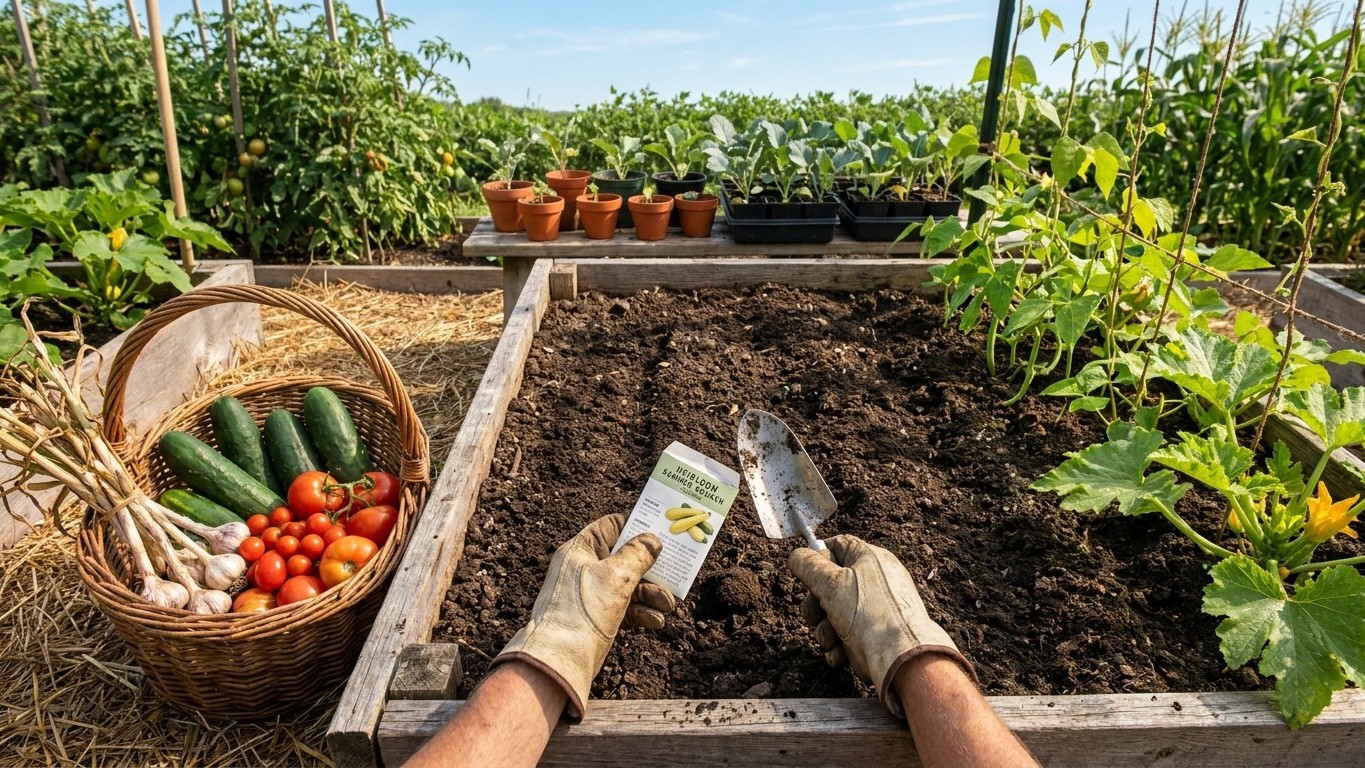

July in Iowa sits well past the last spring frost and well ahead of the first fall one, so the answer is straightforward: keep the summer garden producing while sowing the crops that will fill the plate after the tomatoes are done. That means succession beans and squash early in the month, fall brassica transplants going in mid-month, and a harvest basket already loaded with cucumbers, garlic, and the first ripe fruit.
What goes in the ground in July

The math for this month starts with the frost dates NOAA NCEI’s 1991-2020 Climate Normals put on the calendar: the last spring freeze fell between April 12 and April 24, and the first fall freeze arrives between October 14 and October 25. That leaves roughly 80 to 100-plus days of open growing season still ahead, depending on where in the state a garden sits. A gardener in the far north, closer to USDA hardiness zone 4b, is working with a tighter window than one farther south near zone 6a, so the same July planting decision carries more risk in one spot than the other.
Soil temperature, not the date on a calendar, decides what still makes sense to plant. Warm-season crops that need 45 to 65 days to mature can still go in the ground in early July and finish well before the fall freeze window opens. Root crops for a fall harvest have a slightly longer runway and can be sown into mid-month. Anything needing 75 days or more from seed is a gamble unless it goes in during the first week of the month, and even then it is tight in the northern counties.
| Crop | Typical days to maturity | July verdict |
|---|---|---|
| Bush beans | 50-55 days | Safe, sow early July |
| Summer squash/zucchini | 45-55 days | Safe, sow early July |
| Cucumbers | 50-65 days | Safe, sow early July |
| Carrots (fall crop) | 60-75 days | Safe, sow early to mid-July |
| Beets | 50-60 days | Safe, sow early to mid-July |
| Sweet corn (second planting) | 65-90 days | Gamble, first week only, safer in southern counties |
| Melons | 75-90 days | Not recommended as a new planting |
Fall brassica transplants (broccoli, cabbage, cauliflower) go outside this month too, but they should already be growing under cover before they hit the garden bed, which is where the next section picks up.
What to start under cover
Count backward from the first fall frost window of October 14 to October 25 rather than picking a date off a calendar. A fall broccoli or cabbage transplant needs roughly 60 to 70 days from setting it in the garden to harvest, plus 4 to 6 weeks growing as a seedling before it is ready to transplant. Work that arithmetic and seed for those crops needs to go into trays around the start of July, with transplanting out to the garden happening two to three weeks later, in time to mature before the freeze window closes.
Lettuce and other tender greens are trickier in July heat. Starting seed indoors or in a shaded cold frame keeps the soil temperature low enough for germination, which stalls above roughly 80 degrees. A second option is direct-sowing in a shaded spot outdoors in the last week of the month, aiming for transplant-size plants by the time the weather cools in late summer.
The two ways this goes wrong both cost a harvest. Start too early and the transplants sit too long in their trays, turning leggy and rootbound before there is anywhere cool enough to put them. Start too late, especially for anything needing 60 or more days, and the plant runs out of season before the first fall frost, even working from the earlier end of the October window. Splitting a sowing into two batches roughly ten days apart hedges against both mistakes and against a stretch of unusually hot weather that stalls germination in the first batch.
What is ready to pick
July is when the garden starts paying back the spring’s work. Green beans, cucumbers, and summer squash come in fastest and need checking every day or two once they start, since a zucchini can go from perfect to oversized in 48 hours in warm weather. Tomatoes begin ripening toward the end of the month in most Iowa gardens, with color and a slight give under gentle pressure the signal to pick.
Garlic planted the previous fall comes out of the ground this month. The tell is the lower leaves browning while four or five green leaves remain up top; pulling too late risks the bulb splitting open in storage. Onions signal readiness a little differently: the tops flop over and start to yellow, at which point they should be lifted and left to cure in a dry, airy spot rather than left in wet soil.
Sweet corn, if it was planted early in the season, starts coming ready toward the end of the month in warmer counties. A quick check is peeling back a small section of husk to look for plump, milky kernels rather than watery or overly firm ones. Berries, both cane fruit and blueberries where they are grown, are also at or near peak, and picking every few days keeps birds and rot from getting the crop first.
The jobs that matter this month
Watering rhythm matters more in July than in almost any other month, since heat stress shows up fast as blossom drop on tomatoes and peppers and as bitter, misshapen cucumbers. A deep soak of an inch or more once or twice a week, aimed at the soil rather than the leaves, beats a daily light sprinkle that only wets the surface. Mulch laid down now holds that moisture in and keeps soil temperatures from spiking around the root zone.
Staking and caging should already be done by July, but if tomato or pepper plants have outgrown their supports, this is the last easy window to fix it before the branches are too heavy and brittle to move without snapping. Sprawling vine crops benefit from a quick redirect off the path they are about to take over.
Succession sowing keeps the harvest coming instead of arriving all at once. Bush beans, summer squash, and quick greens sown every two to three weeks through the month stretch the picking season into fall instead of dumping everything at once. Pest scouting earns its keep now too: Japanese beetles, squash vine borers, and corn earworm are all active in July, and catching an infestation early, by hand-picking beetles or checking squash stems for the telltale sawdust-like frass, saves plants that a week of inattention would lose. Clearing out any bolted lettuce or spent pea vines also opens space for the fall crops going in this month.
What not to do in July
Planting new tomato, pepper, or melon transplants this late is a common mistake driven by a garden center still selling them. These crops need more days than are left before the fall frost window opens between October 14 and October 25, so a July transplant of any of them is very unlikely to produce a real harvest, especially north of the middle of the state.
Heavy nitrogen fertilizer aimed at tomatoes and peppers once they are flowering and setting fruit is another one to avoid. Nitrogen pushes leafy growth at the expense of fruit, so a plant that gets a strong feeding in July often ends up bushier and less productive than one left alone or given a fruit-focused feed instead.
Letting watering lapse during a hot stretch causes more damage in July than any other month, showing up as blossom-end rot on tomatoes, split cucumbers, and bitter squash. And pulling garlic or onions before the tops have properly browned or flopped, just because the calendar says it should be time, shortens their storage life considerably; better to watch the plant than the date.
Checking this against your own county
A state-wide July calendar is a starting point, not an instruction for a specific yard. Elevation, local microclimates, and the simple distance between the northern and southern edges of Iowa move frost windows by weeks, not days, which matters directly for how late a succession crop can go in and still finish before fall. The NOAA NCEI airport-station dates cited above also run about 4 days earlier in spring and 10 days later in fall than the county-level figures Iowa State Extension has tracked from 1950 to 2021, so treat the dates in this article as the optimistic end of the range for planning purposes. For a planting calendar tuned to a specific county, Iowa State Extension is the reliable next stop.
Common questions
Is it too late to plant tomatoes in Iowa in July?
For a full-size harvest, yes, in most cases. A new tomato transplant needs more growing days than remain before the first fall frost window of October 14 to October 25, particularly in the northern counties. Existing plants already growing should be kept watered and fed rather than replaced.
Can I still start a fall garden in July in Iowa?
Yes. Fall brassica transplants going in mid-month and quick-maturing crops like beans, squash, and root vegetables sown early in the month are the backbone of a July-started fall garden, timed to finish before the fall frost window opens.
Why is my zucchini blossom dropping without setting fruit?
Heat stress and inconsistent watering are the most common causes in July. Deep, regular watering and mulch to steady soil temperature usually resolve it within a couple of weeks.
When should I harvest garlic in Iowa?
Garlic planted the previous fall is typically ready in July, signaled by the lower leaves browning while four or five leaves up top stay green. Pulling based on that signal, rather than a fixed date, gives a better-curing bulb.