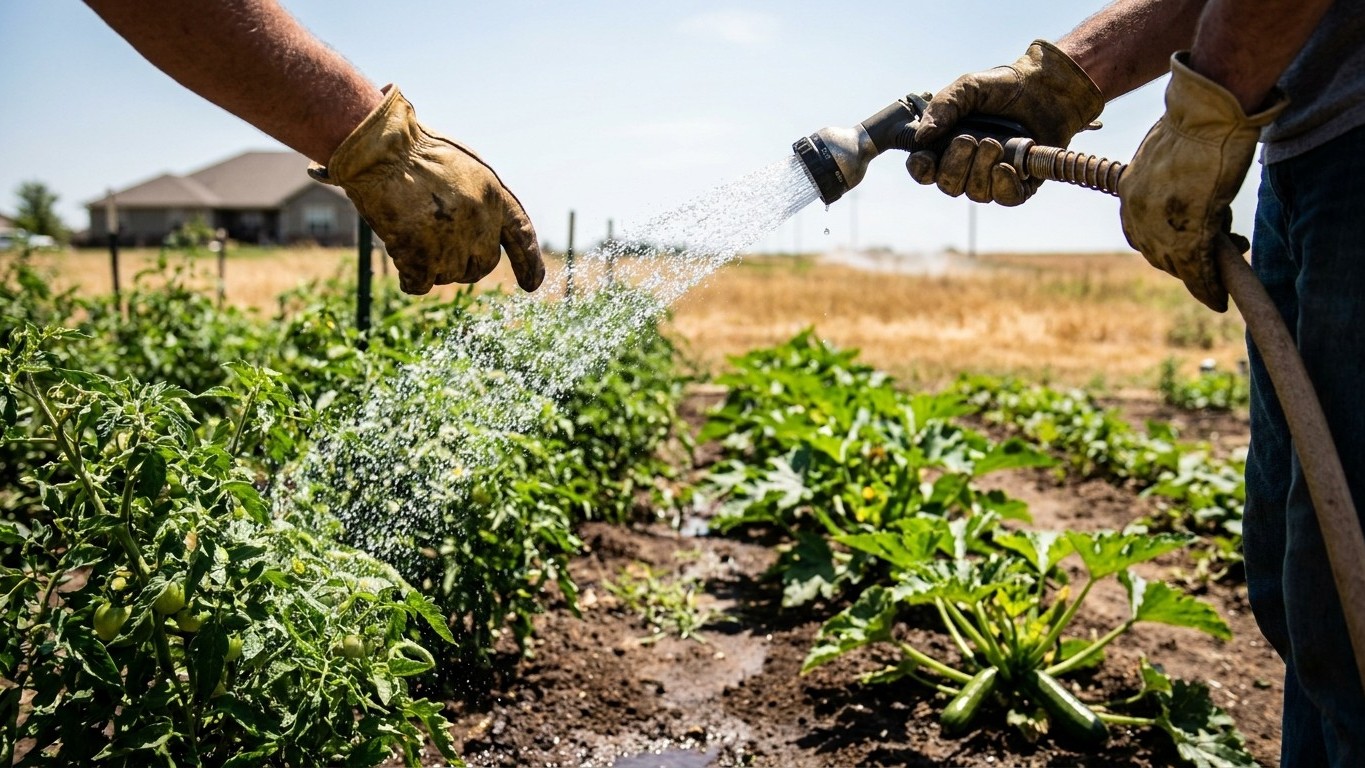

Kansas summers push past 90°F on 57.6 days a year on average at the Wichita reference station, and that single number does more to shape a watering schedule than any calendar date. Add hardiness zones that span 5b to 7a across the state, and the rules below adjust from the Colorado line to the Missouri border.
What the climate asks of you

Start with the number that rules out any illusion of an easy summer: 57.6 days a year at 90°F or hotter, measured at the Wichita reference station over the 1991-2020 period. That is not a hot spell. That is nearly two months of the year when a garden bed is losing water faster than most gardeners assume, whether or not a single cloud shows up.
A garden bed wants roughly an inch of water a week during the growing season, rain or hose. Kansas summer rainfall varies sharply by region and year, and the NOAA Climate Normals dataset behind the temperature figure above does not break out a single statewide June-July-August total the way it does for freeze dates. That is not a gap to paper over with a guessed number. It is a reason to pull the actual monthly averages for your county from your local K-State Research and Extension office before setting a schedule, because a garden near Garden City and one near Kansas City are not living the same summer.
Why the days-above-90 figure matters more than a rain total
Heat, not rainfall alone, is what pushes evaporation rates up and dries out the top few inches of soil between waterings. A week that sees five of those 90°F-plus days will drink through soil moisture at a pace that a mild, overcast week never approaches, even with identical rainfall. That is why the frequency question in the next section leans on soil behavior and hands-on checking rather than a fixed day-count calendar.
Soil texture changes the math further. Sandy ground lets water pass straight through, so the same rainfall or irrigation total that would carry a clay bed for four or five days might be gone from sandy soil in two. Kansas soils range from sandy river-bottom ground to heavy clay loams depending on the region, so the honest answer is: check your own soil, not a statewide average, before deciding how often to water.
How much, how often
Deep and infrequent beats shallow and daily, every time. A quick daily sprinkle wets only the top inch or two of soil, and roots follow the water. Shallow roots then sit in the hottest, driest layer of ground exactly when temperatures climb toward that 90°F mark 57.6 days a year. Watering deeply, less often, trains roots to grow down into cooler, more stable soil where they can ride out a heat spell.
The test for “does this bed need water today” is not a calendar, it is a finger. Push it two inches into the soil near the base of the plant. Dry at that depth, water. Still damp, wait another day and check again. A garden trowel works the same way for raised beds or dense plantings where a finger check is awkward.
A watering routine that fits Kansas heat
- Check soil moisture two inches down before watering, every time, rather than watering on a fixed schedule.
- Water in the early morning, before the heat of the day, so moisture soaks in before evaporation takes over.
- Apply water at the base of the plant, never on the leaves, to cut down on fungal disease in humid stretches.
- On sandy soil, water in shorter, more frequent sessions since the ground holds little moisture at a time.
- On heavy clay, water less often but more thoroughly, and never work or soak clay soil that is already wet, since it compacts and drowns roots.
- During stretches with several 90°F-plus days in a row, check soil moisture daily rather than every few days, since evaporation accelerates fast.
Clay holds a week’s worth of water once it is thoroughly soaked, which sounds like an advantage until it rains on top of already-saturated clay. Roots sitting in waterlogged clay for days lose access to oxygen and start to rot, so the two-inch check matters as much for avoiding overwatering as it does for catching a dry bed.
Restrictions and rules
Watering restrictions are set locally in Kansas, not by a single statewide rule, and they change from year to year depending on aquifer levels, reservoir storage, and drought conditions. Some municipalities and rural water districts impose odd-even watering days, time-of-day limits, or outright bans on sprinkler use during declared drought stages. Others have no formal restriction at all outside of an unusually dry year.
Given that summer heat here already runs high, with 57.6 days a year above 90°F pulling hard on both municipal supply and private wells, checking your local water district’s current rules before setting an automatic timer is worth the five minutes it takes. A district under stage-two drought restrictions in July will not look the same as it did the previous August, and a fine for watering on the wrong day is an easy one to avoid simply by asking first.
Your county’s K-State Research and Extension office keeps current guidance on local water rules, drought stage declarations, and any watering-day schedules in effect, and is the source to check rather than relying on what a neighbor says the rule used to be.
Using less
Cutting water use in a Kansas garden is less about deprivation and more about not wasting what already falls or gets applied. A few changes do most of the work, and they layer on top of each other rather than competing.
- Mulch: a two- to three-inch layer of wood chips or straw over the soil surface slows evaporation dramatically, which matters most on the 57.6 days a year when the sun is working hardest against you.
- Drip irrigation: delivers water straight to the root zone instead of spraying it into the air where a share evaporates before it lands, cutting overall use compared to overhead sprinklers.
- Grouping plants by water need: putting drought-tolerant natives together and thirstier vegetables together means you’re not soaking an entire bed to satisfy the one plant that needs it.
- Organic matter in the soil: compost worked into sandy soil improves its ability to hold moisture, while the same compost worked into clay improves drainage, so it helps both extremes at once.
- Rain barrels: legal in Kansas for residential use, and worth the math. An inch of rain falling on a thousand square feet of roof yields roughly 600 gallons of runoff. Whether that barrel fills reliably or sits empty for weeks depends entirely on your local month-to-month rainfall, which is exactly why checking your county’s actual summer rainfall pattern through K-State Extension matters more here than following a generic barrel-sizing guide.
None of these replace watering altogether. They reduce how much has to come from a hose or sprinkler, which matters most during the stretch of days each summer when temperatures sit above 90°F and every plant in the yard is asking for water at once.
Common questions
How many days a year does Kansas typically see 90°F or hotter?
The Wichita reference station averages 57.6 days a year at 90°F or above, based on NOAA’s 1991-2020 Climate Normals. That figure varies across the state, with warmer conditions typically further south and west.
When is the last spring frost in Kansas?
At the Wichita reference station, the last spring frost typically falls between April 4 and April 18, based on 1991-2020 freeze probability data. Suburban and rural gardens often see frost later than this by one to two weeks, and elevation pushes that later still, so check your own county’s typical date before planting out.
What USDA hardiness zone is Kansas in?
Kansas spans USDA zones 5b to 7a, a wide range across the state rather than a single zone. Reference dated planting or watering recommendations to your nearest city rather than assuming the statewide range applies evenly everywhere.
Are rain barrels legal in Kansas?
Yes, rain barrels are legal for residential use in Kansas. How much value one delivers depends on your local summer rainfall pattern, since a barrel that fills quickly in a wet month may sit empty during a dry stretch, particularly given how much water evaporates during the state’s 90°F-plus days.