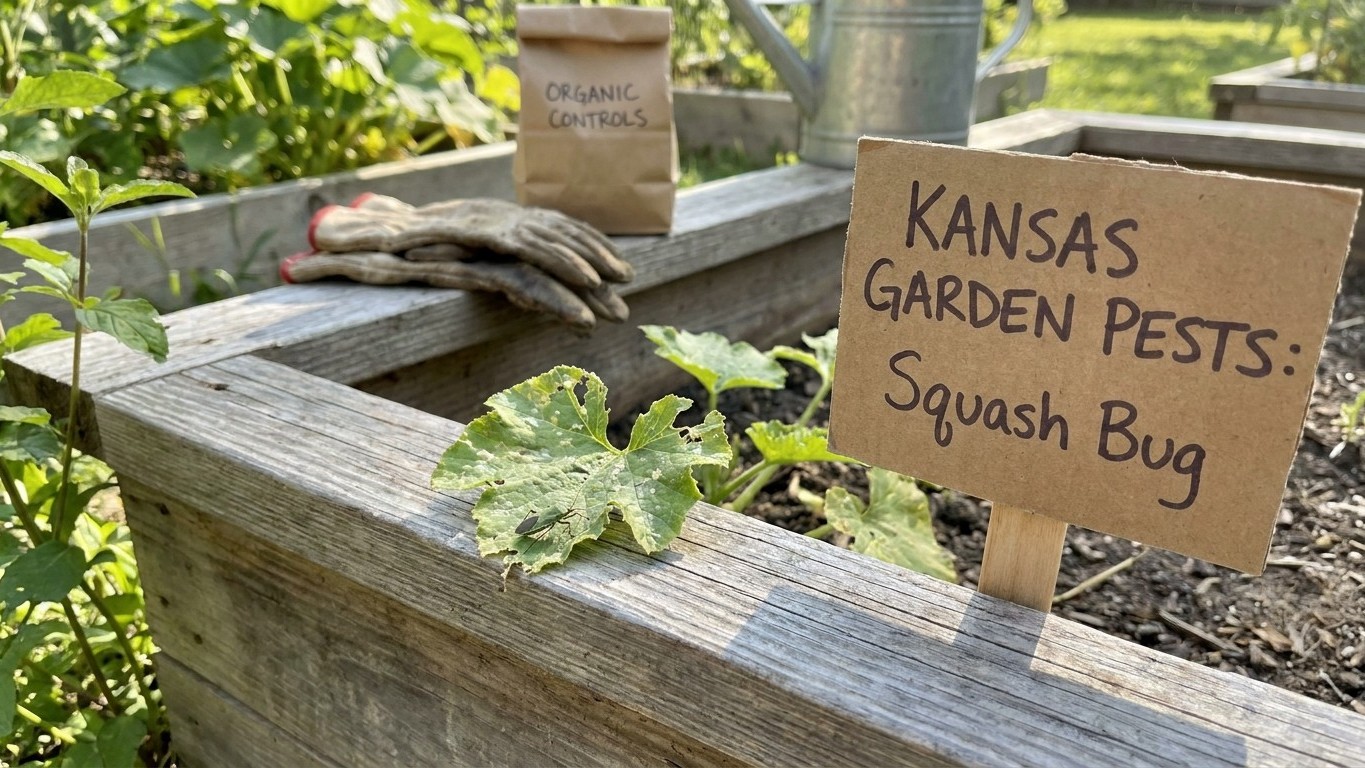

Kansas gardeners deal with a specific, named list of pests: Bagworm populations, squash bug, squash vine borer, the Harlequin bug gardens in Kansas often see on cole crops, blister beetle, grasshopper, striped and spotted cucumber beetle, Colorado potato beetle, and pine sawyer beetle, according to K-State Research and Extension’s S158 Pocket Guide to Common Pest Problems. Pressure runs from spring through late summer, with early arrivals like the striped cucumber beetle and squash bug overwintering as adults, and later arrivals like grasshoppers and Squash vine borer gardens in Kansas see overwintering as eggs or pupae. Check young transplants for chewing and egg clusters the week they go into the ground, since damage on seedlings is the easiest thing to stop before it spreads.
What Kansas gardens actually deal with

The first thing eating your tomatoes or squash this summer is almost never a mystery once you know what to look for, and in Kansas it’s usually one of ten specific insects that show up on a predictable schedule from spring through late summer. Some, like the Striped cucumber beetle in Kansas, which gardeners see year after year, the Spotted cucumber beetle in Kansas, which gardeners also watch for, and the Squash bug in Kansas, which gardens across the state contend with, are already active as soon as you set out transplants, since they spend winter as adults waiting for exactly this. So the single move that matters most: check young seedlings the week they go in the ground for chewing marks or egg clusters on the leaf undersides, before anything has a chance to spread.
Colorado potato beetle

Adults are oval and cream to yellow-orange with black stripes running the length of the wing covers. The Colorado potato beetle in Kansas shows up as potato and tomato plants push new growth in spring. The reddish-orange, humpbacked larvae do the real damage, stripping leaves down to the veins within days of hatching. Handpicking adults and crushing egg clusters on the undersides of leaves before larvae hatch stops most outbreaks before they need anything stronger.
Bagworm

This one hides in plain sight, a spindle-shaped bag of silk and plant debris hanging from juniper, arborvitae, or pine branches. Eggs hatch late April to early May according to K-State Research and Extension, and the young larvae that emerge from that hatch are the ones doing the feeding, not the bag itself. Once the bag hardens later in summer, sprays stop working. The window to treat is narrow, right at egg hatch, before the larvae build a case tough enough to shrug off most products.
Striped cucumber beetle

Bright yellow with three black stripes down the back, about a fifth of an inch long. This is one of the pests that overwinters as an adult, according to K-State Research and Extension, so it is often the first insect on new cucumber, squash, and melon seedlings. Beyond the chewing damage, it carries bacterial wilt, which can kill a plant days after the beetle has already moved on.
Spotted cucumber beetle

Yellow-green with twelve black spots instead of stripes, and about the same size as its striped relative. It feeds on the same seedlings and flowers and can carry the same bacterial wilt. Fewer people notice it in time, because the spotted pattern reads less like a pest at a quick glance.
Squash bug

Adults are flat-backed, shield-shaped, and brownish-gray, about five-eighths of an inch long. Look for their bronze-colored egg clusters lined up neatly on the underside of squash and pumpkin leaves. Squash bug also overwinters as an adult, so it is active early, and its feeding causes leaves to blacken and collapse rather than just show holes. Nymphs do more cumulative damage than the adults because they feed in groups for weeks before maturing.
Harlequin bug

A shield-shaped bug marked in glossy black and orange-red, hard to mistake for anything else once you’ve seen one. It targets cabbage, broccoli, and other brassicas, leaving pale, blotchy patches where it has drained sap from the leaf.
Blister beetle
Narrow and soft-bodied, often black, gray, or striped, and usually found feeding in tight clusters on foliage and flowers rather than alone. A group can strip a row of leaves quickly when it moves through. Do not crush them with bare hands, since their body fluid contains a compound that blisters skin.
Grasshopper
Large and jumping, brown, olive, or yellow-green, grasshoppers build up later in the season rather than arriving all at once. K-State Research and Extension lists grasshoppers among the pests that overwinter as eggs in the soil, which is why numbers climb through summer. They chew ragged holes across whole leaves and, in heavy years, can move through a garden fast.
Squash vine borer
The adult is a day-flying moth with an orange, black-spotted body that looks more like a wasp than a moth. It lays eggs at the base of squash and pumpkin vines, and the larva, a cream-white grub, tunnels inside the stem, doing its damage out of sight. Wilting vines with a pile of wet, sawdust-like frass at the base are the giveaway.
Pine sawyer beetle
A large, mottled brown-and-gray beetle with long antennae, more a pest of stressed or dying pine trees than of the vegetable patch. Adults chew bark and larvae bore into wood, so its presence is usually a sign a pine is already declining rather than the cause of it.
Telling damage apart

Chewed leaf edges with ragged, irregular holes point to something with mandibles: grasshoppers, cucumber beetles, Colorado potato beetle larvae, or blister beetles working through foliage. Damage concentrated at the leaf margins usually means the insect fed from the outside in. Damage in the interior of the leaf, leaving a lacy skeleton of veins, is more typical of Colorado potato beetle larvae, which can strip a plant of everything but the veins in a matter of days.
Sudden, whole-plant wilting on a squash or pumpkin is a different story. If the wilting happens fast and the stem base looks intact, suspect squash bug feeding, which injects a toxin while sucking sap and can collapse a plant without a single visible hole in a leaf. If the wilting is slower and paired with a soft, hollowed-out stem or a pile of frass at the base, that points to squash vine borer working inside the vine. Cut the stem open near the base if you’re unsure. A borer inside settles the question immediately.
Bacterial wilt spread by cucumber beetles looks similar to vine borer damage from the outside, but the stem stays firm and the beetles themselves are usually still visible on the leaves and flowers. That is the practical way to separate an insect problem from a disease problem in cucurbits: check for the insect first, since the beetle is the vector, not just a coincidence.
Not every damaged-looking plant has a pest. Leaf edges that brown and crisp evenly, rather than being chewed, usually mean a watering or heat problem, not an insect. Yellowing that starts at the base of the plant and moves upward is more consistent with a nutrient or root issue than with any insect on this list. Sticky residue on leaves without visible chewing suggests a sap-feeding insect rather than a chewing one, even if you can’t spot the insect itself at the time you notice the residue.
- Ragged holes and missing leaf tissue: chewing insect, check for beetles or larvae
- Sudden wilting with no holes: squash bug or vascular disease
- Hollow, softened stem with frass at the base: squash vine borer
- Evenly browned, crisp leaf edges: watering or heat stress, not a pest
- Sticky film with no visible insect: sap-feeder, check leaf undersides
When each one shows up
Pest activity in Kansas follows plant growth stages more reliably than the calendar. K-State Research and Extension groups its pest list into two broad waves: insects that overwinter as adults and are ready to feed the moment the weather warms, and insects that overwinter as eggs or pupae and build up through the season instead of arriving all at once.
Early wave
Striped cucumber beetle and squash bug fall into the first group. Both overwinter as adults in garden debris or nearby shelter, so they are often already active by the time cucurbit seedlings and transplants go into the ground. Bagworm belongs here too in a narrower sense: egg hatch runs late April to early May according to K-State Research and Extension, timed to when host evergreens are pushing new growth. Start checking new transplants and evergreen tips as soon as they’re in the ground, not after you notice damage, since these pests are already positioned to feed.
Later wave
Grasshoppers and squash vine borer overwinter as eggs or pupae, so their numbers build gradually rather than spike early. Grasshopper populations tend to climb through the middle of the season and become most noticeable in the heat of late summer, especially in dry years when natural vegetation thins and they move into gardens looking for food. Squash vine borer moths emerge and lay eggs on vines once the plants have put on real vegetative growth, so damage typically shows up on established plants rather than seedlings.
Harlequin bug, blister beetle, Colorado potato beetle, spotted cucumber beetle, and pine sawyer beetle don’t have documented emergence windows in the same source, but they follow the same general logic: watch cool-season brassicas early for harlequin bug, watch potatoes as soon as they emerge for Colorado potato beetle, and expect blister beetles in loose groups during the warmer stretch of summer. These figures are measured near Wichita, and timing shifts earlier or later across the rest of the state depending on local spring warm-up. Gardeners across the border deal with a different mix and different timing entirely, covered in our guides to garden pests in Michigan and garden pests in Kentucky.
What actually works
Prevention beats intervention for nearly every pest on this list, because most of the damage happens fast once an insect finds a plant. Crop rotation matters most for squash bug and squash vine borer, since both overwinter in or near the previous season’s cucurbit debris. Moving squash and pumpkins to a different part of the garden each year, and clearing old vines and mulch in fall, removes the shelter these insects depend on.
Barriers and timing
Floating row cover over cucurbit seedlings keeps striped and spotted cucumber beetles and squash bug off young plants during the weeks they’re most vulnerable. Cover has to come off once flowers open, though, or pollinators can’t reach the blossoms. For bagworm, the equivalent move is timing rather than a barrier: treating right at egg hatch, before bags harden, is the difference between a product working and doing nothing at all.
Encouraging predators helps more than most gardeners expect. Birds, predatory beetles, and parasitic wasps all take a share of eggs and young larvae before they become a visible problem, and a garden with diverse plantings and some undisturbed edges supports more of them than a bare, tidy one does.
When intervention is warranted
Handpicking works well for Colorado potato beetle, squash bug adults and egg clusters, and bagworm before the case hardens, because all three are large enough and slow enough to catch by eye. Squash vine borer has to be handled differently: once the larva is inside the stem, the only real fix is slitting the stem to remove it, since no spray reaches an insect that’s already tunneled in. For grasshoppers and blister beetles, which move through in numbers, a targeted insecticide is sometimes the only practical response, and timing it while insects are young and concentrated works better than spraying an established, dispersed population.
Some popular remedies do nothing measurable. Marigolds planted as a border do not repel squash bugs or cucumber beetles in any way that shows up in practice. Garlic or pepper sprays wash off within a day or two and rarely reach the underside of leaves where eggs and nymphs actually sit. Ultrasonic pest repellers have no effect on insects at all, whatever the packaging claims.
What control costs
Home garden pest control splits into four rough categories, and they don’t cost the same in either money or time. Handpicking costs nothing but time, and for pests like Colorado potato beetle and squash bug, a few minutes checking leaf undersides every few days through the growing season is often enough on a garden-sized planting.
Row cover and other barriers cost more upfront, since the material has to be bought once, but it can be reused for several seasons if stored properly and doesn’t need reapplying after rain the way a spray does. The tradeoff is that cover has to be removed for pollination and put back afterward, which adds a small recurring task rather than a recurring cost.
Biological controls, meaning encouraging the predators and parasitic insects already present in a diverse garden, cost almost nothing directly but take longer to show results and won’t stop a fast-moving outbreak like a grasshopper swarm on their own.
Sprays, whether a targeted insecticide or a soap-based product, need repeat applications through the season since they only kill what’s present and exposed at the time of application, not eggs laid afterward. That repeat cost is the real expense, more than the price of any single bottle.
| Method | Upfront effort or cost | Repeat frequency | Best suited to |
|---|---|---|---|
| Handpicking | None, just time | Every few days through the season | Colorado potato beetle, squash bug, bagworm |
| Row cover / barriers | One-time material cost | Reusable for several seasons | Cucumber beetles, squash bug on seedlings |
| Biological control | Low, mainly garden design | Ongoing, builds over seasons | General egg and larva suppression |
| Sprays | Cost of product each time | Repeated through the season | Grasshoppers, blister beetle in numbers |
For a typical home garden, handpicking combined with row cover on cucurbits is the cheapest approach overall, since both rely on effort already built into routine garden checks rather than on a recurring purchase.
Local help
If you’re not sure what’s chewing on your plants, K-State Research and Extension identifies specimens and tracks pest outbreaks across the state through its county offices and its extension website. A local office can confirm identification faster than guessing from a photo online, and it’s worth checking before spraying anything, since the wrong treatment on the wrong pest wastes both money and time. For more on gardening across the state, see our broader Kansas guides.
Common questions
Are the bugs eating my flowers the same ones eating my vegetables?
Usually not. Most pests on this list are specialists tied to one plant family, cucumber beetles to cucurbits, harlequin bug to brassicas, Colorado potato beetle to potatoes and their relatives. Blister beetle is more of a generalist and will feed on flowers and vegetable foliage alike, which is why it’s worth checking ornamental beds too when you see one in the vegetable patch.
Do I have to spray if I only see a few bugs?
Not usually. A handful of squash bugs or beetles is easy to remove by hand, and spraying at low numbers kills beneficial insects along with the pest for little added benefit. Save a spray for numbers you genuinely can’t keep up with by handpicking.
Why do I get squash bugs every year even though I rotate my crops?
Adult squash bugs fly, so rotating within your own yard doesn’t put them out of reach if there’s a squash or pumpkin patch anywhere nearby, including a neighbor’s garden. Rotation still helps by removing the overwintering shelter in your own soil and debris, but it won’t eliminate an insect that can simply fly in from next door.
Can I compost vines that had squash vine borer or a bagworm case in them?
It’s safer not to, unless your compost pile reliably heats up enough to kill insect life, which most backyard piles don’t manage consistently. Bag and dispose of infested vines and bagworm cases instead, and check with your county extension office if you’re unsure what disposal options are available where you live.