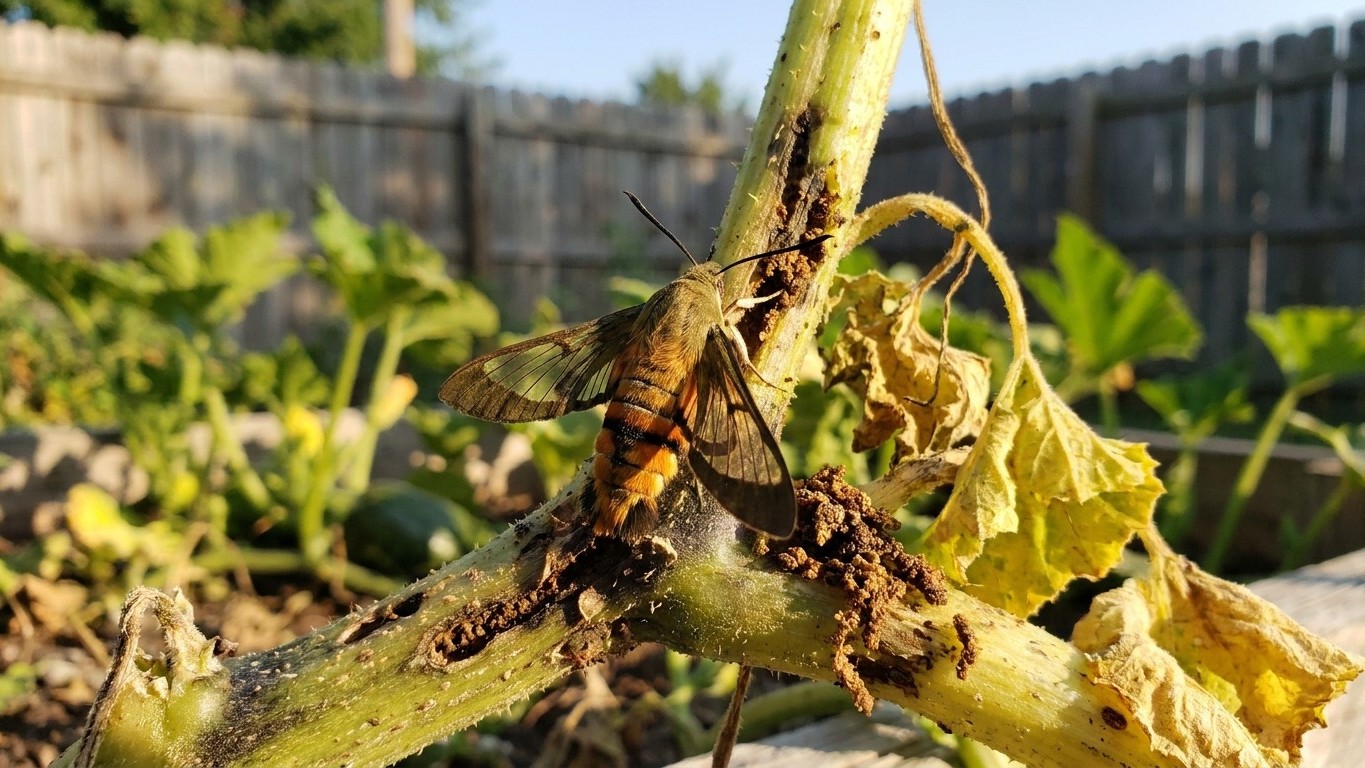

Squash vine borer moths start emerging in Kansas in late June, with peak activity running through mid-July across most of the state. That timing matters because the moth itself does no damage. Its larvae do, tunneling into stems and killing plants from the inside out within days of hatching. If you garden anywhere from Wichita to Manhattan to the Kansas City suburbs, this pest follows a fairly predictable calendar, and that predictability is your best defense.
Why Kansas timing is different from other states

Squash vine borer emergence is tied to soil temperature, not the calendar date on a seed packet. Kansas sits mostly in USDA Hardiness Zones 6a through 7a, according to the USDA Plant Hardiness Zone Map, with warmer pockets in the south central and southeast parts of the state warming up earlier in spring. That earlier soil warming pushes moth emergence ahead of what gardeners in Nebraska or Minnesota experience by one to three weeks.
In practice, this means a gardener in Wichita might see the first adult moths by the second week of June, while someone in a cooler northeastern county like Doniphan might not see them until early July. A single emergence window doesn’t exist statewide. There’s a rolling wave that moves roughly south to north as the season progresses.
Kansas also tends to get two overlapping generations in warmer years, particularly across the southern third of the state. That’s different from the single-generation pattern seen further north. Gardeners who treat squash vine borer as a one-time early-summer problem and then stop watching often get blindsided by a second wave of egg-laying in August.
Spotting the moth before it lays eggs
The adult squash vine borer looks nothing like a typical moth. It flies during the day, has an orange and black abdomen, and clear-tipped wings that make it resemble a wasp more than anything from the Lepidoptera family most people picture. That resemblance is deliberate mimicry, and it’s exactly why so many gardeners miss it. People see an orange-and-black insect hovering near their squash blossoms and assume it’s a beneficial pollinator or a harmless wasp.
Watch for that moth resting on leaves near the base of the plant during the warmest part of the day, typically between late morning and mid-afternoon. If you see one, assume egg-laying has already started or is imminent. Females lay eggs individually at the base of stems, often tucked right where the stem meets the soil line, which is exactly why so many home gardeners never notice them until it’s too late.
The signs that mean larvae are already inside
Once eggs hatch, larvae bore into the stem within a day, and external symptoms lag behind internal damage by a week or more. The classic warning sign is a plant that wilts suddenly during the heat of the day despite adequate soil moisture, then partially recovers overnight. That day-wilt, night-recovery pattern is one of the more reliable field signs, distinct from drought stress or root rot, which tend to produce more consistent wilting regardless of temperature.
Look at the base of the stem for a small hole surrounded by a moist, sawdust-like material called frass. That frass is larval excrement pushed out of the entry hole, and it’s often the first physical evidence a gardener finds, usually days after the actual infestation began. By the time frass is visible, the larva has already been feeding inside the stem, and the window for saving that particular vine has narrowed considerably.
What actually stops squash vine borer in a Kansas garden
No single method eliminates squash vine borer completely once it’s established in a region, but a layered approach cuts losses dramatically. The methods that work best combine timing, physical barriers, and monitoring rather than relying on any one tactic.
Row covers timed to Kansas emergence
Floating row covers placed over young plants before the first moths emerge, generally by late May in southern Kansas and early June in northern counties, physically block egg-laying. The covers need to come off once flowering begins so pollinators can reach the blossoms, which creates a narrow but manageable window of vulnerability. Some gardeners hand-pollinate during this period to keep covers on longer, which extends protection into the peak moth activity weeks of late June and July.
Stem wrapping and physical barriers
Wrapping the lower 4 to 6 inches of stem in aluminum foil or a strip of nylon stocking before planting or transplanting prevents females from accessing the preferred egg-laying zone at the stem base. This method costs almost nothing and takes a few minutes per plant, making it one of the more practical options for a backyard vegetable garden rather than a commercial operation.
Timing plantings around the emergence window
Delayed planting, pushing squash and zucchini seeding to late June or early July instead of the traditional May planting date, lets vines miss the first and often heaviest wave of egg-laying. This sacrifices some early harvest but frequently produces a healthier crop overall, since plants germinate after peak moth activity has passed. It works particularly well for winter squash varieties that mature later in the season anyway.
Surgical removal of larvae
If a stem shows frass but the plant hasn’t collapsed, a longitudinal slit made carefully along the stem with a sharp knife often allows removal of the larva by hand. After extraction, mounding moist soil over the wounded section of stem encourages new root growth from that point, effectively letting the plant re-establish itself past the damaged section. This works more often on winter squash and pumpkins with long sprawling vines than on compact zucchini or summer squash varieties, which have less stem length to spare.
Variety selection and garden habits that reduce risk
Butternut squash and other Cucurbita moschata varieties show measurably less susceptibility than zucchini, yellow summer squash, and pumpkins, which fall under Cucurbita pepo. The stems of moschata varieties are more solid and less hollow, giving larvae less room to establish a feeding tunnel. Kansas gardeners dealing with repeat infestations often shift a portion of their squash bed toward butternut and away from zucchini for this reason alone.
Crop rotation matters more than most home gardeners assume. Squash vine borer larvae overwinter in the soil as pupae, often within a few inches of where the previous year’s infested plant grew. Planting susceptible squash in the same bed year after year gives emerging moths a shorter distance to travel back to a food source. Moving cucurbits to a different section of the garden each year, even by just 15 or 20 feet, disrupts that cycle.
Fall tillage that disturbs the top few inches of soil where pupae overwinter can also reduce the following year’s population, though this benefits the whole neighborhood only if enough gardeners in an area do it. A single yard tilling its squash bed while three neighboring yards leave theirs undisturbed won’t move the needle much on a block-wide infestation, since moths can fly considerable distances to find host plants.
When insecticide timing makes a difference
Because larvae are protected inside the stem almost immediately after hatching, insecticides only work during a narrow window before eggs hatch or in the brief period right after, before the young larva bores in. Products need to reach the stem base, not just the foliage, and timing them to coincide with confirmed moth activity in your specific part of Kansas matters more than following a fixed calendar date. Gardeners who spray on a set schedule regardless of actual moth sightings often waste applications on windows when no eggs are present, while missing the actual egg-hatch period entirely.
Extension offices through Kansas State University track regional pest pressure and can offer more localized emergence guidance than a statewide estimate, since a county in the Flint Hills and a county along the Missouri border rarely share identical timing in a given year.
Gardeners who lose a plant to squash vine borer one season often see the same bed affected again the next year at nearly the same calendar week, since local moth populations tend to synchronize with regional soil warming patterns rather than resetting randomly. Tracking the date of first symptoms in a garden journal, even a simple note on a phone, turns into a useful predictive tool after just two or three seasons of observation.
Related guides
- Squash vine borer in Nebraska: When It Shows Up and What Stops It
- Squash vine borer in Missouri: When It Shows Up and What Stops It
- Squash vine borer in Kentucky: When It Shows Up and What Stops It
- Squash vine borer in Louisiana: When It Shows Up and What Stops It
- Squash vine borer in Ontario: When It Shows Up and What Stops It