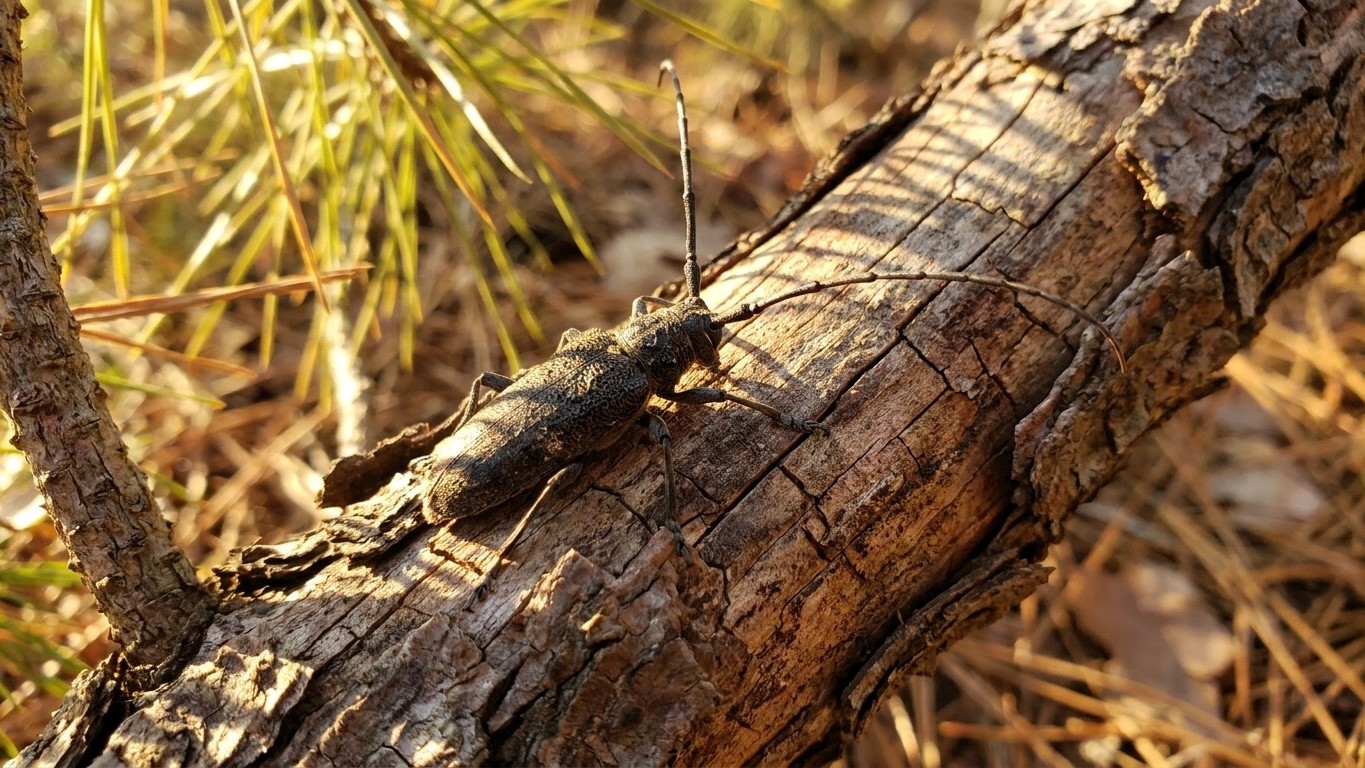

Kansas homeowners typically start seeing pine sawyer beetle activity from late spring into summer, once temperatures stay warm enough to drive adult flight and egg-laying in stressed or dying pines. K-State Research and Extension’s general pest publications don’t single out this species with its own date range, so the practical approach is watching pine health directly, especially through the hottest, driest stretch of the year when trees are most vulnerable.
The weeks to watch

Adult pine sawyer beetles fly in Kansas mainly from late May through September, with numbers building as summer heat pushes weakened pines toward the kind of stress these beetles are drawn to. That’s a wide window, and it stays wide because it depends on tree condition and heat, not on a fixed calendar date.
No Kansas-specific window from K-State
K-State Research and Extension’s S158 Pocket Guide to Common Pest Problems and MF3480 Insect and Mite Pests of Vegetable Gardens split garden insects into two calendar groups: early-season pests that overwinter as adults, such as striped cucumber beetle, squash bug, and bean leaf beetle, and later-season pests that overwinter as eggs or pupae, including stink bugs, twospotted spider mite, grasshoppers, tomato hornworm, imported cabbageworm, corn earworm, and squash vine borer. Pine sawyer beetle appears on neither list, because those guides cover vegetable garden insects rather than wood-boring beetles of pine trees. The local extension service simply doesn’t publish a dedicated seasonal window for this species in these particular guides.
The general pattern for wood-boring beetles
Without a Kansas-specific date, the general biology fills the gap. Adults emerge once day and night temperatures stabilize in the warm range, feed briefly on young twig bark, mate, and then females seek out recently killed, dying, or severely stressed pine material to lay eggs. Larvae then tunnel and feed under the bark through the remainder of summer and into fall, often overwintering to emerge the following year. K-State’s own vegetable calendar uses bagworm egg hatch, late April to early May, as an early marker of the season warming up; pine sawyer flight generally follows a bit behind that, building through May and June as heat accumulates.
Reading the calendar from your last frost

The date a Kansas gardener actually circles on the calendar each spring isn’t a beetle’s flight window, it’s the last frost. NOAA’s 1991-2020 climate normals put that date at April 4 to April 18 for the reference weather station, and pine sawyer beetles pay it no attention at all. What matters to them is accumulated warmth in wood and soil, not a day marked on paper, so an unusually cold April or a mild March both shift the beetle’s timing without changing what the frost date says.
- Start from the reference last-frost window for this station: April 4 to April 18.
- Add the several weeks of sustained warm weather that wood-boring beetles generally need before flight builds toward normal levels, which in most years pushes the first meaningful pine sawyer activity into mid-to-late May, then extends through summer as heat and drought stress accumulate on nearby pines.
Suburban and rural yards away from the airport station where this frost date is measured tend to see their own last frost later, sometimes by one to two weeks, and later still at higher elevation. For homeowners, that means the safe window to start regular inspections of stressed or recently damaged pines, and to have watering support already in place, should be based on the county’s own frost pattern, not this single reference date.
What it attacks, and what the damage looks like

A homeowner usually notices trouble in the tree before ever spotting a beetle. Needles fade from green to yellow-brown surprisingly fast, sometimes within weeks, and the crown can look scorched even when nothing else in the yard shows heat stress. Look closer and there’s often sap staining running down the trunk, small round or oval exit holes chewed through the bark, and coarse, sawdust-like frass collecting at the base or in bark crevices. On a live tree already carrying pine wilt disease, that fading can spread from a few branches to the entire tree within a single season.
- Scots pine
- Austrian pine
- White pine
- Recently cut, storm-damaged, or dying pine logs and firewood
The larvae do nearly all the structural damage, tunneling through sapwood and heartwood for months after eggs are laid, which is also why that stage sits out of reach of anything applied from outside the tree. Adult beetles cause only minor twig damage while feeding, but that same feeding is how pinewood nematodes, when present, move into a healthy tree in the first place.
How Kansas sits in this pest’s range

This page is currently the only one on this site documenting pine sawyer beetle activity for a specific state, which means there’s no neighboring territory’s data to compare Kansas against yet. That single-territory coverage doesn’t say anything about how common the beetle is here relative to other pine-growing states, only that Kansas is the one place this site has pulled together local season and damage details for it so far.
Kansas pine plantings sit within the broader range where Monochamus species and pine wilt disease are an ongoing concern across the central and eastern United States, particularly wherever nonnative pines like Scots and Austrian pine were planted heavily as windbreaks and ornamentals in the twentieth century. Those species tend to fare worse under nematode pressure than the region’s native pines, though this page doesn’t have Kansas-specific incidence numbers to show how the state compares to its neighbors. Until more territory pages exist, the practical takeaway is to treat this as a real, present concern for planted pines rather than to weigh it against a ranking that isn’t documented anywhere yet.
What actually works against it

- Remove dying, storm-damaged, or recently cut pine wood promptly. Sawyer beetles are drawn to the volatile compounds that stressed and dying pine tissue releases, so clearing that material before beetles emerge removes the breeding site, at little cost beyond labor.
- Don’t stack or store cut pine logs or firewood near healthy trees through the warm months. Stored wood keeps releasing the same attractive compounds, and beetles that find it can move on to nearby living pines afterward.
- Keep pines watered through drought stretches and avoid unnecessary trunk or root wounding. A tree under less stress produces fewer of the signals that draw egg-laying females in the first place.
- Inspect pines regularly for early fading, sap staining, or exit holes, especially during the hottest months, so a declining tree can be identified and removed before it becomes a source of beetles for the rest of the yard.
- Once larvae are established under the bark, nothing applied to the outside of the tree reaches them. At that point, removing and properly disposing of the whole affected tree, rather than treating it, is what actually stops the beetle and any nematode it may carry from spreading further.
Common questions
Does the pine sawyer beetle actually kill pine trees in Kansas?
The beetle itself does only minor twig-feeding damage as an adult, but it’s the main way pinewood nematodes reach healthy pines in Kansas. It’s that nematode infection, causing pine wilt disease, that actually kills the tree, sometimes within a single growing season once symptoms start.
Can I treat an individual pine tree to prevent pine wilt disease?
This page doesn’t document specific treatment products or dosages. The measures that hold up are the sanitation and stress-reduction steps above; anything claiming to cure a tree already wilting should be checked against current K-State Research and Extension guidance written specifically for pine wilt disease.
What’s the difference between pine sawyer beetle damage and pine wilt disease symptoms?
Sawyer beetle damage shows up as small exit holes, sap staining, and minor twig dieback from adult feeding. Pine wilt disease shows as fast, whole-branch or whole-crown fading from green to yellow-brown, often with little sawdust or frass visible, since the real damage is happening internally from the nematode rather than from the beetle’s own feeding.