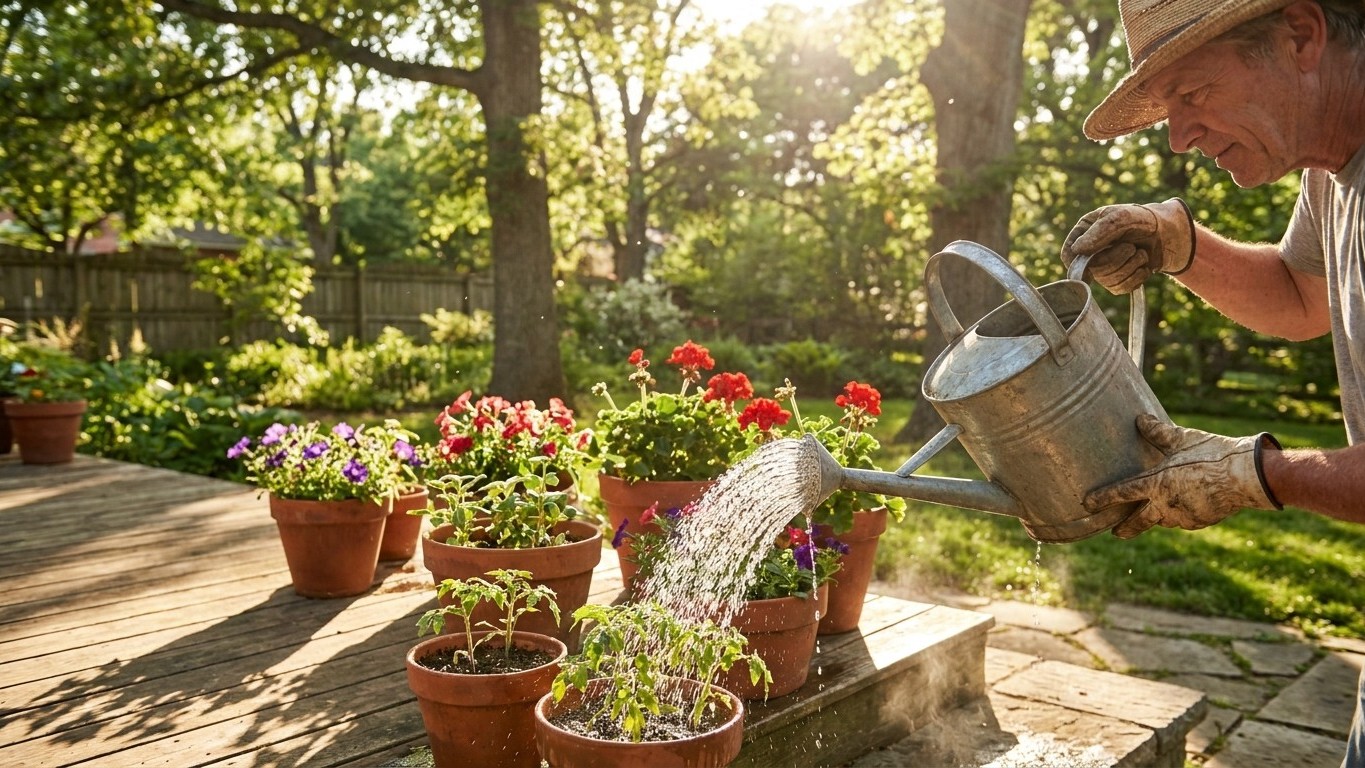

Kentucky gardens need roughly an inch of water a week to thrive, but August, the driest summer month, delivers only about 3.71 inches over the entire month. That gap, combined with 37.2 days a year hitting 90F or higher, means most Kentucky beds need a hose or drip line filling in what the sky skips, especially from late July through August.
What changes here

Two numbers do most of the work in a Kentucky garden’s water budget: 3.71 inches of rain in August, the driest summer month, and 37.2 days a year that reach 90F or above. Together they describe a state where summer doesn’t run dry the way the Southwest does, but where heat load is high enough to pull moisture out of soil and leaves faster than a light rain can replace it. A single hot, breezy afternoon can undo what a Tuesday thunderstorm just put down.
The arithmetic makes the point concrete. A vegetable bed or a young shrub wants close to 1 inch of water a week. August has roughly 4.4 weeks in it, so 3.71 inches spread evenly works out to about 0.84 inch per week arriving free from the sky. That leaves a shortfall of about 0.16 inch a week that has to come from a hose, a can, or a drip line if the plant is going to get the full inch it wants. It sounds small. Over eight or nine weeks of hot weather, that gap is what separates a tomato plant that keeps setting fruit from one that drops blossoms in the heat.
June and July aren’t much easier. June averages 4.27 inches and July 4.05, both ahead of August but still arriving unevenly, often as a single heavy storm rather than a steady drizzle. A downpour that dumps an inch in twenty minutes mostly runs off a Kentucky clay slope or sinks straight through a sandy raised bed; it rarely soaks in the way a slow, all-day rain does. That’s the real reason a wet-looking summer on paper can still leave root zones dry: the rain gauge fills up, but the soil profile doesn’t.
None of this is a forecast for any particular yard. These are 1991-2020 averages from the reference station, and a slope, a nearby parking lot, or a low spot that collects runoff will push an individual garden’s real numbers in either direction. A rain gauge stuck in the ground near the tomatoes is the only way to know what actually landed there this week.
How to water when it matters
Deep, infrequent watering at the base of the plant, done in the morning, is the method that matches how a Kentucky garden actually loses and uses water. Deep watering pushes moisture down where roots can follow it, training them to grow deeper instead of clustering at the surface where the next 90F afternoon bakes them. Watering at the base instead of overhead means the water goes where roots are, not onto leaves where it evaporates before it does any good. Morning watering gives plants a full reservoir before the day’s heat starts pulling moisture out, and it lets any leaf that does get splashed dry off in daylight rather than sitting damp overnight.
Checking soil moisture at root depth, not just at the surface, is what keeps a watering schedule honest. A finger pushed two inches down, or a trowel blade lifted for a quick look, tells the real story; the top half-inch can look bone-dry an hour after watering while the root zone below is still soaked, or look damp while everything six inches down is dust.
Soil texture changes the rhythm more than it changes the total amount. Sandy soil holds little water and drains fast, so it asks for shorter, more frequent sessions rather than one big soak. Heavy clay, common across much of Kentucky, holds a week’s worth of water but suffocates roots if it’s watered again before it has had a chance to dry partway down, so the mistake to avoid on clay is watering on a fixed calendar instead of watering on what the finger test actually finds.
A reasonable starting point: aim for the equivalent of 1 inch of water a week, split into two deep sessions rather than one, and adjust from there based on what two inches down feels like three days after each watering.
- Water at the base of the plant, using a soaker hose, drip line, or the spout of a watering can held low, so leaves stay dry.
- Water in the early morning, before 9 a.m. if possible, so the plant has moisture in reserve before the day heats up.
- Apply enough to soak the top 6 to 8 inches of soil, roughly a slow 20 to 30 minute run for a soaker hose on an average bed.
- Check soil moisture two inches down with a finger or trowel every third day; skip watering if it’s still cool and damp.
- Increase frequency during stretches of 90F days, since that heat load pulls moisture out faster than average.
What goes wrong
“I water a little every day, just to be safe.”
Daily light watering wets only the top inch or two of soil, which trains roots to stay shallow near the surface instead of growing down toward more stable moisture. Those shallow roots are the first to fry once a run of 90F afternoons sets in, since the top inch of soil heats and dries out far faster than anything below it.
“I water in the evening so it doesn’t evaporate.”
Evening watering feels efficient, but if it wets the leaves, that moisture sits on the plant all night instead of drying off in the sun. Fungal and bacterial diseases move fastest on leaves that stay damp for hours in the dark, which is exactly what an evening sprinkle over the top of the plant sets up.
“It rained, so I skipped watering this week.”
A summer thunderstorm can look generous while only wetting the top half-inch of soil, especially on clay ground where a heavy burst mostly runs off. The only way to know if that rain actually reached the roots is the same finger test used for irrigation: two inches down, cool and moist means skip it, dry means water anyway.
“I didn’t bother with mulch this year.”
Bare soil left exposed through a stretch of 37.2 average days at 90F or better gives the sun a direct line to whatever moisture just went into the ground. A two- to three-inch layer of mulch slows that evaporation down considerably, which matters most in August, the month with the smallest rainfall cushion to begin with.
Local help
The University of Kentucky’s Cooperative Extension Service offers county-level guidance on soil testing, plant selection, and seasonal watering for Kentucky conditions; find local contacts and resources through the Kentucky Cooperative Extension Service. Watering restrictions vary by city and water district and change with drought conditions, so check current rules directly with a local water utility before setting an irrigation schedule.
Common questions
How often should I water a Kentucky vegetable garden in August?
Aim for about 1 inch of water total per week, split into two deep sessions, since August’s average rainfall of 3.71 inches covers less than a full inch a week on its own.
Does Kentucky clay soil need less watering than sandy soil?
Clay holds water longer between waterings, but it needs to dry partway down before the next soak; sandy soil drains fast and needs shorter, more frequent watering instead of a lower total amount.
What time of day is best for watering in Kentucky?
Morning, before the heat of the day sets in and before evaporation and the 37.2 average days of 90F-plus temperatures pull moisture back out of the soil.
How do I know if a rain shower was enough to skip watering?
Check two inches down with a finger or trowel; if the soil there is dry, water anyway, since a heavy summer storm often only wets the surface.