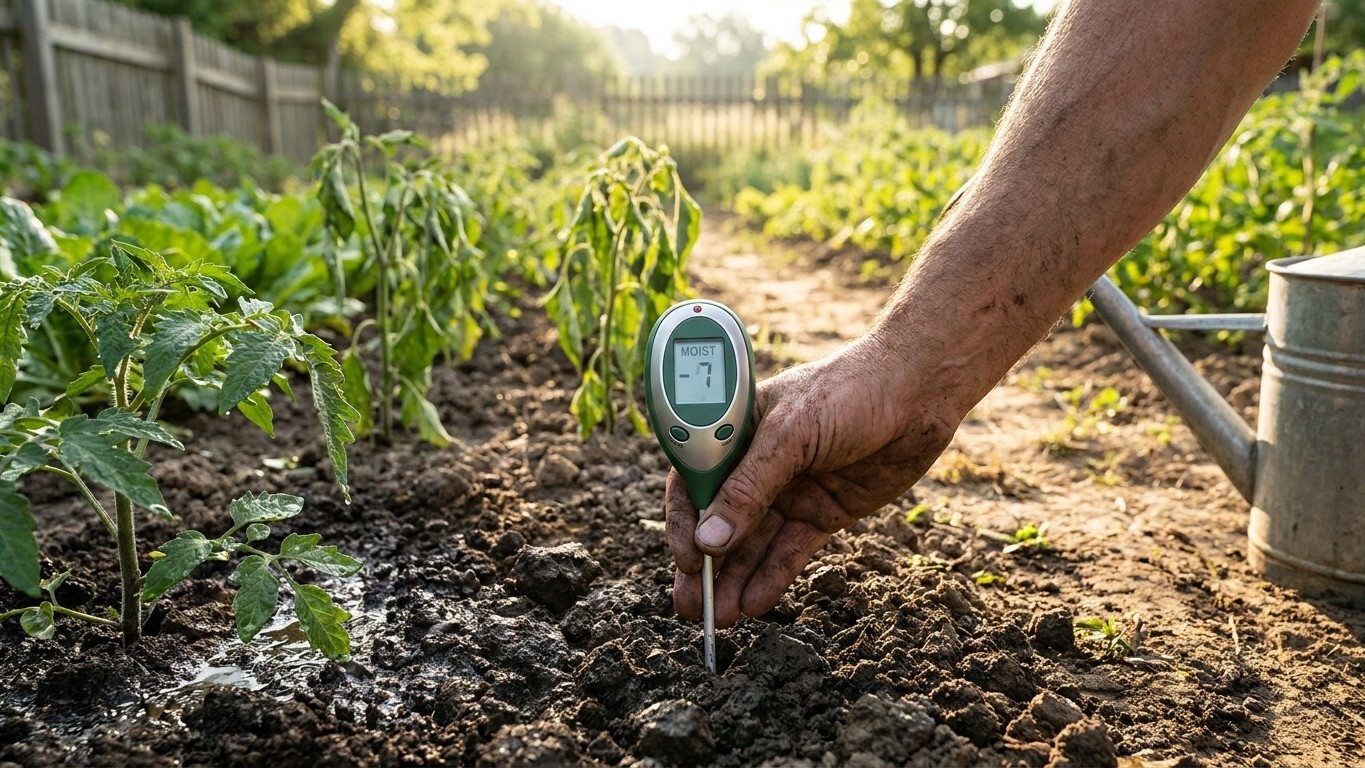

Kentucky gardeners lose the water fight not because the state is short on rain, but because that rain refuses to show up on schedule. A bed still wants about an inch a week no matter what the sky provides. The fix is a deliberate rhythm: water deep, water at the base, water in the morning, and check the ground with your own hand instead of trusting a passing cloud.
What changes here

Two numbers set the terms for a Kentucky garden in high summer. August, the driest month of the growing season, averages 3.71 inches of rain. The same station logs 37.2 days a year at or above 90F. Put together, that’s a month with real rainfall on paper but heat load heavy enough to burn through it fast, which means the numbers look more generous on a chart than they feel with a trowel in your hand in the third week of a hot August.
Do the arithmetic and the gap gets clearer. A vegetable bed or a young shrub wants roughly an inch of water a week. August has a little over four weeks in it, so divide the month’s 3.71 inches across them and the sky is delivering something like 0.85 inch in an average week, just shy of the target. That sounds close enough to ignore, except rain in Kentucky summers rarely spreads itself out that evenly. It tends to arrive as a single afternoon thunderstorm, dumps most of a week’s allotment in twenty minutes, and a good share of it runs off a dry, compacted surface before it ever reaches root depth. The 37.2 days above 90F do the rest, pulling moisture back out of the top few inches of soil almost as fast as it goes in.
Soil texture decides how far that inch actually gets. Kentucky’s Bluegrass region and much of the western part of the state carry a good deal of clay in the topsoil, and clay holds onto water for days once it’s soaked in, but resists absorbing it in the first place, which is exactly why a hard summer storm tends to sheet off a clay bed instead of sinking in. Sandier pockets, more common along river bottoms, let water through fast and dry out again within a day or two. The June, July, and August normals (4.27, 4.05, and 3.71 inches respectively) are what the reference station usually sees over a thirty-year stretch, not a forecast for this particular summer, and they say nothing about what your own yard’s slope, shade, or soil compaction does to that rain once it lands.
How to water when it matters
The method that works on Kentucky ground is the same one that works everywhere, but the rhythm has to answer to the state’s soil and heat. Deep watering pushes moisture down where roots actually live, training them to grow downward instead of clustering at the surface. Watering at the base, rather than overhead, keeps leaves dry and cuts down on the fungal problems that thrive in the state’s humid, sticky summer air. Morning watering gives the soil hours to absorb before the day’s heat starts pulling moisture back out through evaporation, and it lets any leaf that does get splashed dry off before nightfall.
Checking the soil beats checking the sky every time. A finger pushed two inches down, or a trowel pulled up for a quick look, tells you what’s actually happening at root depth. The surface can look bone dry an hour after a storm and still be plenty moist an inch or two down, just as it can look damp on top after a light sprinkle while staying dust-dry where the roots need it.
- Push a finger or trowel two inches into the soil near the plant’s base; if it feels dry at that depth, it’s time to water.
- On heavier clay soil, water slowly and deeply once or twice a week, roughly an inch total, giving the water time to soak in rather than run off.
- On sandy or fast-draining soil, split that same inch into three or four shorter soakings a week, since the ground can’t hold a full week’s water at once.
- Water at the base of the plant, not overhead, aiming the hose or drip line at the soil rather than the leaves.
- Water in the early morning, before the day’s heat sets in, so the ground has time to absorb before evaporation takes over.
- Re-check with a finger two to three days later rather than watering on a fixed calendar, and adjust the frequency up or down based on what you actually feel in the soil.
Treat that one-inch figure as a starting point, not a rule carved in stone. A raised bed with loose, amended soil drains differently than a compacted clay yard ten feet away, and the only way to know for sure is to check your own ground rather than lean on a number from a chart.
What goes wrong
A little water every day
A quick daily splash feels responsible, but it wets only the top inch or so of soil. Roots follow the water, which means they stay shallow and close to the surface, exactly where the state’s 37.2 days of 90F heat bakes the ground hardest. A plant trained that way collapses fast the moment watering gets skipped for even a day or two.
Watering leaves in the evening
An evening hose-down feels like relief after a hot day, but wet foliage sitting overnight in Kentucky’s humid summer air is an open invitation to mildew and fungal disease. Water sitting on a leaf for eight or ten dark hours does far more damage than the same water landing at the plant’s base in daylight.
Trusting a passing shower
A loud summer thunderstorm can dump plenty of rain in twenty minutes and still leave the soil dry two inches down, especially on compacted clay where a hard rain sheets off rather than soaking in. The only way to know if that storm actually helped is the same finger test used everywhere else, not the sound of rain on the roof.
Skipping the mulch
Bare soil left exposed through an August stretch with 37.2 days of 90F heat gives up its moisture fast, sun and wind pulling it straight back out within hours of watering. A two- to three-inch layer of mulch around the base of a plant slows that loss dramatically and stretches the interval between waterings.
Local help
The University of Kentucky Cooperative Extension Service tracks local growing conditions, soil questions, and seasonal advice county by county through its Extension office directory. Watering restrictions during dry stretches vary by water utility and change from year to year, so check with your own local water provider before setting a summer watering schedule.
Common questions
How often should I water my garden during a Kentucky dry spell?
Check the soil two inches down with a finger every two to three days rather than watering on autopilot. Clay soil often needs a deep soak once or twice a week; sandy soil may need shorter waterings three or four times a week.
Is it better to water in the morning or evening in Kentucky?
Morning. It gives the soil time to absorb water before the day’s heat pulls it back out, and any moisture that lands on leaves has hours to dry before nightfall, cutting down on fungal disease in the state’s humid air.
Does an August thunderstorm mean I can skip watering?
Not necessarily. A heavy storm can run off compacted or clay soil before it soaks in. Check with a finger or trowel two inches down before assuming the rain did the job.
Does mulch really make a difference in Kentucky’s heat?
Yes. With 37.2 days a year reaching 90F or higher, bare soil loses moisture fast to sun and wind. A few inches of mulch slows that evaporation and stretches the time between waterings.