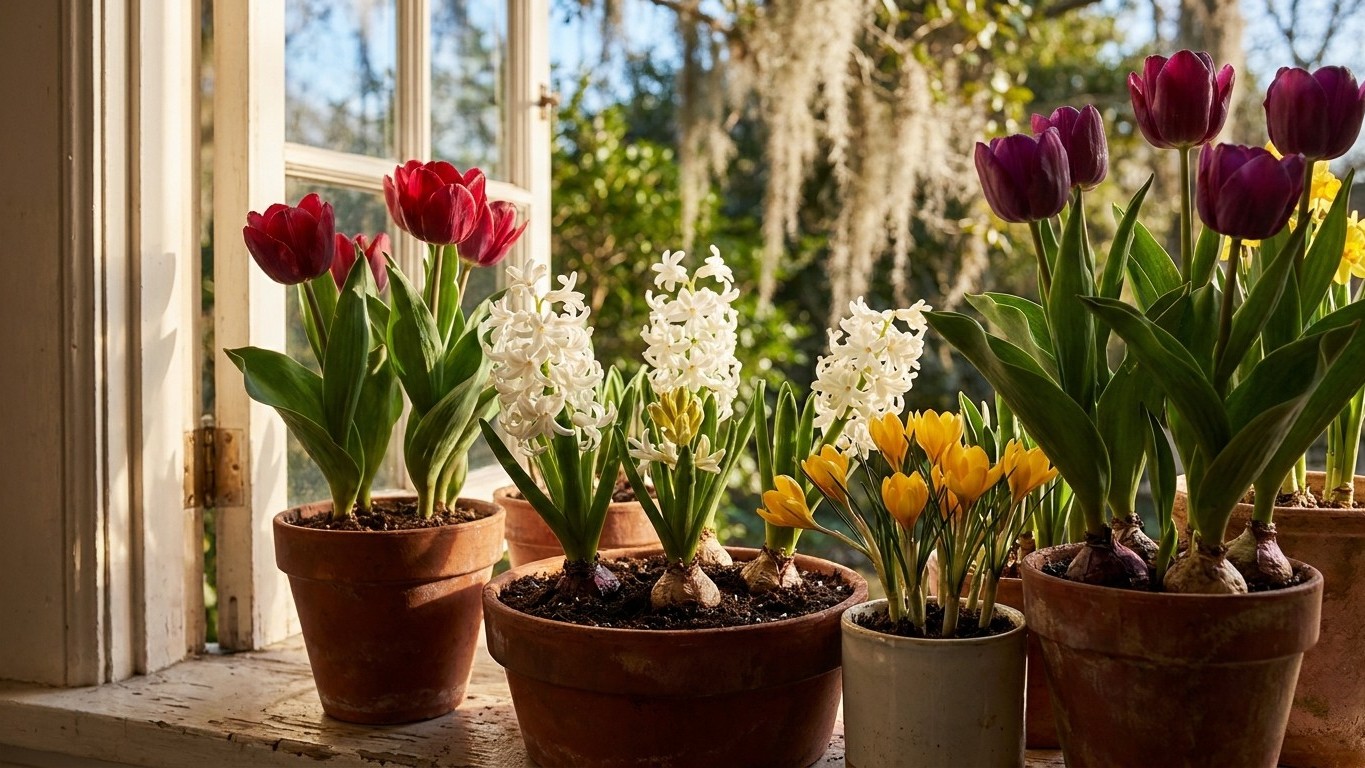

Louisiana’s mild winters don’t deliver the sustained chill spring bulbs need to bloom, so forcing indoors is the reliable route for tulips, hyacinths, and crocus grown in pots here. The coldest month averages a daily low of just 46.1°F, and container freeze-through, the risk that worries gardeners further north, is rarely the problem in this territory. Timing the artificial cold is.
Why this matters in Louisiana

Start with the number that decides everything: 46.1°F. That’s the mean daily minimum for the coldest month, measured at the New Orleans reference station under NOAA NCEI’s 1991-2020 Climate Normals. Spring bulbs like tulips and hyacinths need roughly twelve to fourteen weeks with temperatures consistently below 45°F to break dormancy and set a flower bud. When the coldest month’s average low sits above that threshold, the ground simply never gets cold enough, long enough, to do the job on its own.
That single figure flips the whole question. In a place where winter reliably drops well below freezing for months, the gardener’s job is protecting bulbs from too much cold, and the container problem dominates: a pot freezes solid, roots and all, while the same bulb planted in a garden bed stays insulated by surrounding soil that only freezes at the surface. A hardiness zone that lets a tulip bulb survive in the ground can still kill it in a pot on a porch, because the pot has no thermal mass to buffer the swing.
Louisiana sits in the opposite situation. With a USDA hardiness range of 8a to 10a across the state (2023 Plant Hardiness Zone Map, built on 1991-2020 normals), winters are mild enough that container freeze-through almost never happens to a spring bulb sitting outside. The risk here isn’t the pot freezing. It’s the pot never getting cold enough for long enough. That’s why forcing, supplying the missing weeks of chill yourself in a refrigerator or an unheated space, is the technique that actually matters for this territory, not container insulation or wrapping pots against frost.
Worth noting: 8a to 10a is a wide spread for one state. New Orleans anchors the milder end near 10a, while parishes further north and inland run cooler, closer to 8a. Anyone gardening near the northern edge of the state should expect slightly more natural cold than the New Orleans figure suggests, though not enough, in most years, to replace deliberate chilling for classic spring bulbs.
How to do it here
Forcing a bulb is mechanical, not mysterious. It’s a matter of giving the bulb the cold it would have gotten naturally further north, then warming it up in the right order. Here’s the sequence, step by step.
- Pick bulbs suited to short chilling. Species that need fewer weeks below 45°F succeed more reliably when the source of cold is a refrigerator drawer rather than an entire winter.
- Pot the bulbs in a container with drainage holes, using a well-draining mix. Set them shoulder to shoulder, tips just at the soil surface, and water lightly.
- Find a chilling spot that stays consistently below 45°F but above freezing. An unheated garage that doesn’t dip below 32°F works if the state’s mild winters keep it there; a refrigerator crisper drawer is the more dependable option since the temperature doesn’t swing.
- Keep the pot away from ripening fruit if chilling in a refrigerator. Apples, pears, and bananas release ethylene gas, and ethylene damages the flower bud forming inside the bulb before it ever opens.
- Check the soil every couple of weeks and keep it barely moist, never soggy. Bulbs chilling in a dry fridge drawer dry out faster than most people expect.
- Hold that cold for the full period the bulb species requires before moving it anywhere warmer. Cutting the chill short is the single most common reason forced bulbs fail to flower.
- Move the pot to a cool, dim spot indoors first, not straight to a sunny windowsill, and let it adjust for several days before giving it bright light and warmth.
None of these steps require guesswork. A thermometer in the garage, a drawer in the fridge, a calendar on the wall, that’s the whole toolkit. If a bulb is meant to stay in the container after blooming rather than get planted out, the container hardiness question from the section above still applies: in zone 8a to 10a, pots left outside afterward rarely face a freeze severe enough to kill the bulb, which is one less thing to manage in this climate compared to colder regions.
Which bulbs are worth it
Not every bulb rewards the trouble of forcing. Species with a short natural chill requirement come out of dormancy faster and tolerate the compressed schedule of an indoor chill period better than bulbs that evolved for a long, hard winter. Stem height matters too: a bulb that throws up a two-foot flower stalk is asking for trouble in a shallow container, where it topples the moment the bloom opens.
There’s also a practical point worth making plain: many spring bulbs grown in pots in Louisiana’s climate are treated as a one-season purchase anyway, since the mild winters here don’t reliably re-chill them for a second bloom the following year. That makes forcing essentially free in the long run. The bulb wasn’t going to perform again regardless, so using it up for one good indoor display costs nothing extra.
- Paperwhite narcissus (needs no chilling at all, the classic warm-climate forcing bulb)
- Crocus (short chill requirement, compact enough for any pot)
- Hyacinths (reliable bloomer indoors, sturdy stem)
- Grape hyacinth (muscari) (short and dependable)
- Dwarf daffodil varieties (shorter stems handle pot life better than standard types)
On the other side, a few bulbs sulk under forcing conditions or simply aren’t built for a container.
- Tall trumpet daffodils (long chill requirement, stems too tall for most pots)
- Standard tulip varieties (need the longest cold period of the common spring bulbs, and topple easily once in bloom)
- Fritillaria imperialis (finicky chilling needs and a tall, top-heavy flower spike)
- Camassia (grows too tall and leggy for reliable container display)
A reader unsure which bulb they’re holding can usually settle it by height and bloom time on the label: anything marketed as a “dwarf” or “miniature” variety of a species above the eight-inch mark is the safer container bet.
What goes wrong, and when you can still fix it
Leaves but no flower
Green growth with no bloom means the chilling period was cut short. The bulb had enough stored energy to push up leaves but never finished forming the flower bud inside, which requires the full cold window to complete. This can’t be fixed this season. The bulb has already spent its reserves. If it’s a bulb worth keeping, the only fix is starting over next fall with the full chill duration, timed against a calendar rather than a guess.
Short stem, hidden flower
A bloom that opens practically at soil level, buried under the foliage, usually means the pot was moved from cold storage to warmth too abruptly. The stem didn’t get the gradual transition it needed to elongate normally before the flower opened. This one is done for the season once it happens, there’s no reversing a stem that’s already finished elongating. Next time, give the pot several days in a cool, dim room before moving it to full light and warmth.
Rot in the pot
Soft, discolored bulb tissue or a moldy smell almost always traces back to drainage. A container without drainage holes, or a soil mix that stays waterlogged during the chilling weeks, drowns the bulb before it ever gets the chance to grow. Once rot sets in, the bulb is not salvageable. The fix is entirely preventive: drainage holes every time, and a mix that dries slightly between waterings rather than one that holds standing moisture for weeks.