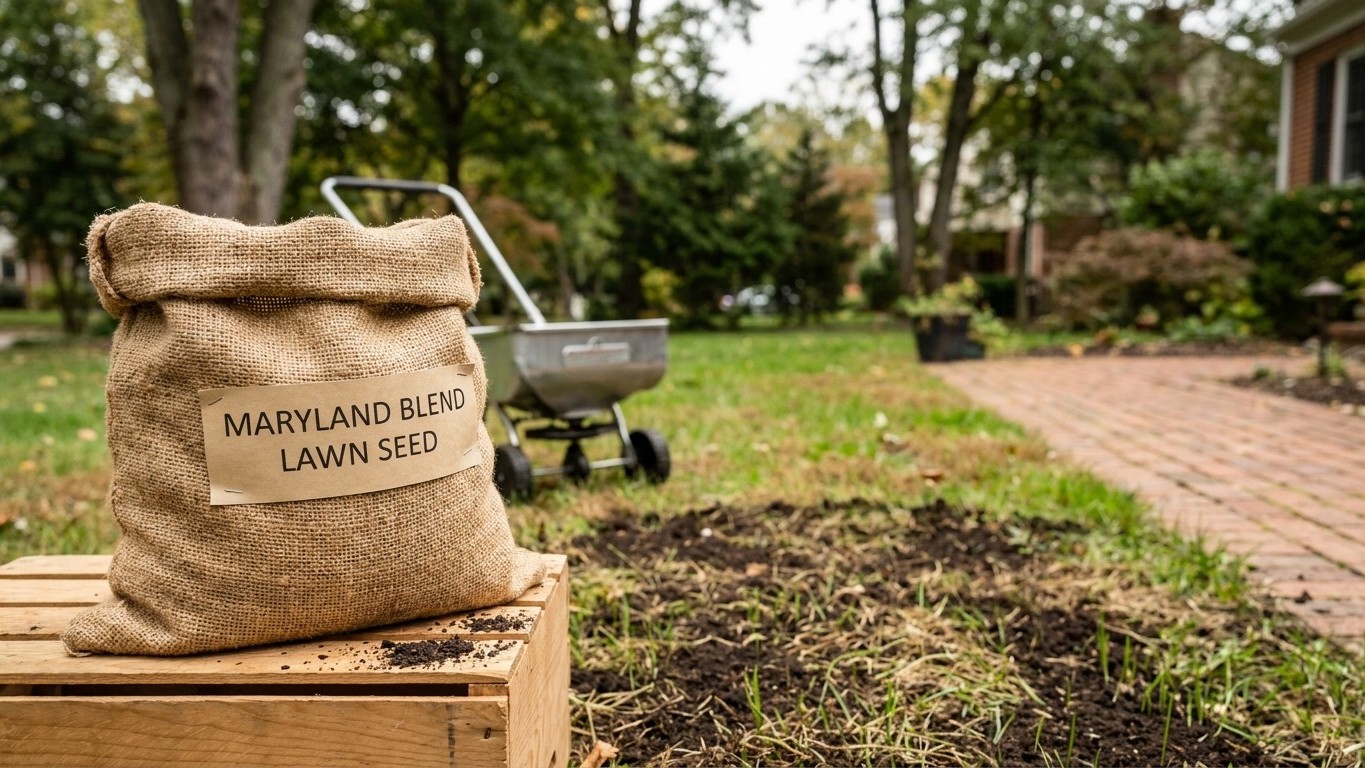

There’s no single best seed for a Maryland lawn, and that’s actually good news once you see why. You’re sitting in the transition zone, which means every seed on the shelf is a trade: green in winter or green in summer, but not both. So before you look at a single bag, walk outside and decide which season you actually care about seeing your lawn — the one when the kids are out of school, or the one when you’re hosting people in the yard. That answer picks your grass for you.
The short answer for Maryland
There is no single best grass seed for a Maryland lawn, because Maryland’s climate sits in what turf scientists call the transition zone: too hot in summer for cool-season grass to thrive without stress, too cold in winter for warm-season grass to stay green. Clemson Cooperative Extension’s HGIC 1214 groups tall fescue, Kentucky bluegrass and perennial ryegrass as the cool-season options for this zone, and zoysiagrass and bermudagrass as the warm-season options, with Penn State Extension providing the agronomic detail on the cool-season species.
Each side trades one season of good looks for another. A cool-season lawn of tall fescue or Kentucky bluegrass stays green from fall through spring and can thin or brown under July and August heat and drought, but it recovers once cooler, wetter weather returns. A warm-season lawn of zoysiagrass or bermudagrass holds color and density through the hottest stretch of summer, then goes dormant and brown from the first fall frost until spring green-up. Near Baltimore, NOAA’s 1991-2020 climate normals put that first fall frost between October 26 and November 5, so a warm-season lawn there is brown for roughly five months of the year.
Which trade-off is worth it depends on how you use the lawn. A household that wants green grass for a spring garden party and doesn’t mind a tan lawn over the holidays leans warm-season. A household that wants green grass through the school year and can tolerate some summer stress leans cool-season. Neither choice is a mistake once you understand what you’re signing up for before you buy seed.
Working through the year

The calendar for a Maryland lawn depends entirely on which grass you planted, because cool-season and warm-season species are worked in opposite halves of the year. Mixing up the two calendars is the single most common way a Maryland lawn gets fed or seeded at exactly the wrong time.
Cool-season lawns: tall fescue, Kentucky bluegrass, perennial ryegrass
Clemson’s HGIC 1219 tall fescue maintenance calendar sets the pattern that also applies loosely to bluegrass and ryegrass lawns: the working season runs from late summer through fall, with a second, lighter window in early spring. Fall is when you seed, overseed thin patches, aerate compacted soil and apply the bulk of the year’s nitrogen, because cool-season grass is building root mass for the winter ahead. Spring gets a lighter feeding and any needed pre-emergent for crabgrass, but heavy nitrogen in spring pushes leaf growth right before the plant needs to be conserving energy for summer stress. Mowing height matters here too: keeping fescue and bluegrass on the taller end of their recommended range through summer shades the soil and reduces water loss, per HGIC 1219. Through July and August, the job is simply keeping the lawn alive: mow high, water deeply but infrequently, and expect some thinning even with good care. This is the exact plan laid out month by month in The Maryland Lawn Care Calendar, Month by Month, which lines these tasks up against the actual months.
Warm-season lawns: zoysiagrass, bermudagrass
Zoysiagrass and bermudagrass run on the opposite schedule, per Clemson’s HGIC 1217 zoysiagrass calendar and HGIC 1216 bermudagrass calendar. Both green up in late spring once soil has warmed, and that green-up is when the first nitrogen application goes down, not before. Summer is the growing season: regular mowing, the bulk of the year’s feeding and irrigation happen here. Mowing height runs the opposite direction from cool-season grass: zoysiagrass and bermudagrass are cut low and often through summer, per HGIC 1217 and HGIC 1216, and letting either grow tall between cuts encourages thatch. By fall, feeding stops well ahead of the first frost, because late nitrogen encourages soft new growth that frost then damages, weakening the plant heading into winter. Once dormant, the lawn needs no mowing, no feeding and no water beyond what rain provides.
Whichever calendar applies to your lawn, the general framework of Maryland Lawn Care holds: match the task to the species’ active growing season, not to the season that just happens to be convenient.
| Grass | Season type | Green during | What it costs you |
|---|---|---|---|
| Tall Fescue | Cool-season | Fall through spring | Thins under high summer heat and drought |
| Kentucky Bluegrass | Cool-season | Fall through spring | Shallow roots need more water through summer heat |
| Perennial Ryegrass | Cool-season | Fall through spring | Usually a nurse grass or overseed, not a standalone lawn |
| Zoysiagrass | Warm-season | Late spring through early fall | Brown and dormant from first fall frost to spring green-up |
| Bermudagrass | Warm-season | Late spring through early fall | Same dormancy window, and it can spread aggressively into beds |
What changes across Maryland
The frost window and grass performance figures above are measured at or near Baltimore, and Maryland’s geography changes enough east to west that a single set of dates doesn’t hold for the whole state.
In the mountainous terrain of Garrett and Allegany counties, elevation cools the growing season on both ends. NOAA’s 1991-2020 climate normals note that this western strip runs weeks later than Baltimore’s October 26 to November 5 frost window, which shortens the usable growing season for warm-season grass even further and makes the case for tall fescue or Kentucky bluegrass stronger there than anywhere else in the state.
The Eastern Shore, by contrast, runs milder than Baltimore, moderated by the Chesapeake Bay and the Atlantic. A milder, longer warm season there narrows the gap that zoysiagrass and bermudagrass have to close before the first frost, and it’s the part of Maryland where a warm-season lawn comes closest to matching a cool-season one for total green days in a year.
None of this changes which five species are realistic choices statewide, per HGIC 1214, but it does shift which side of the cool-season versus warm-season trade-off makes more sense for a given county. Homeowners near the Baltimore-Washington corridor, where the NOAA station behind these figures actually sits, can use the October 26 to November 5 window directly. Anyone outside that corridor should treat it as a starting point and expect their own first frost to land earlier or later depending on which side of the state they’re on.
The mistakes this climate punishes
Maryland’s transition-zone climate is unforgiving of timing mistakes in a way milder or more consistent climates are not. The margin between a task done at the right time and the same task done a month off can be the difference between a lawn that thickens and one that dies back.
Feeding a warm-season lawn in fall
Applying nitrogen to zoysiagrass or bermudagrass as the weather cools pushes soft new growth right when the plant should be shutting down for dormancy. That growth has no time to harden off before the first frost arrives, and the damage shows up the following spring as slow, patchy green-up rather than the week it was applied.
Seeding cool-season grass too late in spring
Tall fescue, Kentucky bluegrass and perennial ryegrass germinate fine in warm spring soil, but seedlings sown as late as May run straight into summer heat before they’ve built enough root system to survive it. The seed germinates, looks promising for a few weeks, and then thins out through July. Damage from a late spring seeding doesn’t show until the exact season it was trying to avoid.
Scalping in summer heat
Cutting cool-season grass down to a short height during a summer hot spell removes the leaf area the plant needs to shade its own root zone and recover from drought stress. The lawn looks fine the day it’s mowed and visibly stressed within a week, browning in patches that take until fall’s cooler weather to fill back in. Raise the mower deck, not lower it, once summer heat sets in, regardless of which grass you’re growing.
Assuming a brown lawn is a dead lawn
A warm-season lawn that’s brown from October through April, on schedule with the first fall frost window, is dormant, not dying. Homeowners who rip out zoysiagrass or bermudagrass in late winter because it looks dead, then reseed with cool-season grass, end up fighting the entire transition-zone trade-off from scratch rather than waiting for the warm-season lawn to green back up on its own timeline.
Checking this against your county
Every figure above is measured at or near Baltimore, and Maryland’s counties differ enough in elevation, soil and coastal exposure that your own frost dates and growing season can run days or weeks off that mark. Before you buy seed or lock in a calendar date, check the county-level guidance from the University of Maryland Extension, which can point you to the office and the current recommendations for your specific county.
If you’re not sure which side of the cool-season versus warm-season trade-off to take, that’s also the office to ask, since local agents see what actually survives a Maryland winter or summer in your particular soil and site, not just what the statewide averages predict.
Common questions
Can I grow bermudagrass in Maryland?
Yes, bermudagrass survives in Maryland’s transition zone and is one of the two warm-season options listed by Clemson Cooperative Extension’s HGIC 1214. Expect it brown and dormant from the first fall frost until spring, and be aware it spreads aggressively by stolons into adjacent beds and can be hard to contain once established.
What’s the best time to overseed a fescue lawn in Maryland?
Fall is the window Clemson’s HGIC 1219 tall fescue calendar centers on, because seed germinating into cooling, moister soil has all winter and spring to build roots before summer heat arrives. Spring overseeding is possible, but the seedlings have far less time to establish before their first hot season.
Why is my zoysiagrass still brown in April?
Zoysiagrass green-up follows soil warming, not the calendar date, so a cool, wet spring can push it later than a warm one. It’s usually not a sign of a dead lawn unless large sections stay bare once nearby lawns, or neighboring zoysia, have clearly greened up already.
Should I mix cool-season and warm-season seed in the same lawn?
No. Cool-season and warm-season grasses have opposite active growing seasons, so a mixed stand means one type is always dormant or stressed while the other thrives. Neither the mowing height nor the feeding schedule can be right for both at once.