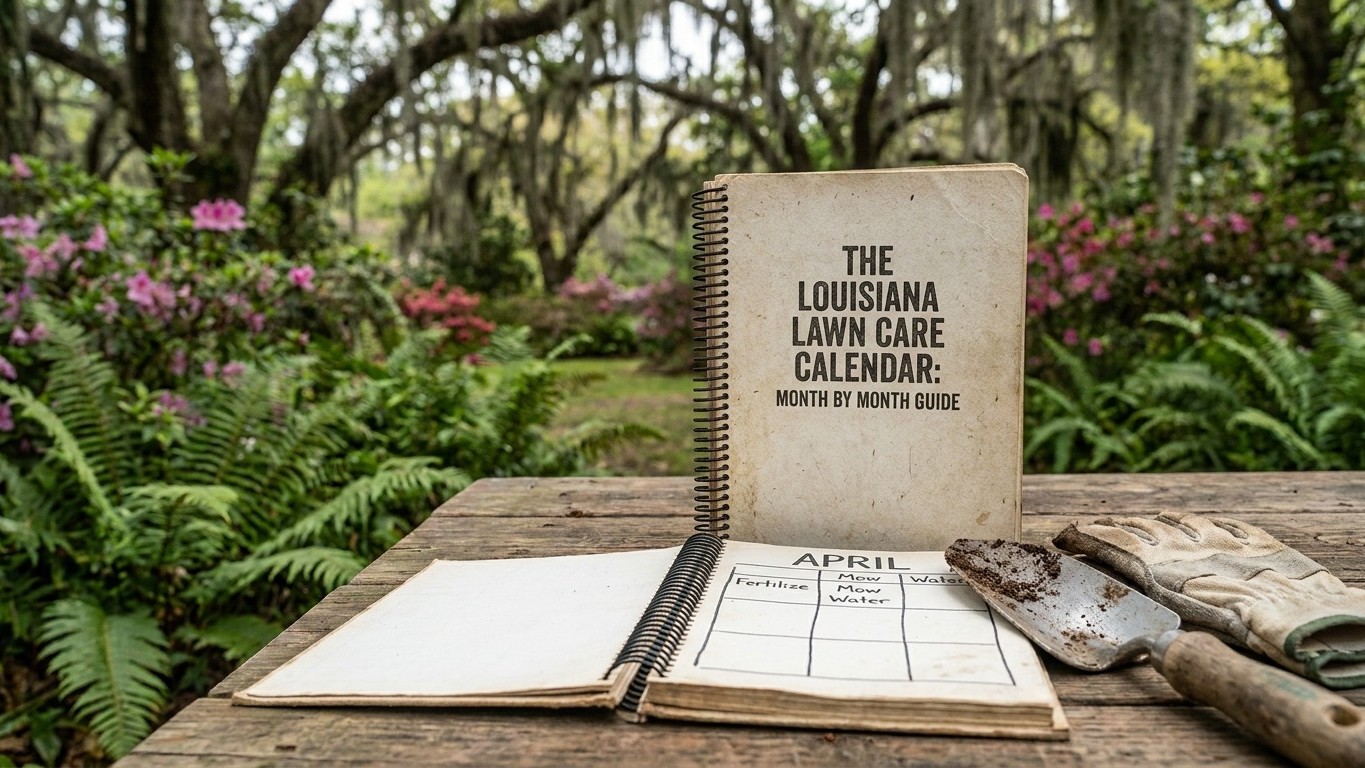

Shreveport’s hard freezes and the marsh south of New Orleans barely freezing at all mean no single date on a calendar was ever going to hold for the whole state. Louisiana sits in the warm-season zone, but that zone stretches from a cold edge near the Arkansas line to ground that skips winter entirely. Bahiagrass, Bermudagrass, Centipede, St. Augustine, Zoysiagrass, Carpetgrass and Seashore Paspalum hold this ground — not the fescue that greens up every spring and cooks by July.
The short answer for Louisiana
Louisiana sits in the warm-season lawn zone, the label The Homestead Post assigns using the season tolerances published by Clemson Cooperative Extension (HGIC 1214) read against how many days a place spends above 90°F and how mild its coldest month runs. That zone fits the reference city of New Orleans specifically. The far north of the state, up around Shreveport, freezes hard and often enough to sit closer to the cooler edge of that same warm-season zone, and the marsh and barrier islands south of New Orleans barely freeze at all.
The species that actually hold a Louisiana lawn are Bahiagrass, Bermudagrass, Carpetgrass, Centipedegrass, Seashore Paspalum, St. Augustinegrass and Zoysiagrass, per Clemson Cooperative Extension HGIC 1214. A cool-season lawn, the tall fescue, Kentucky bluegrass or perennial ryegrass that Penn State Extension covers for the northern half of the country, will green up nicely every spring here and then cook to death by midsummer. If you haven’t settled on a species yet, The Best Grass Seed for Louisiana Lawns walks through which of the seven fits a given yard.
The date that matters most on paper, the first fall freeze, is a wide window rather than a day. NOAA’s NCEI puts it at December 17 to January 8 for the station nearest New Orleans, using the 1991-2020 climate normals’ 32°F freeze-probability band. What the calendar below actually depends on is not that date. It depends on which warm-season grass is already growing in the yard, because Bermudagrass, Centipedegrass, St. Augustinegrass and Zoysiagrass each keep a different mowing height and feeding schedule, set out in Clemson’s species-specific maintenance calendars.
Working through the year

Once a lawn is established (see Louisiana Lawn Care for getting one started), the yearly work on a warm-season lawn breaks into four stretches: spring green-up, peak summer growth, fall shutdown and winter dormancy. Clemson Cooperative Extension publishes a separate calendar for each species, HGIC 1216 for Bermudagrass, HGIC 1217 for Zoysiagrass, HGIC 1215 for Centipedegrass and HGIC 1218 for St. Augustinegrass, and each sets its own mowing height, nitrogen rate and irrigation depth. Pull up the calendar that matches the grass actually growing in the yard before setting a mower deck or spreader rate, because the four species do not share a schedule.
| Grass | Clemson maintenance calendar | Sun needs |
|---|---|---|
| Bermudagrass | HGIC 1216 | Full sun, poor shade tolerance |
| Zoysiagrass | HGIC 1217 | Full sun to light shade |
| Centipedegrass | HGIC 1215 | Full sun to light shade |
| St. Augustinegrass | HGIC 1218 | Full sun to moderate shade |
Spring: green-up and pre-emergent
Warm-season turf greens up as the soil warms, not on a fixed calendar date, and the first mow of spring should wait until green-up is well underway rather than starting on last year’s date. Pre-emergent herbicide for summer weeds like crabgrass goes down before that green-up, timed to soil temperature rather than the day of the month. First nitrogen feeding follows green-up, not before it, and feeding a lawn while it is still brown wastes the fertilizer and can feed winter weeds instead of the turf.
Summer: mowing and irrigation at the peak
This is the stretch that does the real work of the year, and Louisiana’s heat and humidity make it longer and more demanding here than in most places warm-season turf grows. Mow often enough that no single cutting removes more than about a third of the leaf blade. The exact deck height and weekly irrigation depth for the grass actually growing in the yard are set out species by species in Clemson’s HGIC 1216, 1217, 1215 and 1218 calendars, and cutting any of the four shorter than its own calendar recommends is what invites summer scalping and disease.
Fall: the last feeding, not a new one
Warm-season grass needs to slow down and harden off before whatever freeze the winter brings, and that freeze is unpredictable here. Stop nitrogen feeding well ahead of the fall freeze window rather than pushing one more round of fertilizer into September or October. A lawn still growing hard when a freeze does hit browns harder and comes back slower the following spring.
Winter: dormancy, not death
A warm-season lawn that browns after a freeze is dormant, not dead, and it greens back up on its own once soil temperatures climb again in spring. Mowing all but stops. The main winter task most Louisiana lawns need is staying off wet turf and keeping fallen leaves from smothering the crown.
What changes across Louisiana
The figures in this calendar are measured at the NOAA station nearest New Orleans, and Louisiana is long enough, and varied enough in coastline, that other parts of the state run on a different clock.
North Louisiana freezes harder and more often
Up around Shreveport and the rest of the northern parishes, winter delivers more freezes, and more reliable ones, than the coast does. A lawn there hardens off earlier in fall and can be counted on to stay dormant through more of the winter, which actually makes the fall feeding cutoff easier to judge than it is near the coast, where a warm November can fool a lawn into pushing new growth right before a freeze finally shows up.
The coast and the river parishes barely freeze at all
Near New Orleans and along the Gulf coast, a warm-season lawn can stay green, or close to it, straight through what would be full winter dormancy farther north. That is not a bonus. It means summer heat stress, fungal disease and weed pressure all run longer here than in almost anywhere else warm-season turf is grown, and mowing and irrigation both need to keep going later into what other regions would already call the off-season.
Drainage changes the picture too
Louisiana has little elevation to speak of, but drainage does much of the job elevation does elsewhere. A low-lying yard that holds water after rain stays wetter, invites more fungal disease in summer, and often needs a different irrigation schedule than a well-drained yard two streets over, even within the same parish.
The mistakes this climate punishes
Feeding a warm-season lawn into fall
Nitrogen pushed into a Bermudagrass, Centipedegrass, St. Augustinegrass or Zoysiagrass lawn in September or October keeps it growing right when it should be hardening off for whatever freeze eventually shows up in the December-to-January window NOAA records for the New Orleans area. The damage doesn’t show until that freeze actually arrives. A lawn fed late browns harder and comes back slower than one that was already dormant.
Planting cool-season grass because it looks better in spring
Tall fescue and other cool-season species genuinely do look better than any warm-season lawn during a Louisiana spring, which is exactly why people plant them here and then watch them collapse. The failure doesn’t show in April. It shows by midsummer, when the same heat and humidity that put this state in the warm-season zone cook a cool-season lawn to death over a matter of weeks, with no fall recovery the way a warm-season lawn’s winter browning recovers.
Cutting too short during a heat wave
Scalping a lawn in July to get ahead of growth removes the leaf area the grass needs to shade its own roots and crown, and in Louisiana’s summer heat that damage shows within days, not weeks, as a yellow or thinning lawn that stays weak until cooler weather returns. Raise the mower deck in the hottest stretch of summer rather than lowering it, whatever baseline height the species-specific Clemson calendar sets.
Guessing at the pre-emergent date
Putting pre-emergent herbicide down on a fixed calendar date rather than watching soil temperature either wastes the application, because it breaks down before weed seeds germinate, or misses the window entirely if a warm spell arrives early. Either mistake shows up as a crabgrass or goosegrass flush in early summer that better timing the following year would have prevented.
Checking this against your county
Every figure above comes from a single NOAA station near New Orleans, and Louisiana runs from Gulf marsh to the hill country near Arkansas, so a lawn in Shreveport, Monroe or Alexandria is working with a different freeze calendar than one in Metairie or Houma. The LSU AgCenter keeps parish-level guidance and can confirm local freeze risk, soil type and disease pressure for wherever the lawn actually sits. Confirm the freeze risk for your parish before locking in a date for the first spring feeding or the last one in fall.
Common questions
Can I just water a cool-season grass like fescue enough to get through a Louisiana summer?
No. Extra irrigation buys a cool-season lawn a few extra weeks at best, but Louisiana’s summer heat and humidity are the reason this state sits in the warm-season zone in the first place, and fescue, bluegrass and ryegrass all decline under those conditions no matter how much water they get. Plant one of the seven warm-season species Clemson Cooperative Extension lists for this region instead.
Why did my Centipedegrass stay brown in spring while the neighbor’s Bermudagrass already greened up?
The two species green up on different timelines even in the same yard, and Centipedegrass is one of the slower warm-season grasses to start each spring, which is why Clemson’s HGIC 1215 calendar sets its first mowing and feeding later than the Bermudagrass calendar, HGIC 1216, does. Check that the lawn isn’t also still recovering from being fed too late the previous fall, which delays green-up further.
Should I overseed my Bermudagrass with ryegrass for green color in winter?
You can, and it is purely cosmetic. Ryegrass overseeded into a dormant Bermudagrass lawn keeps color through winter, but it competes with the Bermudagrass as it wakes up in spring, so it needs to be mowed out or allowed to die back before the warm-season grass’s own spring green-up gets going.
My lawn barely goes dormant most winters. Is that normal?
Yes, if the lawn sits near the coast. NOAA’s 1991-2020 climate normals show a 32°F freeze happens in only 86.8 percent of years at the station nearest New Orleans, so in roughly one winter out of seven there is no freeze at all, and a warm-season lawn there can stay partly green right through what would be full dormancy farther north.