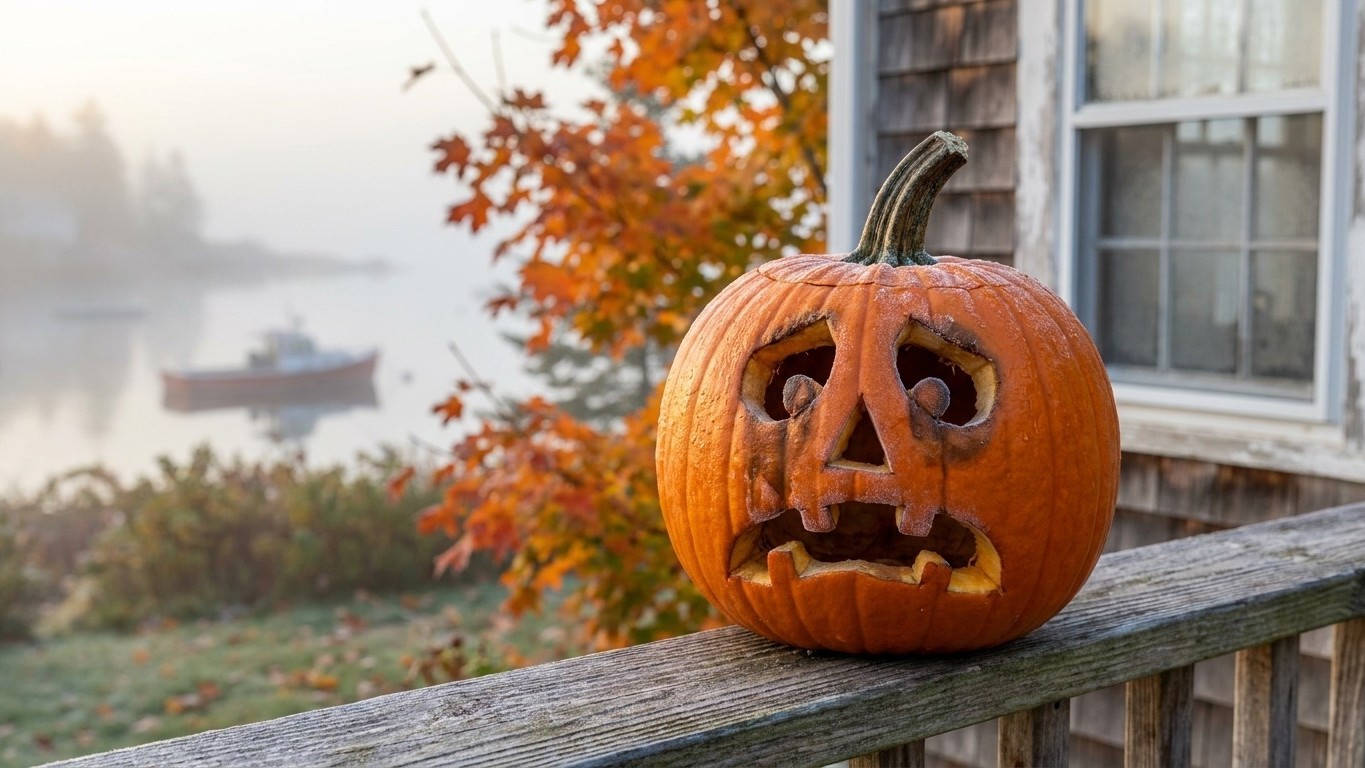

Around Portland, the mean first fall frost lands between October 9 and October 21, according to NOAA climate normals. That’s roughly ten to twenty-two days before Halloween. For a pumpkin sitting on a porch waiting for October 31, that gap matters. In most of Maine, frost arrives well before Halloween, not on it and not after it. The carving window this creates is narrow enough that timing, not luck, decides whether your pumpkin still looks good on trick-or-treat night.
The short answer

Along the coast near Portland, the mean first fall frost falls somewhere between October 9 and October 21. That’s an average drawn from three decades of NOAA data, not a guarantee for any single year. Some autumns push later, some arrive earlier, and a mean frost date only tells you where the middle of that range sits. Still, it’s the best planning tool available, and it says something useful: in coastal Maine, frost is likely to show up ten days to three weeks ahead of Halloween.
That timing changes the whole calculation for a carved pumpkin. A jack-o’-lantern carved too early spends extra days exposed to cold, moisture, and Temperature swings before it ever meets a porch light on Halloween night. In a territory where frost tends to arrive well ahead of the holiday, carving early doesn’t buy you anything extra. It just adds days of decline to a pumpkin that’s already cut open and vulnerable.
Inland and northern Maine complicate this further. The October 9 to October 21 window comes from a coastal reference station, and Maine’s interior and northern counties run substantially colder in fall than the coast does. If you’re carving in Aroostook County or the western mountains, treat that window as the late edge of what’s possible, not the middle. Frost there tends to arrive earlier, sometimes well before the coastal average, which shrinks the safe carving period even further.
The practical takeaway: carve close to Halloween, not weeks ahead of it. A pumpkin carved three or four days before October 31 gives you a display that still looks fresh on the night that matters, without asking a cut, exposed pumpkin to survive frost, freeze-thaw cycles, or extended time outdoors in a climate that’s already tilting cold by mid-October. If your area tends to see frost on the earlier side of the window, or if you’re inland, lean toward carving even closer to the day.
Frost or heat: which one gets it here
A whole pumpkin keeps best stored between 45 and 50 degrees Fahrenheit, according to University of Illinois Extension. That’s a narrow band, and the question for any territory is which direction the local climate pushes past it: too warm, or too cold. In Maine, the answer is unambiguous.
The cold end
Maine’s coldest month has a mean daily minimum temperature of 15.6 degrees Fahrenheit at the Portland reference station. That’s the average low on a typical night in the depths of winter, not a record and not an outlier. It signals just how firmly the state sits on the cold side of that 45-50 degree storage band once autumn turns toward winter. By the time frost has already arrived, which in Maine tends to happen well before Halloween, overnight temperatures are frequently dropping below the pumpkin’s ideal storage range, and they keep dropping from there. Freezing, not warmth, is what threatens a pumpkin left unprotected outdoors in Maine during pumpkin season.
The warm end
Heat simply isn’t the risk here. Some southern states worry about pumpkins softening or rotting in temperatures that stay too warm through October, but Maine’s climate doesn’t create that problem. Even the mildest, most coastal parts of the state are trending cooler by the time frost dates arrive, and nowhere in Maine does late October run warm enough to threaten a stored pumpkin from the heat side of the equation. The entire concern here sits on the cold end: keeping a pumpkin from freezing, not keeping it from cooking.
That distinction matters for storage decisions. A pumpkin problem in Maine isn’t solved by finding shade or a cooler spot. It’s solved by finding somewhere that doesn’t dip well below that 45-50 degree band on the coldest nights, which in this climate usually means bringing it indoors rather than leaving it exposed on an open porch once nighttime temperatures start falling toward the mean minimums.
Where to keep it until you carve
- An unheated garage or mudroom. These spaces typically run cooler than the living areas of a house but stay buffered from the sharpest overnight cold, making them a reasonable match for that 45-50 degree storage window in Maine’s climate.
- A three-season porch, if it’s enclosed. An open, uncovered porch exposes the pumpkin directly to whatever the night delivers, and in Maine that can mean temperatures well under 45 degrees once frost season sets in. An enclosed porch offers some protection while still staying cooler than the house interior.
- A cool basement or root cellar corner. Basements tend to hold steadier temperatures than anywhere above ground, and a corner away from the furnace or any heating duct can land close to the ideal range even as outdoor temperatures swing.
- Away from ripening fruit and vegetables. Store the pumpkin apart from apples, potatoes, or tomatoes. Ripening produce gives off a gas that speeds up aging in a pumpkin sitting nearby, which is exactly why a porch shared with a crate of fall apples tends to work against you rather than for you.
- Somewhere dark. Light exposure isn’t the main concern the way temperature is, but a dim, out-of-the-way spot away from direct sun helps keep conditions steady, which matters more than any single factor when you’re trying to hold a pumpkin in good shape for weeks.
Once carved, none of this storage advice still applies in the same way. No university extension service publishes a preservation protocol for a carved pumpkin, and none publishes how many days a carved pumpkin is expected to last. Bleach dips, petroleum jelly coatings, and specific day counts you might see elsewhere don’t come from research institutions. What’s actually documented is simpler: choose a good pumpkin, keep it whole for as long as possible, and carve it close to the day you plan to display it.
Checking this against your own county
The frost window and temperature figures here come from a coastal reference station near Portland, and Maine’s interior and northern counties run colder and often earlier in fall than that coastal data suggests. Before you commit to a carving date, check conditions specific to your county through University of Maine Cooperative Extension. Their offices track local frost patterns and can tell you whether your area tends to run ahead of or behind the coastal average used in this guide. That local check matters more the farther you are from the coast, since a pumpkin plan built on Portland’s timing could leave an inland or northern Maine carver carving too late for their actual conditions.
Common questions
Does a hard freeze damage a pumpkin faster than a light frost?
A light frost and a hard freeze aren’t the same event, and a hardiness zone rating doesn’t predict either one. The frost dates and temperature figures cited here describe typical fall patterns, not a guarantee of what any single night will bring, so treat them as planning guidance rather than a fixed schedule.
What should I look for when buying a pumpkin in Maine?
University of Illinois Extension recommends choosing a pumpkin with 1 to 2 inches of stem still attached. Once that stem breaks off, the exposed spot becomes an entry point for spoilage. The pumpkin should feel heavy for its size, with no soft spots or blemishes. Shape doesn’t matter.
Can I carry a pumpkin by its stem?
No. The stem isn’t a handle, it’s a seal protecting that part of the pumpkin. Carrying or lifting a pumpkin by the stem risks breaking it off, which is exactly the damage that shortens a pumpkin’s storage life.
How long will a whole, uncarved pumpkin actually last?
A whole pumpkin stored between 45 and 50 degrees Fahrenheit in a cool, dark spot can keep for three to six months, according to University of Illinois Extension. That figure applies to a whole pumpkin only; once it’s carved, that storage life no longer holds, and no extension service publishes a replacement number for a carved one.