
Squash bugs typically appear in Manitoba gardens in late May through June, once soil and air temperatures hold steady above 70°F, and they stick around feeding on cucurbits until the first hard frost, usually mid-September to early October. Unlike gardeners in warmer states dealing with two overlapping generations a season, Manitoba’s short growing window generally limits Anasa tristis to a single generation per year. That single-generation pattern is actually the best piece of news in this whole story, and it shapes every control decision that follows.
Manitoba’s Growing Season Shapes the Squash Bug Timeline

Squash bugs don’t survive Manitoba winters as eggs or larvae. Adults overwinter, tucked under leaf litter, loose bark, mulch piles, or the siding of sheds and garden structures. When they emerge in spring, they don’t head straight for your garden. They wait for host plants, meaning squash, pumpkin, zucchini, cucumber, and melon vines, to put out real leaf growth. In most of southern Manitoba, that’s late May to mid-June, depending on how early the ground warmed up and whether transplants or direct-seeded cucurbits were used.
Once adults find a host plant, mating and egg-laying start within days. Females can lay dozens of eggs in a single cluster, and because Manitoba’s frost-free period runs roughly 100 to 120 days depending on the region, there’s only enough warm-season runway for one full life cycle: egg, five nymph stages, then adult. Compare that to states like Texas or Florida, where warm seasons stretch long enough for two generations, and the pest pressure compounds. Manitoba gardeners get a narrower but still serious window of vulnerability, concentrated in July, when nymphs are actively feeding and doing the most visible plant damage.
Cool, wet springs push emergence later. A stretch of nights below 50°F will stall both plant growth and bug activity, so in a slow-starting year, the real infestation pressure might not build until early July instead of mid-June. That timing gap matters for scouting: checking plants too early can give a false sense that squash bugs skipped your garden this year, when really they’re just running two or three weeks behind schedule.
How to Identify Squash Bugs at Every Stage
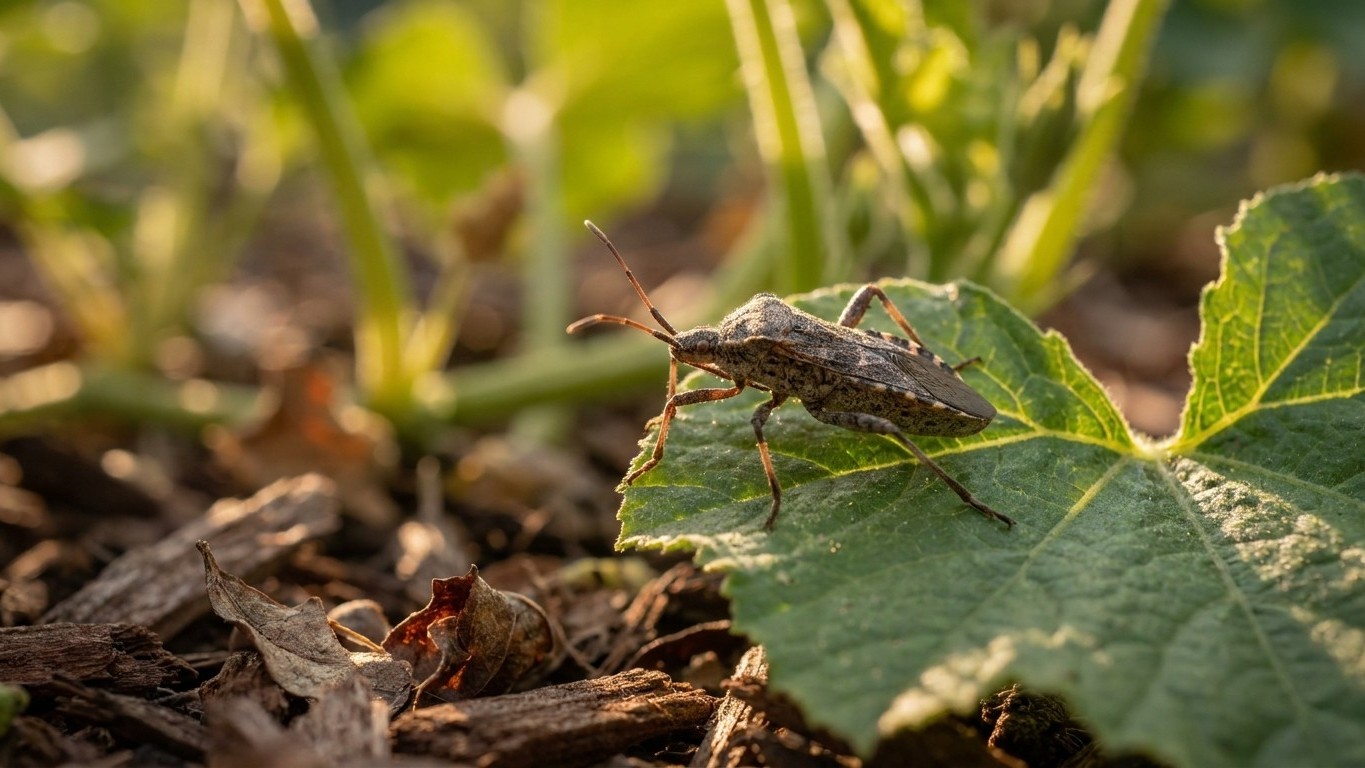
Misidentifying squash bugs costs gardeners valuable treatment time, since the insect looks completely different depending on life stage. Adults are roughly 5/8 inch long, shield-shaped, and dull grayish-brown to dark brown, with alternating orange and brown markings along the edge of the abdomen visible when the wings are folded. They move slowly and tend to cluster near the base of plants or hide under leaves when disturbed, rather than fly off immediately.
Eggs are the easiest stage to catch early, and catching them early is where most of the damage prevention happens. Look on the undersides of leaves, particularly where leaf veins branch, for clusters of shiny, bronze-to-copper colored eggs arranged in tight, somewhat geometric groups. A single cluster can hold 20 or more eggs, and one female may lay several clusters across a season.
Nymphs go through five distinct molts before reaching adulthood, and their appearance shifts dramatically along the way:
- First-instar nymphs are tiny, pale green to gray, with black legs and antennae
- Mid-stage nymphs turn a dusty gray, almost powdery in appearance
- Late-instar nymphs darken toward the grayish-brown of adults but still lack fully developed wings
- All nymph stages tend to gather in groups on stems and leaf undersides
- Nymphs move quickly when disturbed, scattering rather than flying
Because nymphs cluster together, a single leaf flip can reveal ten or more insects at once, which is exactly why weekly scouting through June and July catches infestations before they spread across the whole plant.
Why Squash Bug Damage Looks Like a Disease
The damage pattern confuses a lot of gardeners because it mimics bacterial wilt, a completely different problem caused by a pathogen rather than an insect. Squash bugs feed by piercing plant tissue and injecting saliva that contains toxins, then sucking out the sap. That saliva disrupts the plant’s ability to move water and nutrients through the stem, and the visible result is leaves that wilt, turn black or brown at the edges, and eventually collapse, starting with the leaves closest to where the insects fed.
Researchers refer to this as “Anasa wilt,” distinguishing it from bacterial wilt spread by cucumber beetles. The practical difference matters less for treatment than the timing does: Anasa wilt symptoms show up fast once nymph populations build, sometimes within a week of a heavy feeding session, and they tend to spread outward from a cluster point rather than appearing randomly across the plant.
Young plants and transplants take the hardest hit. A cucurbit seedling with only four or five true leaves can be killed outright by a squash bug population that an established, sprawling vine would barely notice. That’s one reason Manitoba’s shorter season actually raises the stakes early on: transplants set out in late May or early June are at their most vulnerable stage right when the first wave of overwintered adults is searching for host plants.
What Actually Stops Squash Bugs in Manitoba Gardens
Control works best as a layered approach rather than a single fix, and timing each layer to Manitoba’s compressed season makes a real difference.
Cultural and Mechanical Controls
Fall cleanup is the single most effective long-term step, because it removes the overwintering sites adults rely on. Pulling and disposing of cucurbit vines completely after harvest, rather than leaving them to break down in place, eliminates a major shelter option going into winter. The same goes for garden debris, boards, and mulch left sitting against garden edges over winter; those become adult hideouts that let the population restart faster the following spring.
Boards or shingles laid flat near plants during the growing season work as trap sites. Squash bugs seek shelter under flat objects overnight, and a quick morning check under those boards, followed by dropping trapped insects into a bucket of soapy water, can meaningfully thin adult numbers before they lay eggs. This trick works especially well in home gardens where checking a few boards daily is realistic.
Crushing egg clusters by hand, using tape to lift them off the leaf surface, or simply cutting out and disposing of the leaf section, prevents entire generations before they hatch. Given that Manitoba only supports one generation per year, disrupting egg-laying in June has an outsized effect on July and August pressure, since there’s no second wave coming to replace lost numbers.
Row Covers, Timing, and Resistant Varieties
Floating row covers placed over young plants at transplant or seeding time physically block adults from reaching the leaves to lay eggs. Covers need to come off once flowering starts, since cucurbits require pollinator access, but that window, roughly the first three to four weeks after planting, lines up closely with when overwintered adults are most actively searching for hosts. Removing covers right as flowers open still protects plants through their most vulnerable early stage.
Staggering planting dates by a week or two, where the season allows it, can also throw off the timing between adult emergence and available host tissue. It’s not a guarantee, but combined with row covers and trap boards, it adds one more layer of friction that reduces how many eggs actually get laid.
Some squash and pumpkin varieties show measurably better tolerance to squash bug feeding than others. Butternut squash, for instance, tends to hold up better against Anasa wilt than zucchini or crookneck varieties, which are among the most susceptible. Choosing tolerant varieties doesn’t eliminate the pest, but it buys plants extra time to establish before feeding pressure does real damage.
Insecticidal soaps and other targeted treatments work best against nymphs in their early instars, since older nymphs and adults develop a tougher exoskeleton that’s harder to penetrate. Applying treatment directly to clusters found during leaf-underside scouting, rather than spraying entire plants broadly, protects beneficial insects like bees and predatory wasps that also visit cucurbit flowers. The University of Florida’s Featured Creatures program, which documents pest biology in detail, notes that younger nymphs are consistently more vulnerable to contact insecticides than mature nymphs or adults, which reinforces why early scouting timing matters more than the specific product chosen.
One detail Manitoba gardeners sometimes overlook: because the region supports only one generation annually, a bad squash bug year doesn’t necessarily predict a worse one the next season. Winter mortality among overwintering adults varies with how exposed their shelter sites are, and a harsh, low-snow winter with deep cold penetration can knock back populations more than gardeners expect, sometimes more effectively than any spring treatment applied the year before.
Related guides
- Squash bug in Ontario: When It Shows Up and What Stops It
- Squash bug in Maryland: When It Shows Up and What Stops It
- Squash bug in Massachusetts: When It Shows Up and What Stops It
- Corn earworm in Manitoba
- Spotted wing drosophila in Manitoba
- Striped cucumber beetle in Manitoba
- Squash bug in British Columbia: When It Shows Up and What Stops It
- Squash bug in Utah: When It Shows Up and What Stops It