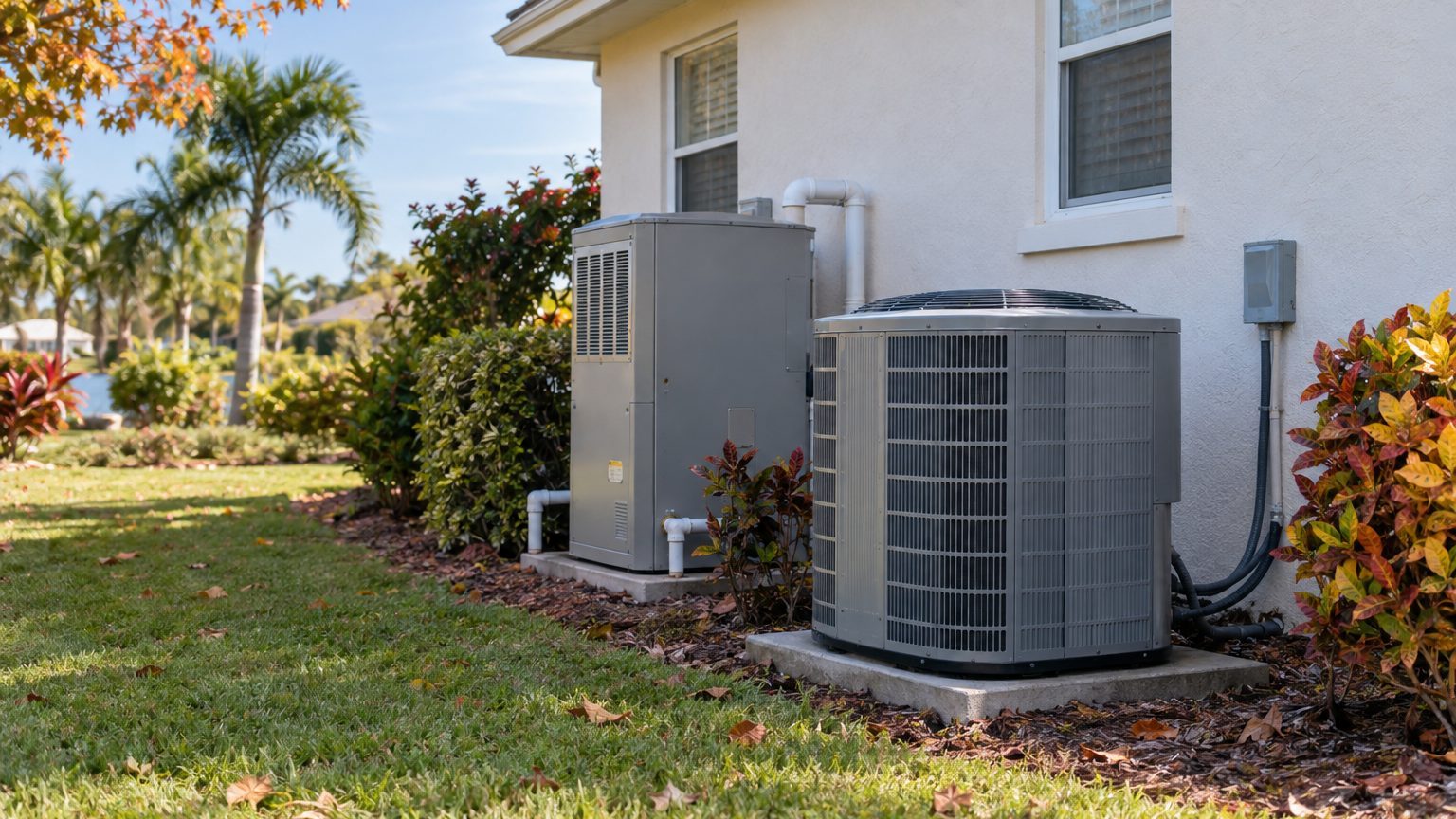

Maryland’s average residential electricity price is 21.30 cents per kWh. At that price, a heat pump delivers heat for far less than electric baseboard. Whether it also beats a gas furnace depends on a number the statewide data here doesn’t carry: what your gas utility charges. This article shows how to run that comparison, and where climate, existing equipment and air conditioning change the answer.
The short answer for Maryland
The computed figures put the heat pump at $26.30 per million Btu of heat delivered to the house. Electric resistance, meaning baseboard heat at 100% efficiency, comes to $62.43. That leaves the heat pump $36.13 less per million Btu. These numbers come from EIA residential prices combined with ENERGY STAR efficiencies and EIA fuel conversions. The heat pump figure assumes a unit at the ENERGY STAR minimum of 8.1 HSPF2, a seasonal coefficient of performance of about 2.4.
Natural gas is the gap. The figures here carry no gas price, so a gas furnace gets no ranking, and inventing one would mislead you. Your gas rate has to come from your own bill or from the utility’s published rate sheet. Once you have it, the comparison takes about ten minutes.
This is a running-cost comparison on the same unit of heat. It is not a yearly bill, because a yearly bill depends on your house: its size, insulation, air leaks and thermostat habits. It also says nothing about what the equipment or installation costs. A system that is cheaper per million Btu can still take years to pay back a higher purchase price.
The mechanism is simple. Baseboard heat turns each unit of electricity into one unit of heat, and no more. A heat pump moves heat that already exists outdoors, so at a seasonal coefficient of about 2.4 it delivers more heat than the electricity it consumes. If you heat with electricity today, a heat pump is the cheaper system to run; if you have gas service, get your utility’s gas rate before you decide.
What each option costs to run in Maryland
| System | Efficiency used | Cost per million Btu delivered |
|---|---|---|
| Electric resistance (baseboard) | 100% | $62.43 |
| Heat pump | 8.1 HSPF2 (seasonal COP about 2.4) | $26.30 |
| Gas furnace | Your furnace’s rated efficiency | Needs your utility’s gas price |
The electricity behind the table is 21.30 cents per kWh, the average residential price for Maryland, year-to-date through July, from the U.S. Energy Information Administration’s Electric Power Monthly (Table 5.6.B). It is a statewide average. Utilities and rate plans differ, so use it to compare fuels and estimate, not as a stand-in for your bill.
The heat pump row uses the ENERGY STAR minimum for a ducted system. ENERGY STAR asks more of ductless equipment: 8.5 HSPF2 for non-ducted split systems against 8.1 for ducted ones. A ductless unit has no duct losses, so it starts with an advantage and has to be better to earn the same label. A ductless unit that merely meets its own threshold should therefore run a little cheaper than the $26.30 shown. How HSPF2 is measured, and why ductless is held to a higher number, is covered in What HSPF2 Measures, and Why Ductless Asks for More.
One kWh carries 3,412 Btu, and baseboard delivers all of it as heat. A heat pump delivers more than that from the same kWh. A cubic foot of natural gas carries about 1,037 Btu, and a furnace delivers only the share its efficiency rating allows. So the honest gas comparison has two inputs: the price you pay per cubic foot or per unit on your bill, and the efficiency printed on your furnace’s label or spec sheet. To check gas yourself, convert your gas price to cost per million Btu using the 1,037 Btu per cubic foot figure, divide by the furnace’s efficiency, and set the result beside $26.30.
How cold it gets, and what that does to a heat pump
Baltimore Washington International Airport, the reference station, logs about 4,484 heating degree days a year on a 65°F base. Heating degree days add up, for every day of the year, how far the average temperature sat below 65°F. Twice the degree days means roughly twice the fuel for the same house. The same station records about 1,322 cooling degree days, which measure the opposite: summer heat that needs cooling.
The coldest month there has a mean daily minimum of 25.4°F, from NOAA’s 1991-2020 Climate Normals. That is an average of nightly lows, not a record. Some nights in a Maryland January run colder, and one station can’t speak for the whole state. Mountain counties in the western part of the state can run well colder than Baltimore.
Here is where the $26.30 needs a caveat. It uses a seasonal efficiency, an average across a whole heating season. In deep cold a heat pump’s efficiency drops, because there is less heat outdoors to move. On the coldest nights the system leans on a backup: electric resistance strips built into the unit, or a furnace running alongside it. Strip heat costs the same as baseboard heat, the $62.43 row in the table. So a house that spends many hours on backup will run above the seasonal figure.
The point is not that heat pumps fail here. The point is that the backup is part of the system’s design, and it should be a decision rather than an afterthought. Ask an installer what carries the house on the coldest nights, and how much of the heating load the heat pump is sized to cover. For a closer look at how performance falls as temperatures drop, see How Cold Is Too Cold for a Heat Pump.
Treat $26.30 as a seasonal average, and get the backup plan in writing before you buy.
What homes in Maryland already heat with
The Energy Information Administration’s 2020 Residential Energy Consumption Survey gives state-level shares. By equipment, 64% of Maryland homes use a furnace, 19% a central heat pump and 7% a steam or hot-water boiler. By fuel, natural gas heats 49%, electricity 41% and fuel oil or kerosene 7%. For propane, the survey does not publish a figure: the estimate was suppressed as unreliable. That is not the same as zero, so don’t read it as no one in the state using it.
What this means for the choice depends on your house. With a gas line already at the meter, the gas-versus-heat-pump comparison is a live one, and your gas rate settles it. Without a gas line, the question narrows: you are comparing a heat pump with electric resistance, oil or propane, and against resistance the table is clear. Roughly four in ten Maryland homes heat with electricity, and if yours has baseboard, that $36.13 gap per million Btu is the one that applies to you.
A boiler house is a different conversion. Radiators and baseboard hot-water pipes have no ductwork to reuse, so a ducted heat pump means building one. Ductless units skip that step, and Ductless or Central walks through the tradeoff. For the wider picture of how homes here are heated, see Heating a Home in Maryland.
When the other choice wins
The cheaper-to-run system is not always the right call. A few situations in Maryland push the other way.
- A furnace with years left. A working furnace has no installation cost to recover. If it is reliable and your gas rate looks good against $26.30, repairing it can beat replacing it. Repairing a Furnace or Replacing It covers how to weigh that.
- A dual-fuel setup. A heat pump handles most of the season and a furnace takes over on the coldest nights. This keeps gas as the backup instead of resistance strips, which matters because strip heat sits at the $62.43 price.
- A need for air conditioning. With about 1,322 cooling degree days at the reference station, summers here ask for real cooling. A heat pump is also an air conditioner, so replacing a failing AC with one covers both seasons. A gas furnace still needs a separate cooling system.
- No gas service. Here the gas furnace isn’t an option at all, and the heat pump’s $36.13 advantage over resistance does the work.
If your furnace is sound and you haven’t checked your gas rate against $26.30, replace it when it fails, not before.
Common questions
Is a heat pump cheaper to run than a gas furnace in Maryland?
The available figures can’t say, because they include no gas price. They do show the heat pump at $26.30 per million Btu against $62.43 for electric resistance. Compare your own gas rate and furnace efficiency against that $26.30.
Does a heat pump keep up during a Maryland cold snap?
It can, but efficiency drops in deep cold, and the coldest nights are usually carried by a backup, either resistance strips or a furnace. The reference station’s coldest month averages a nightly low of 25.4°F, though individual nights run colder.
What does HSPF2 tell me?
It measures heating efficiency over a season. Its companion, SEER2, measures cooling. Compare the same letter between units. ENERGY STAR sets 8.5 HSPF2 for non-ducted split systems and 8.1 for ducted ones.
Do I have to keep my furnace if I add a heat pump?
No, but some homes do, as a dual-fuel setup, so the furnace handles the coldest nights. Whether that makes sense depends on your gas rate, your furnace’s age and how the system is sized, and an installer’s load calculation should answer it.