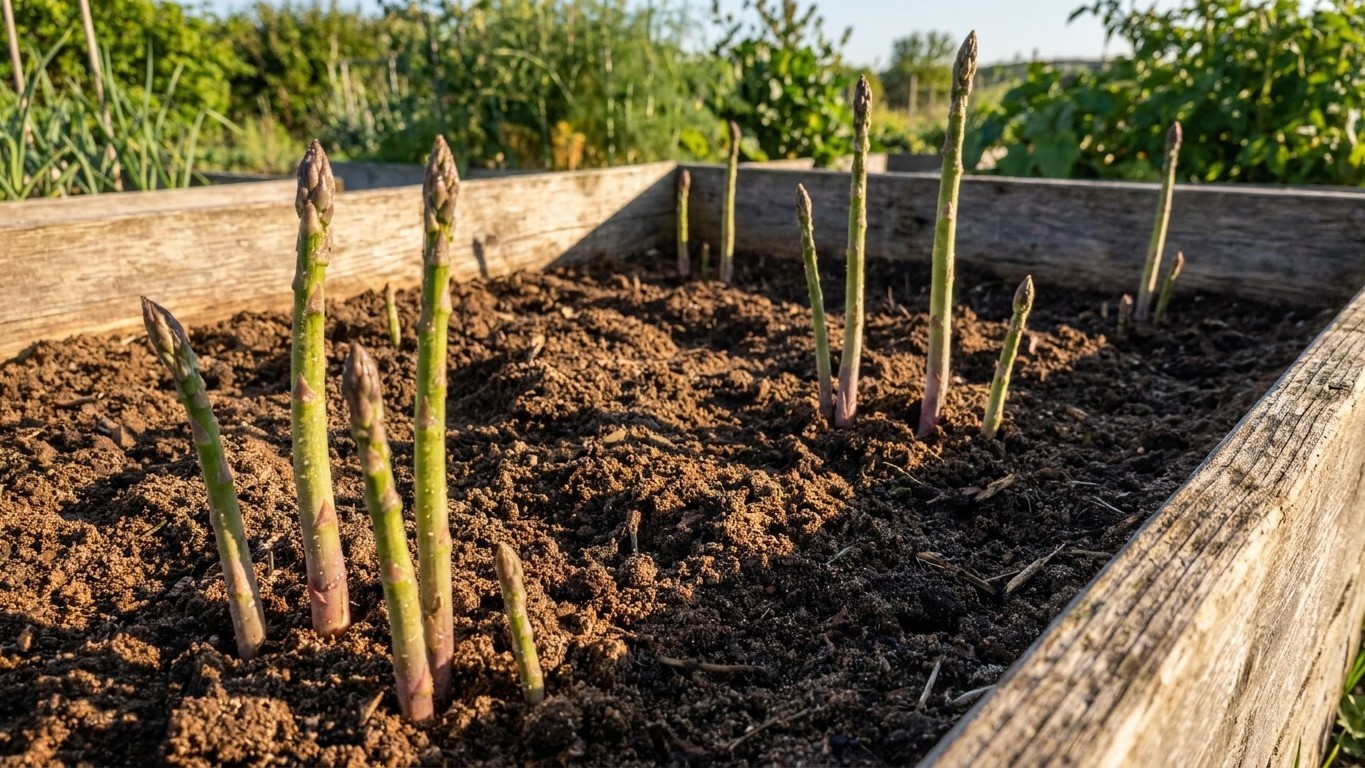

Asparagus gets eaten twice in a season: the spears in spring, and the ferns from early summer on. In Maryland the first damage shows up soon after the last spring frost, April 3 to April 16 at the reference station, and the second round runs through the hot, fairly wet summer. Insects that chew, insects that suck sap, and plain mechanical injury all leave similar marks, so the symptom comes before the name.
Which pests attack asparagus in Maryland
University of Maryland Extension is the service that documents which insects feed on asparagus in the state, and its county offices are where a damaged spear or frond gets a name. Its lists cover every crop in the state. Only a few entries belong in an asparagus bed, and sorting them comes down to what the plant offers to eat.
Asparagus is a soft, herbaceous perennial. It puts up fleshy spears first and then tall, feathery ferns. That leaves three groups of feeders that matter:
- Chewing insects, adults and larvae, that scar or strip spears and ferns.
- Soil-dwelling feeders that cut spears at the surface or work on the crown below.
- Sap-sucking insects that colonize ferns and leave them pale or sticky.
The stakes are higher than they look because of how the bed is built. Crowns go into 8-inch furrows in early spring, and the bed is not harvested until year 3, then produces for 10 to 15 years. For two full seasons the ferns are all the plant has, and every frond a pest strips is leaf the crown needed. Feeding on a young bed is a bigger setback than the same feeding on a mature one.
When each one shows up, and what it does first
The calendar runs off the frost-free window. NOAA NCEI’s most recent 30-year climate normals put the last spring frost at April 3 to April 16, based on the 32°F freeze probabilities in the 30 to 70 percent band (station data). Western Maryland (Garrett, Allegany) is mountainous and runs weeks later. The Eastern Shore runs milder. Crowns go in during early spring, and everything below counts from emergence, not from a date on the wall.
Spring: what damages spears
The first sign is on the spear itself. A spear with a ragged bite out of its side, or rough brown scarring along the surface, points to a chewing insect. A spear that stands one evening and is gone or cut at the soil line the next morning points to something feeding in the dark at ground level. Look at the tips as they push up, because feeders gather there.
For a bed in its first two years, none of those spears are meant for the table. Check at first emergence, then again once the ferns open, since that is when the target switches from spears to foliage. In a producing bed the harvest runs for a stretch of weeks each year, and a damaged spear in that window is simply a lost spear.
Summer: what damages ferns
Once harvest ends, the rule is a pencil: stop when most spears come up thinner than one. The ferns grow out from there and take over as the food source. Chewing damage now looks like stripped or ragged fronds with bare, tan stems showing. Sap feeders look different. The ferns turn pale or finely speckled, or feel sticky, and the insects can be seen packed along the stems.
Summer weather muddies the picture. Rain across June, July and August adds up to about 12.6 inches (3.98 in June, 4.48 in July, 4.09 in August, per NOAA NCEI normals at the reference station). That is a decent summer total, yet the Sassafras series, Maryland’s state soil, is sandy and well drained, so rain moves through quickly. The ground can be dry a few inches down even in a wet month. Heat does the rest by driving evaporation.
Telling the damage apart from everything else
The common mistake is reaching for an insect explanation when the plant is short of water or nutrients. The Sassafras series is an Ultisol, an old, heavily leached soil that is naturally acid and low in nutrients, with about 1.6 percent organic matter at the surface. That describes what the region’s ground tends to do. A soil test gives the number for one garden. The table lists the usual look-alikes.
| What you see | Insect sign | Common look-alike | What settles it |
|---|---|---|---|
| Pale or yellowing ferns | Fine speckling, sticky film, insects along the stems | Nutrient shortage in lean ground | Whether the whole bed fades evenly (soil) or patches fade with visible insects (feeders); a soil test |
| Wilted, browning fern tips in summer | Chewed edges, frass, insects on the plant | Water stress on fast-draining sand | Soil moisture a few inches down, and whether it perks up after a deep watering |
| Bent, scarred or snapped spears | Ragged, bitten edges | Hoe, foot, mower or wind | A clean cut or a crushed spot means mechanical; a chewed edge means something fed |
| Spots or powdery patches on spears or ferns | None; tissue is intact | Fungal disease | Nothing is missing from the plant, only discolored; an extension diagnosis |
| Thin, spindly spears | None | Harvest pressure or a young crown | Count the years since planting and check the pencil rule |
The question that decides most cases is whether tissue is missing or only discolored. Insects remove tissue, while drought, hunger and disease change its color. Any call beyond that is not safe from a photo or a description. Take a damaged spear or frond, and the insect if one is on it, to the University of Maryland Extension county office. They can confirm what is feeding in that county.
What actually works here, and what is a waste of time
A short, mild-to-hot season rewards timing more than any product. In a young bed, a physical barrier laid over the spears at the right moment keeps most feeders away before there is anything to treat. Lightweight fabric over the row during emergence blocks chewing adults from reaching the spears. Taking it off once the ferns are up leaves them free to feed on the foliage, so combine it with regular checking. Picking insects off by hand also works on a bed of ordinary size, and it is quick when done every few days.
Much of the real protection is making the plant strong enough to shrug off damage. Stop harvest at the pencil rule so the ferns can grow and feed the crown. Respect the no-harvest rule for the first two years. Backfill the furrow gradually rather than all at once, so you are not stepping over buried spears and breaking them. Water deeply during dry stretches, since sandy ground drains quickly, and a stressed plant is both more attractive to feeders and slower to recover.
What wastes time is spraying before knowing the target. A product that works on one insect does nothing for another, and treating a nutrient problem as an insect problem fixes nothing. Registered products for home use in Maryland change from season to season, so the county extension office is the right place to ask what is currently allowed and for which insect. It will also say when treatment is worth doing at all, and for a few scattered holes in the ferns it often is not.
Where a bed has to be rebuilt, the better lesson is spot choice. Asparagus stays put for 10 to 15 years, and drainage is part of that decision. Will Maryland Soil Hold an Asparagus Bed for Fifteen Years? looks at that choice, and When to Plant Asparagus Crowns in Maryland covers the early-spring planting window.
Where to check this for your own county
The local authority is University of Maryland Extension, through the office that serves your county. Staff there see what is turning up in the area, can identify a specimen, and know what is registered for home use in the state. For the broader picture of site, planting and care, Growing Asparagus in Maryland is the place to start.
Maryland runs from the mountains of Garrett and Allegany, where spring comes weeks later, to the milder Eastern Shore, so timing shifts with the county. The climate figures here come from one reference station, and the Sassafras series is the soil USDA lists as representative of the state (USDA NRCS State Soils programme, with values from Soil Data Access). That soil is sandy, well drained and acid at the surface. It is a starting point, and a back garden may be nothing like it, especially on river bottoms, in hill country or on ground a builder has scraped or filled.
Your own plot settles the rest. A rain gauge shows what actually falls, and a soil test gives a pH and nutrient picture for the bed rather than the region. When damage shows up, bring the damaged spear or frond itself, along with the photo, to the county office. Do that before buying anything.
Common questions
Can I harvest spears that insects have chewed in year two?
No spears are cut until year 3, whatever shape they are in. The ferns of a young bed are feeding the crown, and removing them for a few meals costs more than it gives. After year 3 the harvest runs 4 weeks, then 6, then 8.
When do I stop harvesting so the ferns can recover?
Stop when most spears come up thinner than a pencil. That is a rule you read off the plant, so it needs no week number, and it works whatever the spring was like.
Are yellow ferns always caused by insects?
No. Yellowing can come from water stress on fast-draining sandy ground, from a nutrient shortage in lean, acid soil, or from disease. Insect damage removes tissue, while those other causes change its color. A soil test and a visit to the county extension office sort it out.
Who can tell me what products are allowed for home use in Maryland?
University of Maryland Extension. What is registered for home gardeners changes, and the county office knows the current rules and which insect they apply to.