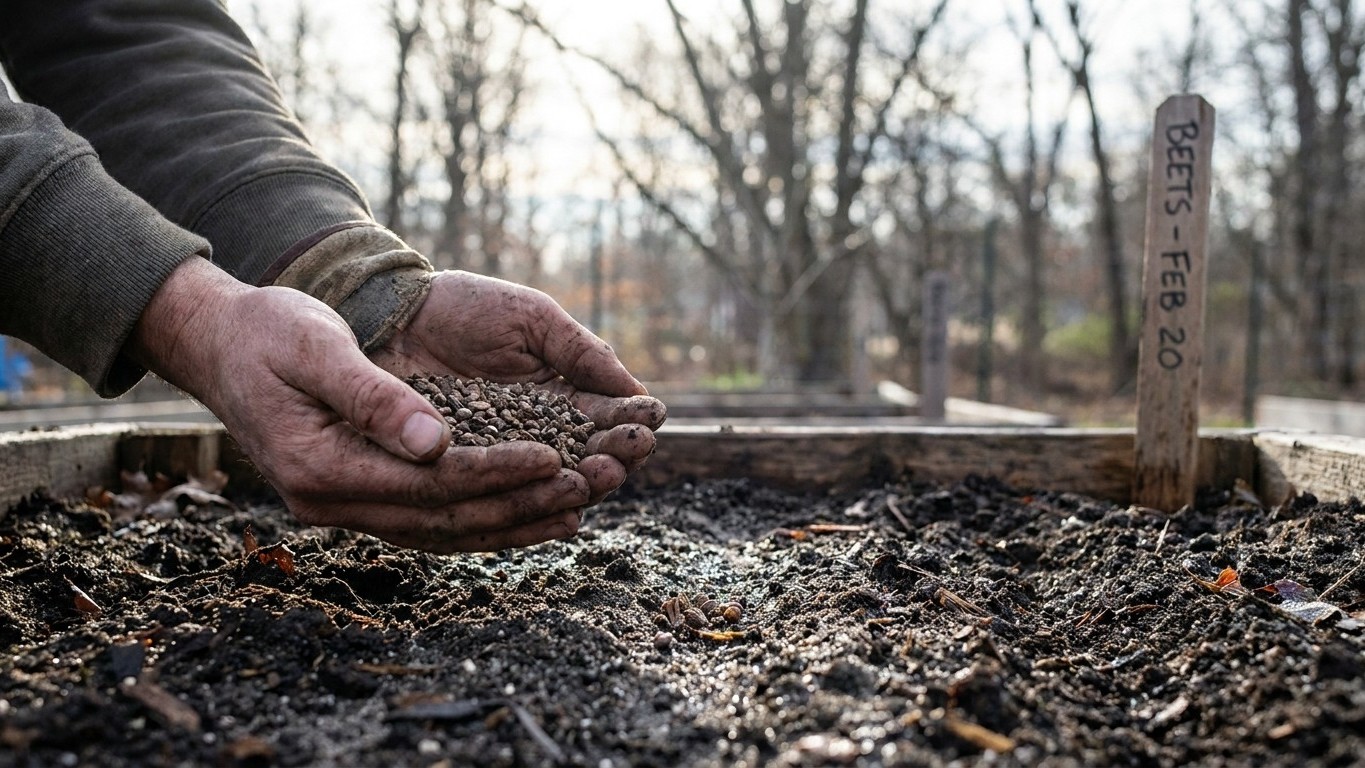

Sow beets in Maryland two to three weeks before the last spring frost, which the National Oceanic and Atmospheric Administration’s climate normals place between April 3 and April 16 at the Baltimore-Washington reference station. That puts most gardeners sowing in the back half of March or the first days of April, with roots ready in roughly 60 to 80 days if the soil stays cool enough and moist enough through establishment.
The short answer
Maryland’s representative soil, the Sassafras series, is an Ultisol: old, heavily weathered, naturally acid. The surface horizon runs about 67 percent sand, 10 percent clay and 23 percent silt, with organic matter around 1.6 percent and a surface pH near 5.3, which counts as strongly acid. That texture drains well, sometimes too well. Sandy ground with that little clay to hold a reservoir of water dries out fast between rains or irrigation cycles, and beets are unforgiving about that in their first six weeks. A stretch of dry sandy soil right after germination is exactly the kind of water stress that pushes a beet plant toward premature flowering instead of a root.
The acidity matters too. A pH of 5.3 sits well below what beets generally want, and on ground like that a soil test before planting will usually point toward some lime to bring the bed closer to neutral. Low organic matter, just 1.6 percent, means the soil has little buffering capacity and few nutrients banked up for a crop that likes rich, deep ground. Utah State University Extension recommends amending with no more than 1 inch of composted organic matter per 100 square feet, a modest correction rather than a heavy hand, since beets don’t want an overly rich bed either.
On the heat side, the published guidance is specific about the threshold that causes trouble: temperatures above 85 F combined with water stress make beet roots turn woody. Maryland summers reliably clear that mark by mid-summer, though an exact count of days per year above 90 F for a Maryland reference city isn’t published here. What that threshold means practically is that a beet crop pushed into July heat while the soil runs dry is at real risk of a fibrous, tough root, regardless of how well it germinated back in March.
None of this describes every yard in the state. Maryland spans hundreds of mapped soil series, from the Eastern Shore’s flatter, often wetter ground to the rocky, thinner soils of Western Maryland’s mountains. The Sassafras series is what USDA lists as representative for the state, a starting point for thinking about how the ground behaves, not a stand-in for the dirt under any one garden. A basic soil test remains the only way to know an actual pH and nutrient picture for a specific bed.
The six weeks that decide it here
Sowing two to three weeks ahead of the April 3 to April 16 frost window means the first six weeks of a beet’s life, germination through early root formation, land squarely in Maryland’s spring. That’s the stretch that decides whether a crop bolts before it ever sizes up. It also means those weeks fall during a season that can behave inconsistently: a run of cool, damp days can flip into a dry, windy week without much warning, and sandy ground like the Sassafras series sheds moisture quickly once a dry stretch sets in.
That variability is exactly the risk the water-stress warning is built for. A gardener working sandy soil who lets the bed dry out during a warm dry snap in April, even briefly, right when seedlings are putting down their first roots, is setting up the plant for premature flowering later. The fix isn’t complicated, but it does require attention during a period when a lot of gardeners assume spring rain has the watering covered. On sandy, well-drained ground it often doesn’t, and a hand on the soil surface every few days through that window is worth more than a calendar.
The frost dates themselves aren’t uniform across the state. NOAA’s normals describe the Baltimore-Washington corridor; Western Maryland’s mountain counties, Garrett and Allegany, run their last frost weeks later, which pushes the whole sowing window back for gardeners there. The Eastern Shore trends milder and can support an earlier start. Anyone gardening outside the central Maryland corridor should treat the April 3 to April 16 range as a reference point to adjust from, not a fixed rule, and lean toward the later end of any local estimate rather than the earlier one if there’s doubt.
The other timing pressure sits at the far end of the season. Since beets run 60 to 80 days from the day seed goes into the ground, not from any later transplant date, a mid-March to early-April sowing generally finishes before the worst of Maryland’s summer heat arrives. Pushing a sowing date later into spring narrows that margin and raises the odds that the crop is still filling out its root when temperatures start clearing 85 F, which is a separate risk from the early bolting problem and shouldn’t be solved with the same fix.
What goes wrong here
- Sandy soil dries out between waterings and triggers bolting. The Sassafras series’ 67 percent sand content drains fast, and a dry spell during the first six weeks after sowing is enough to push beets toward premature flowering instead of root growth. Check soil moisture by hand every few days through germination and early growth, and water before the top inch feels dry rather than after.
- Acid soil, pH near 5.3, limits nutrient uptake and stunts growth. A soil test ahead of sowing will usually call for lime on ground this acidic. Skipping the test and planting straight into unamended, strongly acid soil often shows up later as pale, slow-growing plants rather than an outright failure to germinate.
- Low organic matter, about 1.6 percent, leaves little reserve of nutrients or water-holding capacity. Utah State University Extension’s guidance of up to 1 inch of composted organic matter per 100 square feet corrects this without over-enriching the bed, which matters because beets don’t want soil that’s too rich either.
- Sowing too early into cold, wet ground causes poor germination. Sandy soil warms fast once spring arrives, but a sowing date pushed too far ahead of the April 3 to April 16 frost window can still land on soil too cold for reliable sprouting. Waiting for workable, crumbly soil rather than a fixed date avoids a patchy stand.
- Summer heat above 85 F combined with dry soil produces woody roots. This is a separate failure from spring bolting, tied to a later stage of growth. A crop sown on time in March or early April and harvested within its 60 to 80 day window generally clears this risk; a late sowing that drags into July heat does not.
Common questions
Can I sow beets in Maryland in the fall for a second crop?
The soil and heat facts on this page describe the spring sowing window tied to the April 3 to April 16 last-frost period. A fall sowing works around a different set of variables, first-frost timing rather than last-frost timing, which isn’t covered by the figures gathered here.
Do I need to add lime before sowing beets in Maryland’s typical soil?
The state’s representative Sassafras series runs a surface pH around 5.3, strongly acid and below what beets generally prefer. A soil test is the only way to know an actual garden bed’s pH and how much lime, if any, it needs; the state figure is a reference point, not a substitute for that test.
How much compost should I work into sandy Maryland soil before sowing?
Utah State University Extension’s guidance caps it at 1 inch of composted organic matter per 100 square feet. Given the Sassafras series’ low organic matter, around 1.6 percent, that amendment addresses a real gap, but more isn’t better here since overly rich soil isn’t what beets want either.
Does the sowing window change for Western Maryland or the Eastern Shore?
Yes. The April 3 to April 16 range comes from the Baltimore-Washington reference station. Garrett and Allegany counties, in the mountains, run their last frost weeks later, which delays the whole sowing window. The Eastern Shore trends milder and can generally support an earlier start than the reference date suggests.