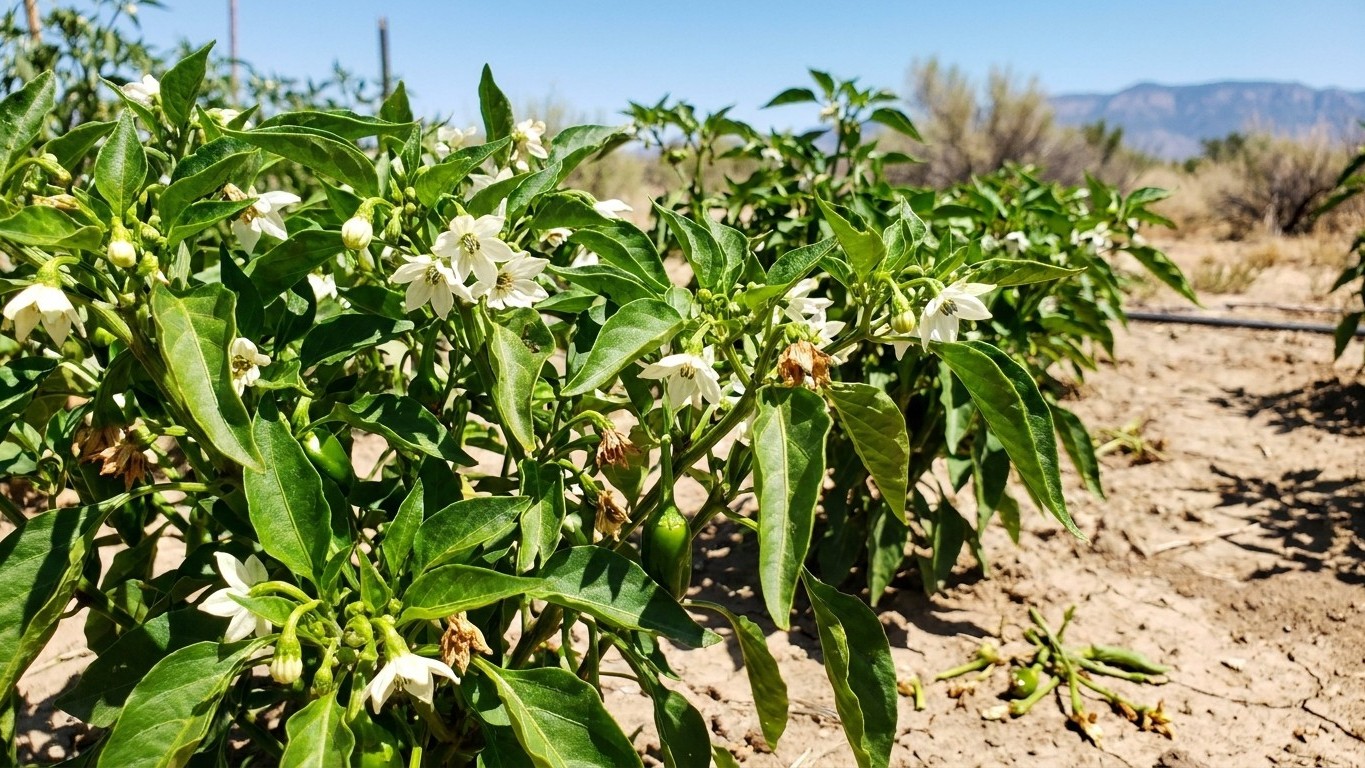

Maryland’s verified pepper data doesn’t name specific insect species eating the crop. What’s documented, and sourced, is the climate window that decides how exposed a pepper plant is to feeding damage in the first place: a last-frost date that closes the cold season, a summer heat count that closes the warm one, and a fruit-set rule that fails at both edges. Confirming which insect is actually on a leaf is a county-level question. This page covers the timing that decides vulnerability, and where to send the diagnosis.
Which pests attack pepper in Maryland
The verified dataset behind this page does not carry a named list of insect species that feed on pepper in Maryland, sourced to a state entomology or extension program. A lot of pest pages lift a generic vegetable-pest roster, assembled for tomatoes, squash, or tree fruit, and stick it onto whatever crop and state happen to be in the headline. This one won’t do that.
What this page can source is the climate mechanism that decides when a pepper plant is exposed to feeding pressure at all. Insects attack when a plant is tender, stressed, or flowering, and those windows are set by temperature, not by a calendar month. Maryland’s numbers give three of those windows.
The first is the cold end. The last spring frost across most of Maryland falls between April 3 and April 16, based on 1991-2020 climate normals from NOAA NCEI. Western Maryland, in Garrett and Allegany counties, runs weeks later because of elevation; the Eastern Shore tends to run milder. A transplant set out before that window closes sits in cold, wet soil longer, and that’s exactly the condition under which a weak seedling gets overwhelmed by whatever’s already active in the bed.
The second is the heat end. Baltimore’s reference station averages 24.6 days a year at or above 90°F, per NOAA NCEI Climate Normals (1991-2020). That’s a heat-load count, not a pest count, and it matters because heat-stressed pepper plants drop blossoms and stall fruit set on their own, with no insect involved.
The third is fruit set itself. Utah State University Extension states that pepper fruit set fails at both ends of the range: nights below 55°F, or days above 90°F. Neither failure mode is an insect, and neither responds to anything sprayed on a leaf. For actual insect identification, that job belongs to a county extension office working from a sample or a clear photo, not to a state-level dataset like this one.
When each one shows up, and what it does first
Without a named pest inventory to hang a calendar on, the timeline that holds up across Maryland is the plant’s own vulnerability schedule, not an insect’s. It starts indoors, weeks before anything touches the soil.
Utah State University Extension recommends starting pepper seed 8 to 10 weeks before transplanting, and moving transplants outside only after the soil has warmed to 60°F and frost has passed. In most of Maryland that means waiting until after the April 3 to April 16 window closes; growers in Garrett or Allegany counties should expect that window later, while gardeners near the Chesapeake or the Eastern Shore may see it clear earlier. A transplant pushed into cold soil ahead of that date is stunted before anything with legs ever touches it, and stunted transplants tend to show damage first, whatever the cause turns out to be.
The next stress point lands at flowering, where the fruit-set rule bites: a run of nights below 55°F, or a stretch of days at or above 90°F, and the plant drops blossoms instead of setting fruit. Baltimore’s average of 24.6 days a year at or above 90°F makes that heat failure mode a real possibility in a normal summer. This site doesn’t carry Maryland’s summer night minimums, so the cold-end failure has to be judged by watching your own thermometer at bloom time.
In practice, what a gardener sees first tends to fall into one of two buckets: a plant that looks fine but won’t set fruit (a temperature failure, no insect required), or a plant with visible chewing, stippling, or distorted new growth (a feeding signal worth a closer look from a county extension agent, since this dataset doesn’t name what’s doing it). Harvest, when fruit does set, typically follows 70 to 85 days after transplanting, according to Clemson Cooperative Extension, which gives a rough sense of how long a plant is exposed to feeding pressure before the crop comes off the vine.
Telling the damage apart from everything else
Most of what gets blamed on insects in a home pepper patch isn’t insect damage at all. Before assuming something is eating the plant, it helps to rule out the two culprits that mimic feeding damage most convincingly: temperature stress and storage handling.
| What you see | Likely cause | What separates it from insect feeding |
|---|---|---|
| Blossoms or small fruit dropping with no chew marks | Temperature failure at flowering (nights below 55°F or days at/above 90°F) | No holes, no frass, no insects on close inspection; the whole plant is affected evenly |
| Wilting during the hottest part of the day, recovering by evening | Heat and water stress, more likely on days pushing toward 90°F | Leaves look intact under a hand lens; wilting tracks the sun, not a feeding pattern |
| Stunted, pale transplants set out too early | Cold-soil shock from transplanting before the soil holds 60°F | Damage is uniform across the row, not concentrated on a few plants or leaves |
| Soft, pitted, sunken skin on harvested fruit | Chilling injury from storage below about 45°F | Shows up after harvest, in storage, never in the field, and only on refrigerated fruit |
| Ragged holes, stippled leaves, or a visible insect | Actual insect feeding | The only category where an insect, egg, or frass is physically present; worth a photo for a county extension agent |
That last storage line is the mistake nearly everyone makes: a home refrigerator runs colder than peppers can tolerate. Clemson Cooperative Extension’s guidance puts optimal pepper storage at 45 to 50°F with 80 to 90 percent relative humidity, good for two to three weeks under those conditions. Most refrigerators run colder than 45°F, which pits and softens pepper skin, chilling injury that looks a lot like early insect damage to anyone unfamiliar with the difference.
None of this replaces an actual look at the plant. If chewing, holes, or an insect itself is present, that’s the point to stop guessing and send a photo or sample to a local expert rather than working from a symptom list alone.
What actually works here, and what is a waste of time
On a growing season as compressed as Maryland’s, timing does more work than any product could. The single highest-leverage move is holding transplants back until the soil has actually reached 60°F and the local frost window, April 3 to April 16 across most of the state, has closed. Every week gained by starting seed 8 to 10 weeks early indoors is a week the plant spends stronger and less exposed by the time anything is looking to feed on it.
A physical barrier, like row cover, set in place right at transplanting and removed once flowering starts (pepper needs pollinator access to set fruit) does more to prevent early feeding damage than a treatment applied later, once damage is already visible. That’s a timing decision, not a purchase decision, and it costs nothing to get the calendar right.
What wastes time: treating a plant for insects when the actual problem is temperature. A grower who sees blossom drop during a stretch of days pushing past 90°F, or during a run of cool nights, and responds by spraying for insects has solved nothing, because fruit-set failure at both ends of the range, per Utah State University Extension, is a temperature response no insecticide touches. The same goes for cold-shocked transplants set out ahead of the frost window: nothing applied to the leaves fixes soil that hasn’t warmed up yet.
This site doesn’t recommend specific pesticides or active ingredients, on purpose. What’s labeled and legal to use on pepper changes by state and by year, and only a state’s cooperative extension service keeps that current. Anyone past the point of timing and barriers, dealing with a confirmed insect, should get a specific, currently legal recommendation from a county extension office rather than from a general gardening page.
Where to check this for your own county
Everything documented on this page comes from national climate datasets and university extension guidance that applies broadly, not from a county-by-county pest survey. Insect presence in Maryland varies at a much finer grain than any state-level page can capture: a garden in Garrett County, at elevation and with a frost window running weeks behind the rest of the state, faces a different pressure schedule than a garden on the Eastern Shore, where frost clears earlier and the season runs longer.
For actual pest identification, or for what’s currently legal to use against a confirmed insect on pepper in Maryland, the right first call is University of Maryland Extension, working through the local county office rather than a general search. County agents see what’s actually showing up in gardens that season, closer to real time than any climate normal or national dataset can be.
Bring specifics when reaching out: a photo of the damage, the plant’s growth stage (seedling, flowering, fruiting), and rough dates, since the same symptom means something different on a three-week-old transplant than it does on a plant already carrying fruit around day 75. If the damage matches a temperature pattern instead, hot days pushing past 90°F or a late frost that hit before the window closed, mention that too; it can rule out an insect before anyone spends time looking for one.
The next useful step for most gardeners isn’t a treatment decision at all. It’s a call or an email to the county office with a photo attached, made before deciding anything needs to be sprayed.
Common questions
Does this page name the specific insects that eat pepper in Maryland?
No. The verified dataset behind it covers climate thresholds, not a pest inventory: frost timing, heat-day counts, and fruit-set failure points. For species identification, a county office of University of Maryland Extension is the right resource.
When is the safest time to transplant pepper outdoors in Maryland?
After the soil has reached 60°F and the local last-frost window has passed. That window runs April 3 to April 16 across most of the state, later in Garrett and Allegany counties, per NOAA NCEI 1991-2020 climate normals and transplant guidance from Utah State University Extension.
Why do pepper plants drop blossoms with no visible bugs around?
Pepper fruit set fails at both temperature extremes, nights below 55°F or days at or above 90°F, according to Utah State University Extension. Maryland’s Baltimore reference station averages 24.6 days a year at or above 90°F, so the heat-side failure is a realistic cause with no insect involved.
Can harvested peppers go straight into the refrigerator?
Not a standard one. Clemson Cooperative Extension recommends storage at 45 to 50°F with 80 to 90 percent relative humidity, good for two to three weeks. Most refrigerators run colder than that, which causes pitting and softening from chilling injury rather than keeping the fruit fresh.