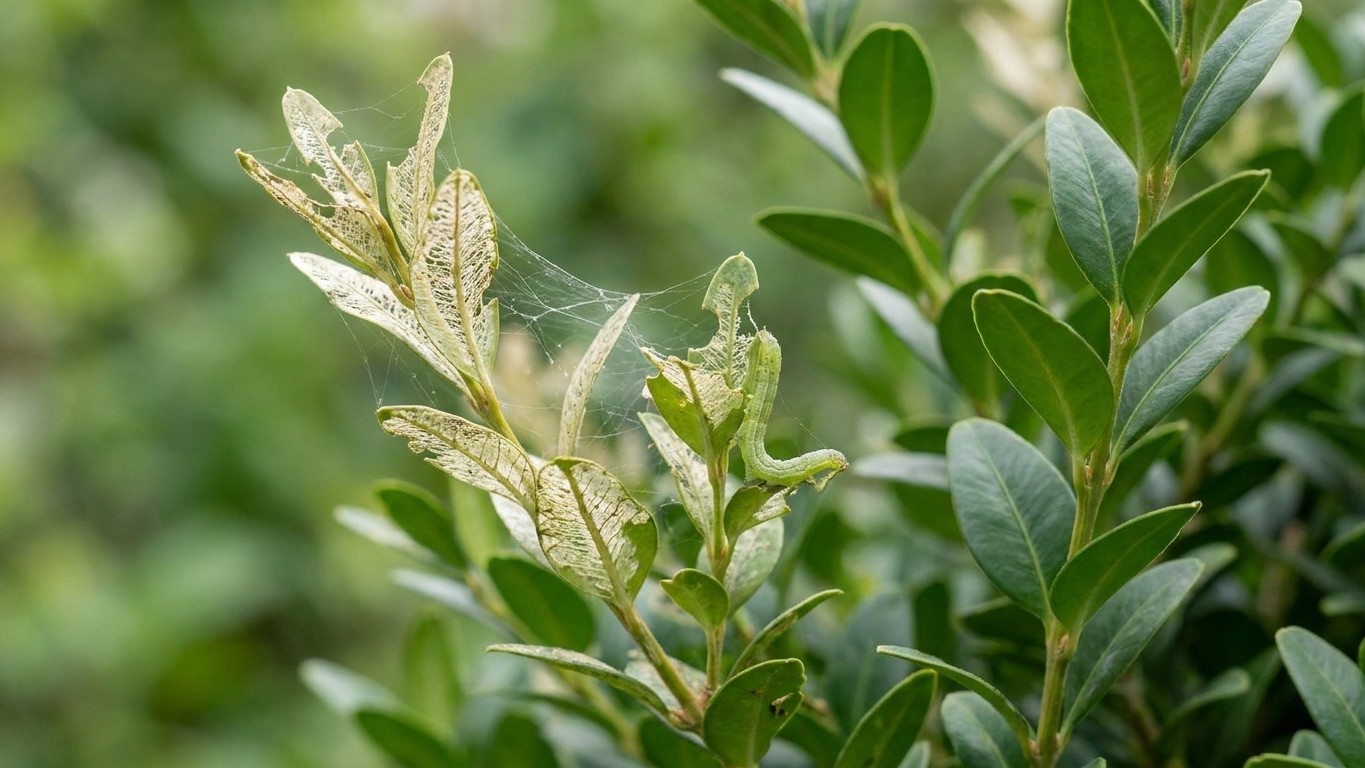

Box tree moth has been confirmed in Maryland only since July 2025, and it feeds on boxwood exclusively, not on vegetables or lawns. No statewide flight calendar exists yet for this pest, but the caterpillars are active whenever boxwood is pushing new leaves, roughly from spring into fall. Damage usually gets noticed first in early summer, when a shrub that looked fine in May suddenly looks skeletonized.
The weeks to watch

There is no published week-by-week window for box tree moth in Maryland yet, because the state’s first confirmed find only happened in July 2025. The University of Maryland Extension Home and Garden Information Center tracks a long list of invasive and vegetable insects month by month on its seasonal tips page, flea beetles and cucumber beetles in May, spotted lanternfly eggs hatching from May through July, brown marmorated stink bug laying eggs June through August, but box tree moth isn’t one of the species it currently schedules. That gap matters for how you plan: you’re working from general biology, not a Maryland-specific calendar.
Overwintering larvae wake up in spring
Box tree moth spends winter as small larvae wrapped in silk webbing between boxwood leaves. Once temperatures climb enough for the plant to start pushing new growth, those larvae resume feeding. This is the stage most likely to go unnoticed, since the webbing can look like ordinary leaf litter caught in the branches.
First generation feeds through early summer
The overwintered larvae mature, pupate, and produce adult moths that lay the first full generation of eggs. This generation tends to do the most visible damage, since the caterpillars are larger and feeding heavily right as the shrub is trying to leaf out for the season.
Later generations extend into fall
In regions where box tree moth has been Established longer, two to three generations per year is typical, with feeding continuing into fall before the final generation settles in to overwinter. Whether Maryland sees that same pattern consistently isn’t something the local extension service has published data on yet, since the detection is still recent.
Reading the calendar from your last frost

Maryland’s last spring frost falls between April 3 and April 16, according to NOAA’s 1991-2020 climate normals for the region, though Western Maryland (Garrett and Allegany counties) runs weeks later because of elevation, and the Eastern Shore tends to warm up sooner. Box tree moth doesn’t answer to a date on the wall. It answers to when boxwood breaks dormancy and starts putting out new leaf growth, which is what the overwintering larvae are waiting for. An early spring pulls that activity forward; a cold, stretched-out one delays it.
You can use your own last frost date as a checkpoint rather than a guess pulled from nowhere:
- Start with your local last frost date (April 3 to April 16 for most of Maryland).
- Begin checking boxwood for webbing and leaf damage as soon as new growth flushes after that date, since that’s the cue the larvae are also responding to.
Treat that frost window as a normal, not a promise. A boxwood in a sheltered spot near a house foundation may leaf out earlier than one in an open, exposed yard even a few miles away. The practical takeaway is timing your first inspection to your own shrub’s growth, not to a fixed day on a calendar.
What it attacks, and what the damage looks like

Most homeowners notice the damage long before they ever see the caterpillar. A boxwood that looked green and full one week and then shows patches of skeletonized, see-through leaves the next is the classic first sign. Fine silk webbing tangled through the interior branches, greenish-yellow frass (droppings) collecting on leaves below, and rapid, uneven defoliation that starts inside the shrub and spreads outward are the other telltale signs. Left alone, an infested boxwood can go from healthy to bare in a matter of weeks.
Box tree moth is host-specific. It feeds almost exclusively on plants in the genus Buxus:
- American boxwood
- English boxwood
- Japanese boxwood (Buxus microphylla)
- Other ornamental Buxus cultivars planted as hedges or foundation shrubs
The damage is done entirely by the larval (caterpillar) stage. Adult moths don’t feed on foliage at all, they’re mainly concerned with mating and laying the next round of eggs. That matters for timing any response: once larvae have bored deep into dense interior growth, treatments aimed at the surface come too late to help that generation.
How Maryland sits in this pest’s range

This site currently documents box tree moth in one territory, Maryland, which puts the state near the edge of where this pest has been formally confirmed and tracked rather than somewhere in the middle of an established, widespread range. That’s different from pests like spotted lanternfly or brown marmorated stink bug, which show up across many states and where the real difference between territories is just timing, not whether the insect is present at all.
Maryland’s situation is closer to a new arrival being watched than a long-established population with a known seasonal rhythm. The state’s first confirmed detection came in July 2025, according to the University of Maryland Extension Home and Garden Information Center. No ranking, severity level, or spread trend has been published for Maryland relative to other states, and none should be assumed from a single detection date. What can be said plainly is that Maryland gardeners with boxwood hedges are dealing with a pest whose local behavior isn’t fully documented yet, which is exactly why close, regular inspection matters more here than it might in a state where the pest has been present and studied for a decade.
What actually works against it

Cheapest and most effective first, here’s the order that makes sense for a homeowner with boxwood on the property:
- Inspect boxwood regularly, especially the interior branches. Part the foliage and look for webbing, frass, and skeletonized leaves rather than just glancing at the outside of the shrub. Catching an infestation early, while it’s confined to one branch, is the difference between pruning and losing the whole plant.
- Hand-pick visible caterpillars and webbing. This works because it physically removes the feeding stage before it can mature and reproduce. It stops working once larvae have tunneled into dense, tightly packed growth where they can’t be seen or reached.
- Prune out and destroy infested branches. Cutting back webbed sections and disposing of the clippings (not composting them, since larvae and pupae can survive in yard waste) removes an entire local population at once.
- Avoid moving or sharing boxwood cuttings or plants from an infested area. This pest spreads through the nursery trade and through people moving plant material, so keeping cuttings local prevents introducing it to a new hedge or a neighbor’s yard.
- Report suspected sightings to your local extension office. Because this is a newly confirmed pest in Maryland, documented sightings help build the very seasonal data that’s currently missing.
None of these measures help once larvae are already deep inside thick, established growth with no visible entry point, at that stage, removing and destroying the affected branches is the only option left that actually removes the insect rather than just the symptom.
Common questions
Is box tree moth actually established in Maryland, or just passing through?
The state’s first confirmed detection was in July 2025, according to the University of Maryland Extension Home and Garden Information Center. Whether it’s a small, isolated find or the start of an established population isn’t something that’s been publicly determined yet.
Can box tree moth spread to other shrubs besides boxwood?
No. It feeds almost exclusively on plants in the Buxus genus, so hollies, azaleas, and other common hedge shrubs aren’t at risk from this particular insect.
What should I do if I find webbing and skeletonized leaves on my boxwood?
Prune out and destroy the affected branches, avoid composting the clippings, and report the find to the University of Maryland Extension Home and Garden Information Center so it can be tracked.