
Colorado potato beetles wake up in Maryland gardens as soon as soil temperatures climb past 50°F, which usually happens in late April or early May across most of the state. That first wave of hungry adults crawls out of the ground where they spent winter buried a few inches down, and within days they’re mating, laying eggs, and stripping potato foliage. Knowing that window, and having a plan ready before it opens, is what separates a healthy potato patch from a field of bare stems by July.
Maryland sits squarely in the beetle’s comfort zone. The insect thrives anywhere solanaceous crops (potatoes, eggplant, tomatoes) grow alongside mild winters and warm, humid summers, and the Chesapeake region checks every box. Farmers in Frederick County, home gardeners on the Eastern Shore, and small-plot growers around Baltimore all report the same pest showing up almost like clockwork each spring.
When Colorado Potato Beetles Show Up in Maryland

Adults overwinter in soil, typically at the edges of last year’s potato or eggplant patches, under leaf litter, or in nearby hedgerows. They don’t travel far from where they fed the previous season, which is part of why crop rotation works so well against them. Once the soil warms, they dig out, feed briefly on whatever host plant is available, and start mating almost immediately.
In Maryland’s climate, that emergence generally falls between mid-April and mid-May depending on the season, the same stretch of weather that pushes local soil temperatures past that 50-degree threshold. A female can lay 300 to 500 eggs over her lifetime, deposited in clusters of a few dozen on the underside of leaves. Those eggs hatch in four to nine days depending on temperature, and the resulting larvae do the real damage.
Most of the state sees two generations per year. The first generation peaks in late May and June, the second in late July and August, with some overlap in between. That second wave often catches gardeners off guard because they assume the worst is behind them after the June cleanup. It isn’t. Late-summer plantings of eggplant or a second potato crop can take a beating from that second generation just as bad as the first.
Identifying Colorado Potato Beetle at Every Life Stage
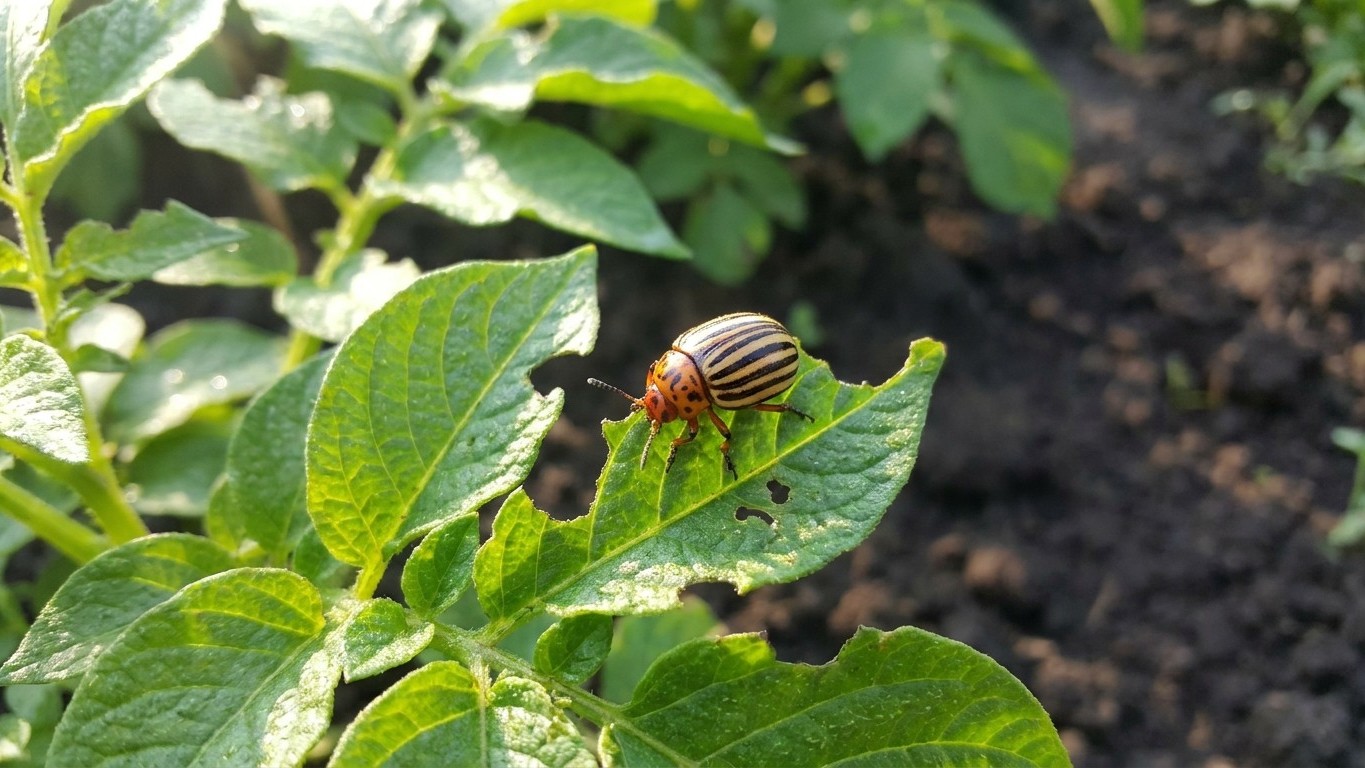
The adult beetle is hard to miss once you know what to look for: a rounded, roughly 3/8-inch body colored pale yellow to orange, with ten black stripes running down the wing covers. It’s often confused with the false potato beetle, a harmless look-alike, but the true Colorado potato beetle’s stripes are bolder and more evenly spaced.
Egg masses are bright orange-yellow, laid in tight clusters on leaf undersides, and easy to spot if you flip leaves over during a quick garden walk. Larvae start out dark red with black heads, then shift to a softer orange-pink with two rows of black spots along each side as they grow through four instars over about three weeks. They’re humpbacked and slow-moving, but what they lack in speed they make up for in appetite. A single larva can consume roughly four square inches of foliage before pupating in the soil.
The damage pattern is distinctive too. Rather than small pinholes, Colorado potato beetle feeding produces large, irregular holes and, in bad infestations, completely skeletonized leaves with only the thickest veins left standing. Defoliation above 30 percent during tuber formation can cut potato yields noticeably, according to research from land-grant university extension programs studying the pest’s economic impact.
What Actually Stops Colorado potato beetle in Maryland Gardens
No single tactic wins this fight on its own. Colorado potato beetle has a well-documented history of developing resistance to insecticides faster than almost any other agricultural pest, so the most reliable approach layers several methods together.
Cultural Controls That Cut Populations Before They Start
Crop rotation is the single most effective free tool available. Because overwintering adults emerge close to where they fed the previous fall, moving potatoes, eggplant, or tomatoes at least 50 to 100 feet from last year’s location forces beetles to hunt for their host plant, and many simply never find it. In a small backyard plot that distance isn’t always possible, but even rotating to the opposite side of the yard reduces the initial hit.
Floating row covers installed at planting and left on until flowering block adults from reaching young plants during that critical first-generation window. Straw mulch applied thickly around plants has also shown a measurable dent in colonization rates in field trials, likely because it interferes with the beetles’ ability to locate host plants by scent and sight at ground level.
Hand-picking remains underrated. Checking plants every few days in May and June, crushing egg masses, and dropping adults into a jar of soapy water sounds tedious, but on a home-garden scale it genuinely works, especially if started the moment the first adults appear rather than after larvae have already hatched.
Biological and Low-Toxicity Options
Bacillus thuringiensis subspecies tenebrionis, sold as a biological insecticide, targets young larvae specifically and leaves most beneficial insects unharmed. Timing matters here: it works best against first- and second-instar larvae, before they’ve grown large enough to shrug off the toxin. Spinosad, derived from a naturally occurring soil bacterium, offers another option with a lower impact on pollinators than broad-spectrum sprays, though it still requires care around bee activity.
Natural predators help too. Ground beetles, spined soldier bugs, and certain parasitic wasps feed on eggs and young larvae. Gardeners who avoid broad-spectrum insecticides tend to see these predator populations build up over a few seasons, which is one more argument for starting with the least disruptive tools first.
Chemical Controls and the Resistance Problem
Synthetic insecticides still have a place, particularly for larger plantings where hand-picking isn’t practical. The catch is that Colorado potato beetle populations across the mid-Atlantic have shown resistance to multiple insecticide classes, including some organophosphates and pyrethroids, after decades of repeated use on commercial farms. Rotating between different modes of action, rather than reaching for the same product every time, slows resistance development and keeps chemical options viable longer.
University of Maryland Extension recommends scouting fields weekly starting at emergence and treating only when beetle counts cross an economic threshold, rather than spraying on a fixed calendar. That threshold-based approach reduces unnecessary applications, saves money, and cuts down on the selection pressure that drives resistance in the first place.
Maryland-Specific Factors Worth Knowing
Soil type plays a bigger role than most gardeners expect. Colorado potato beetles overwinter more successfully in sandy, well-drained soils common on the Eastern Shore than in the heavier clay soils found in parts of central Maryland, which can mean slightly higher pressure in coastal growing areas each spring.
Home gardeners growing eggplant should pay particular attention, since eggplant is actually a preferred host over potato in some studies, meaning a mixed vegetable garden with both crops may see beetles concentrate on the eggplant first. Tomatoes are a lower-preference host but not immune, especially once potato and eggplant foliage has been stripped and beetles go looking for alternatives.
Commercial growers in counties like Wicomico and Somerset, where potato acreage is more concentrated, tend to see heavier pressure simply because there’s more continuous host material available across the landscape. Backyard growers in more suburban parts of the state, where potato and eggplant plantings are scattered and isolated, often get a natural break just from the patchwork nature of home gardening.
One detail that surprises a lot of first-time potato growers: seed potatoes bought from garden centers occasionally carry beetle eggs already attached if they were stored near infested plant material. Inspecting seed potatoes and any purchased eggplant or tomato transplants before planting adds one more checkpoint against an infestation that starts before the growing season has even really begun.
Related guides
- Colorado potato beetle in Delaware: When It Shows Up and What Stops It
- Colorado potato beetle in Pennsylvania: When It Shows Up and What Stops It
- Colorado potato beetle in Massachusetts: When It Shows Up and What Stops It
- Colorado potato beetle in Minnesota: When It Shows Up and What Stops It