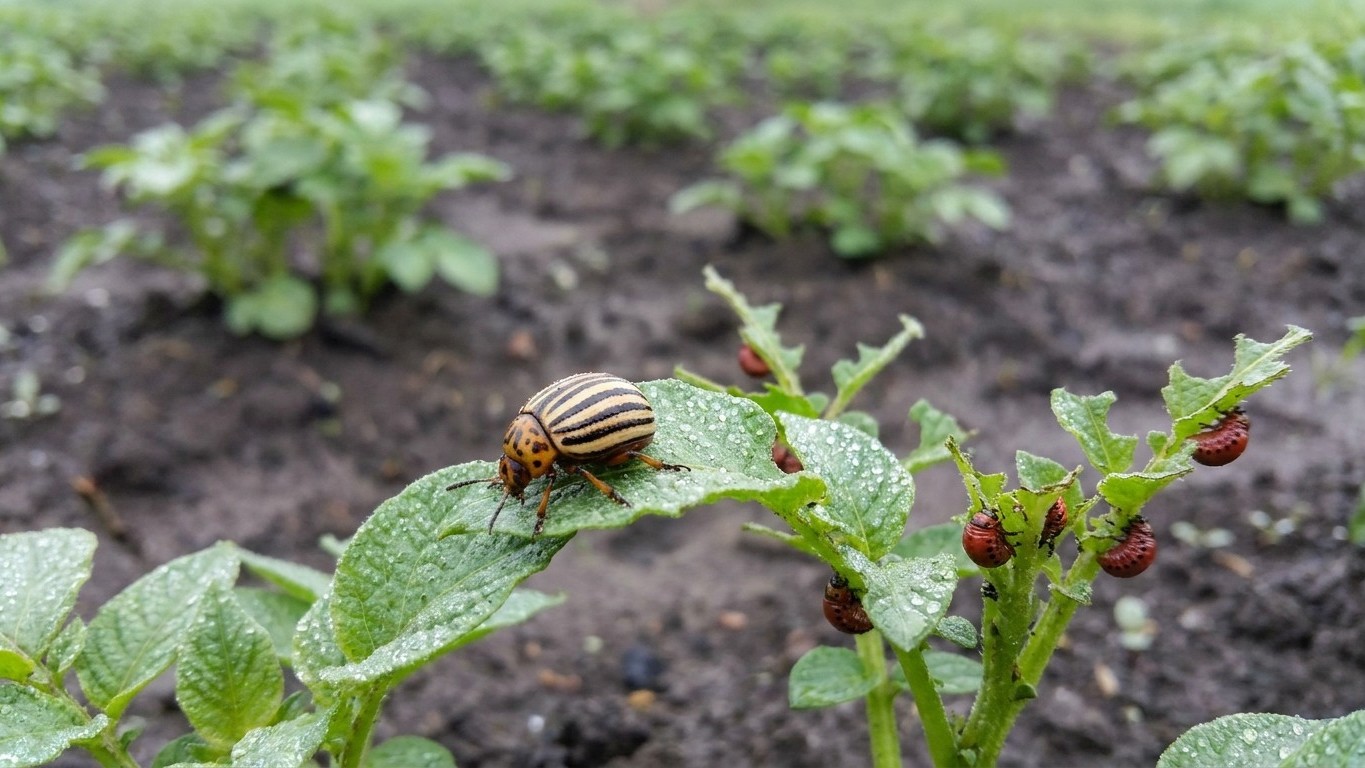

Colorado potato beetles typically emerge in Minnesota gardens and fields between late April and mid-May, right around the time potato plants push their first leaves through the soil. They overwinter as adults buried a few inches deep in soil near last year’s potato patch, so the moment ground temperatures climb into the 50s, they crawl out hungry and start looking for host plants. The real damage window runs from late May through July, when adults and their red, humpbacked larvae strip leaves down to bare stems.
Where and When Minnesota Growers See Them First

Southern and central Minnesota counties generally see beetle activity a week or two before the northern part of the state, simply because soil warms faster there. Home gardeners around the Twin Cities metro often spot the first adults on emerging potato shoots by the first week of May, while growers near Duluth or International Falls might not see beetle pressure until closer to Memorial Day.
Soil temperature matters more than the calendar date. Beetles need consistent ground temps above 50°F to break diapause, so a cold, wet spring can push emergence back by ten days or more. A quick way to check readiness: if your potato plants are at the two-inch stage and daytime highs have held in the 60s for a week straight, start scouting daily.
Minnesota only gets one full generation most years, sometimes a partial second generation in warmer southern counties during long, hot summers. That’s different from states like Iowa or Missouri, where two full generations are routine. Fewer generations means Minnesota growers get a narrower, more predictable control window, but it also means missing that window costs you the whole season.
Identifying the Beetle and the Damage It Leaves Behind
Adult Colorado potato beetles are about three-eighths of an inch long, rounded, with ten black stripes running down a yellowish-orange back. They’re easy to confuse at a glance with the harmless three-lined potato beetle, but the stripe count and body shape give it away once you look twice. Eggs are bright orange-yellow, laid in tight clusters of a few dozen on the undersides of leaves, usually near the plant’s growing tip.
The larvae do the most damage. They start out dark red with black spots and grow into a plump, humpbacked orange-red grub as they molt through four stages over about three weeks. A single larva can eat through several square inches of foliage before pupating in the soil, and a heavy infestation strips a plant bare in days.
Potatoes are the primary target, but Minnesota gardens with eggplant, tomato, or petunia nearby aren’t safe either. Beetles will move to these relatives when potato foliage runs out, which is worth knowing if you’re planning next year’s garden layout. Defoliation early in the season, before tubers have bulked up, cuts yield far more than late-season feeding once the plant has already stored most of its energy underground.
Distinguishing True Damage from Other Pests
Flea beetles leave small round shot holes, aphids curl leaves without stripping them, and blister beetles chew ragged edges but travel in smaller numbers. Colorado potato beetle damage looks different: entire leaf sections vanish, veins often left intact like a skeleton, and you’ll usually find the culprits, egg clusters, or larvae right on the plant when you look.
The Beetle’s Life Cycle Under Minnesota Conditions
Overwintering adults emerge from soil in spring and feed for one to two weeks before mating and laying eggs. Females can lay 300 to 500 eggs over their lifetime, spread across many small clusters, which is part of why populations build so fast once they get established in a garden bed.
Eggs hatch in four to nine days depending on temperature. Larvae feed for two to three weeks, then drop to the soil to pupate for another one to two weeks before emerging as new adults. In Minnesota’s shorter growing season, that full cycle from egg to new adult takes roughly five to six weeks under average summer conditions.
New adults that emerge in July or August feed briefly, then burrow into soil to overwinter rather than starting a second full generation, at least in most of the state. This is the key biological fact that shapes control timing: knock down the first generation of adults and larvae before mid-July, and you’ve largely handled the season’s pressure.
What Actually Stops Colorado Potato Beetle in Minnesota
Crop rotation is the single most effective non-chemical tool available to home gardeners and small-scale growers. Overwintering adults emerge in the same spot they buried themselves the previous fall, so moving potatoes at least 30 feet from last year’s plot, ideally further, forces beetles to walk a longer distance to find food. University research on beetle dispersal has repeatedly shown that even modest rotation distances cut early-season infestation significantly, because many overwintered adults simply can’t locate the new planting fast enough before natural mortality thins their numbers.
Hand-picking works surprisingly well for small plots if you’re consistent about it. Checking plants every two to three days starting at emergence, crushing egg clusters and knocking adults into a bucket of soapy water, can keep populations below damaging levels through the whole season on a garden-sized planting. It’s tedious, but it’s free and it doesn’t touch beneficial insects.
Row covers placed at planting and removed once plants flower (beetles need pollinator access at that point, and the plants are more resilient by then) physically block the spring migration of overwintered adults. This works best in gardens where the previous year’s potato bed is nowhere close to this year’s planting.
Straw mulch applied heavily around potato plants has shown a modest but real reduction in beetle colonization in field trials, likely because it interferes with the beetles’ ability to walk between plants and may support predatory ground beetles that eat eggs and small larvae.
Biological and Organic Options
Bacillus thuringiensis var. tenebrionis (sometimes labeled Btt or BT-san diego) targets young larvae specifically and is approved for organic production. It needs to be applied while larvae are still small, first and second instar, because older larvae are far less susceptible. Spinosad, another organic-approved option, has broader activity against all larval stages but needs to be reapplied after rain.
Beneficial insects, particularly certain predatory ground beetles and the spined soldier bug, do eat Colorado potato beetle eggs and young larvae naturally. Avoiding broad-spectrum insecticide use protects these predators, which is one reason integrated approaches that combine hand-picking, rotation, and targeted biological sprays tend to outperform a single strategy over a full season.
The Insecticide Resistance Problem, and Why It Matters in Minnesota
Colorado potato beetle holds a distinction few other agricultural pests can claim: it has developed resistance to more insecticide classes than almost any other insect species studied. Populations across the Midwest, including Minnesota, have shown reduced susceptibility to organophosphates, carbamates, pyrethroids, and in some regions, certain neonicotinoids, largely because of decades of repeated use of the same chemical modes of action on the same fields.
This matters directly for Minnesota growers because leaning on a single spray product year after year is exactly the practice that built resistant populations elsewhere. Rotating between different insecticide modes of action, or better yet relying primarily on cultural and biological controls with chemicals as a backup rather than a first response, keeps whatever chemical tools remain effective longer.
Commercial potato operations in the Red River Valley, one of the country’s major potato-growing regions straddling Minnesota and North Dakota, have dealt with resistance issues seriously enough that resistance management is now a standard part of regional extension guidance, not an afterthought. Home gardeners face lower stakes but the same underlying biology, so the same rotation logic applies even at a backyard scale.
Fall Cleanup: The Step Most Gardeners Skip
Removing potato plant debris and volunteer potato plants after harvest reduces the number of adults that find easy shelter nearby for overwintering. Tilling the soil in the fall, particularly in and around the previous potato bed, exposes buried adults to cold temperatures and predators, cutting overwintering survival measurably compared to leaving soil undisturbed.
Volunteer potatoes, the ones that sprout from missed tubers the following spring, are a bigger problem than most gardeners realize. They give emerging beetles an early food source right where they overwintered, letting populations build strength before the main crop is even planted. Digging thoroughly at harvest and checking for sprouts the following spring closes that loophole.
Minnesota’s freeze-thaw winter cycle does kill off a portion of the overwintering population naturally, more so than milder climates see, which partly explains why the state generally deals with lighter beetle pressure than warmer potato-growing states to the south. That natural advantage disappears fast, though, in gardens where rotation and fall cleanup get skipped for a few years running, letting local populations build up a comfortable, well-fed overwintering site right next to next year’s planting.
Related guides
- Colorado potato beetle in South Dakota: When It Shows Up and What Stops It
- Colorado potato beetle in New Brunswick: When It Shows Up and What Stops It
- Colorado potato beetle in Newfoundland and Labrador: When It Shows Up and What Stops It
- Colorado potato beetle in Nova Scotia: When It Shows Up and What Stops It