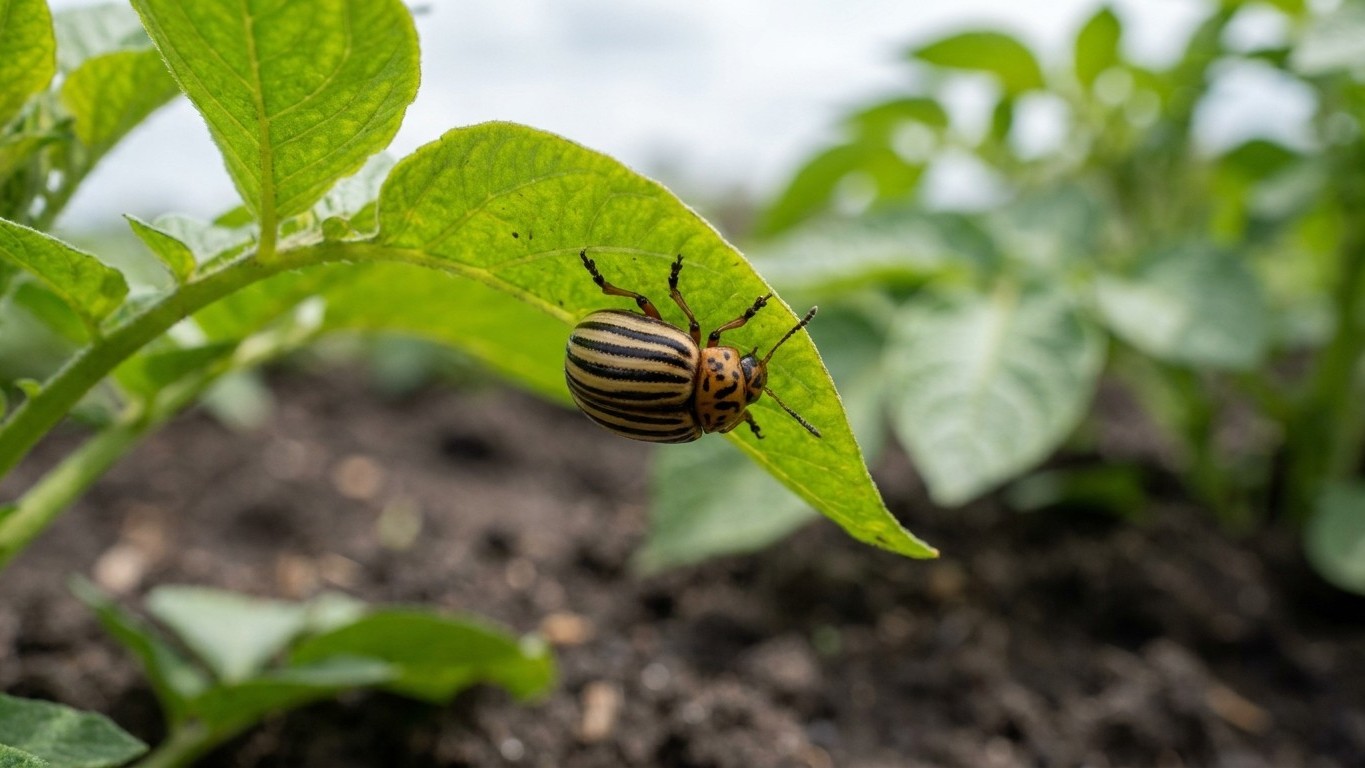

Colorado potato beetle adults start crawling out of Delaware soil once ground temperatures hit roughly 50°F, which usually lands somewhere between mid-April and early May across the state. Two generations typically hatch before frost, and the fastest way to stop them is a combination of early scouting, crop rotation, straw mulch, and targeted use of Bacillus thuringiensis var. tenebrionis or spinosad before larvae reach their third instar.
The weeks to watch

Delaware sits in USDA hardiness zones 7a and 7b, with winters mild enough that overwintering adult beetles survive at high rates in the top few inches of soil near last year’s potato, tomato, or eggplant beds. Once soil warms past that 50°F threshold, adults dig out and head straight for the nearest solanaceous crop. In New Castle County, that emergence often starts in mid-April. Farther south in Kent and Sussex counties, where soils warm a bit earlier thanks to the sandy coastal plain, growers sometimes spot the first striped adults by the first week of April.
These early arrivals feed for a week or two, then females start laying clusters of 20 to 40 bright orange-yellow eggs on the undersides of leaves. A single female can lay several hundred eggs over her lifetime. Eggs hatch in four to nine days depending on temperature, and the resulting larvae do the real damage, stripping foliage down to bare stems within days if left unchecked. Delaware’s climate supports two full generations most years, sometimes a partial third in warmer coastal areas, which means the pressure doesn’t let up after the first wave.
County-Level Timing Differences
Sussex County growers, who manage the bulk of Delaware’s commercial vegetable acreage, generally see the heaviest first-generation larval damage in mid-to-late May. New Castle County gardens and small farms, sitting slightly cooler and closer to the Piedmont transition, tend to run one to two weeks behind. That gap matters for timing sprays or row cover removal, since treating too early wastes product on a population that hasn’t fully emerged yet.
Identifying Each Life Stage
Misidentifying this pest costs gardeners time every season, since the larvae look nothing like the adults. Here’s what to watch for on potato, tomato, eggplant, or pepper leaves:
- Adults: roughly 3/8 inch long, hard-shelled, with five bold black stripes running lengthwise down a yellow-orange back.
- Eggs: tight clusters of 20 to 40 bright orange-yellow ovals, always on the underside of leaves.
- Young larvae: dark red, humpbacked, soft-bodied, with two rows of black spots along each side.
- Mature larvae: swell to nearly 1/2 inch, turn a paler orange-pink as they approach pupation in the soil.
The larval stage causes roughly 90 percent of defoliation, according to entomology research from Cornell University’s vegetable program, which studies the same pest complex found throughout the Mid-Atlantic. That’s the window where control decisions matter most.
Why Delaware’s Climate Keeps the Population Steady
Coastal Delaware’s humidity and moderate winter temperatures create close to ideal survival conditions. Overwintering mortality for Colorado potato beetle adults tends to run higher in states with harder freezes and less snow cover to insulate the soil. Delaware rarely delivers that kind of winter kill. Add sandy loam soils common in Sussex County, which warm quickly in spring and let overwintering adults tunnel out with less effort, and the state ends up with an emergence window that’s both early and fairly synchronized across a region.
Proximity to Maryland’s Eastern Shore and southern New Jersey, both significant potato and vegetable growing areas, also means beetle populations can migrate across county and state lines during dry, windy spells. Adults are strong walkers and can fly short distances when temperatures climb above 75°F, so isolated home gardens aren’t necessarily protected just because they’re not near a commercial farm.
Cultural and Physical Controls That Actually Work
Rotating solanaceous crops to a different part of the yard or field each year remains one of the most reliable, lowest-cost defenses. Overwintering adults emerge close to where they pupated the previous fall, so moving potatoes or eggplant even 50 to 100 feet away forces beetles to search harder to find a host, which cuts survival and delays egg-laying.
Heavy straw mulch, three to four inches deep, makes it physically harder for emerging adults to reach the surface and also shelters the small predatory insects, like ladybird beetles and lacewings, that eat Colorado potato beetle eggs. Floating row covers installed at planting and kept sealed at the edges block early migration almost entirely, though they need to come off once plants flower to allow pollination.
Hand-removal still works well for backyard gardens with fewer than a couple dozen plants. Checking the undersides of leaves every three to four days during May and June, crushing egg clusters and dropping larvae into a bucket of soapy water, can keep a small potato patch nearly damage-free without a single spray. It’s tedious. It’s also nearly free and doesn’t contribute to the resistance problem building up in commercial fields.
Trap cropping offers another angle: planting a small block of potatoes a week or two earlier than the main crop draws overwintering adults to concentrate there first, where they’re easier to spot and treat before spreading to the rest of the planting.
Biological and Chemical Options, and the Resistance Problem
Bacillus thuringiensis var. tenebrionis, sold under several trade names as a Bt product specific to leaf beetles, kills young larvae within a few days of ingestion and has minimal impact on bees or beneficial insects. It works best applied while larvae are still in the first or second instar, before they’ve done much feeding damage and while they’re most vulnerable to the toxin.
Spinosad, derived from a soil bacterium, offers another option with a similarly low impact on pollinators when applied in the evening after bees have finished foraging. Neem-based products can suppress feeding and egg-laying but tend to work more slowly and need repeat applications.
Here’s the part that frustrates a lot of growers: Colorado potato beetle has developed resistance to more classes of insecticides than almost any other agricultural pest in North America, according to research compiled by Michigan State University’s entomology department, which has tracked resistance development in this species for decades. Populations in parts of the Northeast and Mid-Atlantic have shown reduced susceptibility to organophosphates, carbamates, and even some neonicotinoids after repeated seasons of heavy use. Delaware growers who’ve relied on the same chemical class for several years in a row are the ones most likely to see control failures now.
The practical fix is rotating insecticide modes of action, not just brand names, and reserving synthetic options for years when biological and cultural controls fall short. A single well-timed Bt application on young larvae, backed by mulch and hand-picking, often outperforms a full-season spray schedule that trains the local population to shrug off whatever’s applied.
Seasonal Timeline: From Spring Scouting To July’s Second Wave
If it’s April or early May, focus on scouting emerging adults near last year’s potato or tomato beds and installing row covers before egg-laying starts. If larvae are already visible on leaves, that’s the window for a Bt or spinosad application, timed to hit the population while it’s still in early instars. Later in the season, watch for the second generation building in July, especially if the first wave wasn’t fully controlled, since that second flush tends to hit tomatoes and eggplant harder than the spring generation that targets potatoes first.
Delaware’s relatively mild winters mean this pest isn’t going anywhere on its own. Growers who treat it as a season-long management project, rather than a one-time spray decision, consistently report less defoliation and fewer resistance headaches the following year.
Related guides
- Colorado potato beetle in Maryland: When It Shows Up and What Stops It
- Colorado potato beetle in Pennsylvania: When It Shows Up and What Stops It
- Colorado potato beetle in Georgia: When It Shows Up and What Stops It
- Colorado potato beetle in Idaho: When It Shows Up and What Stops It
- Colorado potato beetle in Indiana: When It Shows Up and What Stops It
- Colorado potato beetle in Nova Scotia: When It Shows Up and What Stops It