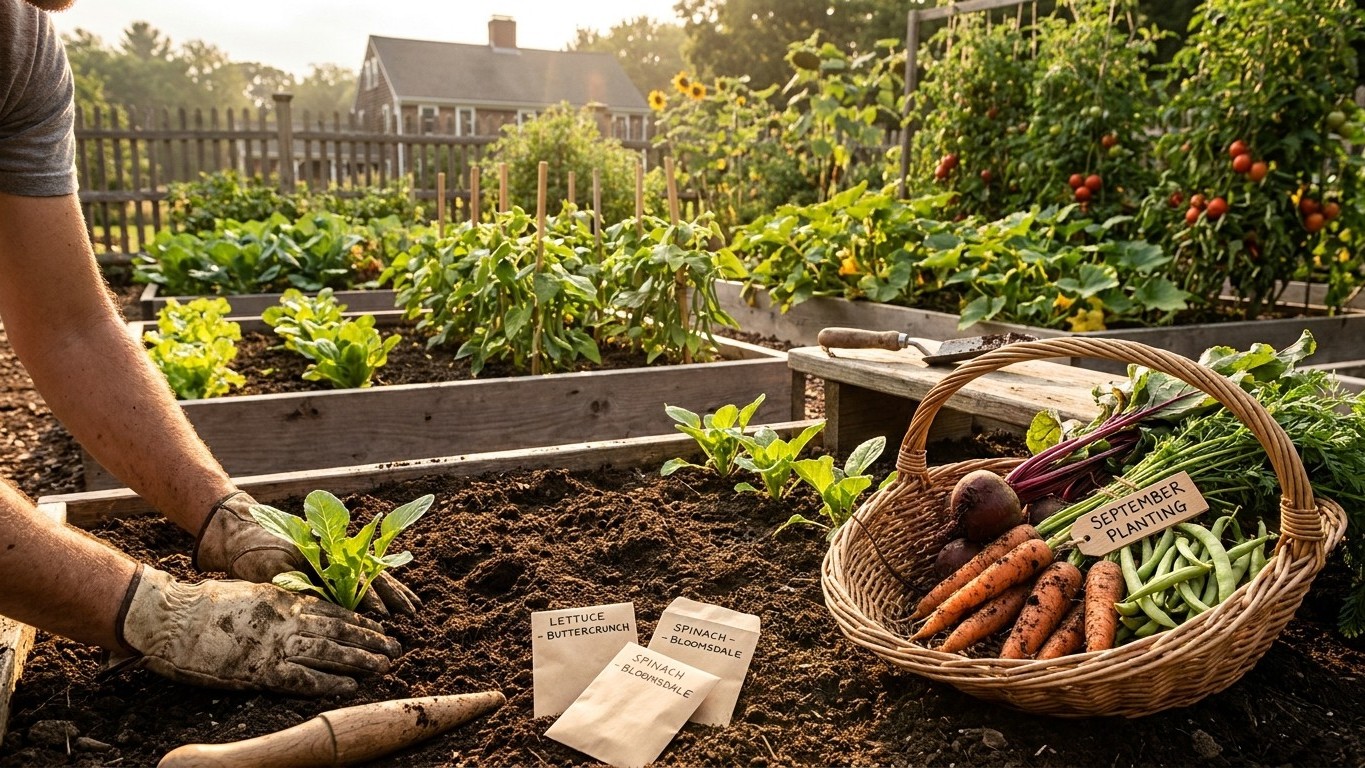

August in Massachusetts sits squarely between the state’s last frost window (April 1 to April 8) and its first fall frost (November 3 to November 14), so the ground is warm, daylight is still long, and the garden is at its most productive. This is a month for two jobs at once: keeping summer crops fed and picked, and getting fall crops into the soil before the frost clock runs out.
What goes in the ground in August

The math that matters this month is simple: count the days between today’s date and the first fall frost, then check that number against the days-to-maturity on the seed packet. A gardener sowing on August 1 has roughly 94 days before the earliest frost date of November 3. By August 31, that window has shrunk to about 64 days. Anything with a maturity time longer than that gap is a gamble, not a plan, unless it is a cold-hardy crop that shrugs off a light frost.
Direct-sown into open soil, the safe bets for early-to-mid August are the fast, cold-tolerant crops: bush beans (only in the first week or two, since they need real heat to finish), beets, carrots for a fall harvest, radishes, turnips, scallions, and a second round of peas for autumn eating. Leafy greens are the workhorses of the month: lettuce, spinach, arugula, mustard greens, and Asian greens like tatsoi or mizuna all germinate fast in warm soil and mature well within the remaining window, even sown as late as early September in many spots.
Transplants, not seeds, for the slower fall crops
Broccoli, cauliflower, cabbage, and kale for a fall harvest are usually better set out as transplants in August rather than direct-sown, because they need a head start that direct seeding in hot soil often can’t give them. If those transplants were started in June or July under cover, early August is the moment to get them into the garden, watering them in deeply so the heat doesn’t stress young roots before they establish.
Garlic and shallots are not an August crop in Massachusetts; that planting happens closer to October, after the soil has cooled. Trying to get a jump on it now, while the ground is still warm, tends to push premature top growth that won’t survive winter well.
What to start under cover
Starting seeds indoors or under shade cloth in August is less about beating the frost and more about beating the heat. Direct sun and 85-degree soil can cause damping-off and bolting in seedlings that would otherwise do fine outdoors in spring. For crops destined for a cold frame overwintering setup, such as spinach, mâche, and hardy lettuce varieties, starting them in flats under light shade in August and transplanting into the frame in September gives roots time to establish before the light drops off in fall.
The backward arithmetic works the same way here as it does for direct sowing: take the first fall frost range (November 3 to November 14), subtract the days to maturity, then subtract another one to two weeks for the seedling to recover from transplant shock. A crop that needs 60 days to mature and two weeks to settle in after transplanting needs to go into a flat by roughly mid-August to make a November 3 frost, and has a little more room to spare if the local frost lands closer to November 14.
Two mistakes show up every year with this kind of counting. Starting too early in the heat produces leggy, rootbound seedlings that stall the moment they’re transplanted, since their roots have already run out of room in a small cell. Starting too late means the plant is still small and unhardened when the cold arrives, with no reserve of growth to draw on through a Massachusetts autumn that can turn sharply once the first frost window opens.
What is ready to pick
This is the month the garden pays its rent. Tomatoes, peppers, and eggplant are coming in steadily, and cucumbers and summer squash need checking every day or two, since a zucchini left on the vine for 48 hours too long turns into a baseball bat. Sweet corn, if it was planted on schedule earlier in the season, is usually ready when the silks turn brown and dry while the husk stays green; a quick thumbnail test on a kernel, looking for a milky rather than watery liquid, confirms it.
Beans and peas from earlier sowings should be picked young and often, since letting pods mature toughens them and signals the plant to stop producing. Melons are trickier to judge: a cantaloupe usually slips free from the vine with light pressure when ripe, while watermelon ripeness is better judged by the dull, hollow-sounding thump and the pale spot where it rests on the ground turning from white to cream or yellow.
Onions and garlic planted earlier in the season are usually pulled and curing by now, laid out somewhere dry and airy out of direct sun for two to three weeks before storage. Brambles like raspberries and early blueberry varieties are also finishing their run, and basil should be cut back hard and often to keep it from flowering and turning bitter.
The jobs that matter this month
Watering rhythm matters more in August than almost any other month, because heat stress shows up fastest as blossom end rot on tomatoes and bitterness in cucumbers. Deep, infrequent watering, aimed at soaking the root zone rather than wetting the leaves, beats a quick daily sprinkle every time, and a two-to-three-inch mulch layer holds that moisture in while also keeping weed pressure down during the month weeds grow fastest.
Staking, succession sowing, and scouting
Tomato cages and stakes that were installed loosely in June are usually being outgrown by August, and a plant that topples under its own fruit weight is far more prone to rot and pest damage than one held upright. This is also the last realistic window for succession sowing fast greens and roots for a fall harvest, so any bare row space freed up by finished bush beans or spent lettuce should get a new round of seed rather than sitting empty.
Pest scouting pays off disproportionately this month. Japanese beetles, squash vine borer, and tomato hornworm are all active in August, and catching an infestation in its first week, rather than its third, is often the difference between hand-picking a few pests and losing a whole planting. Checking the undersides of squash leaves for the sawdust-like frass that signals a vine borer, or looking for skeletonized leaves from beetles, takes five minutes and saves weeks of damage.
Finally, onions, garlic, and any early potatoes coming out of storage from a spring planting should be checked over for soft spots or sprouting, since one rotting bulb in a storage bin can spread to its neighbors within days.
What not to do in August
The most common mistake this month is treating warm air as a green light for crops that actually need a full season ahead of them. Sweet corn or melons started from seed in mid-to-late August almost never mature before the first fall frost arrives between November 3 and November 14, no matter how warm the days feel; that heat is a summer signal, not a season-length guarantee.
Letting watering lapse for even a few days during a hot stretch is the second classic error, and it shows up two ways: blossom end rot on tomatoes and peppers from inconsistent soil moisture, and bitter, misshapen cucumbers from the same stress. A consistent watering schedule matters more than the total amount of water applied over a week.
Heavy nitrogen feeding late in the tomato and pepper season is a mistake gardeners make with good intentions and bad timing. Nitrogen pushes leafy green growth at the expense of fruit set and ripening, which is the opposite of what an August plant needs when it should be finishing, not expanding. A lower-nitrogen, higher-potassium feed supports fruit development better at this stage.
Crowding fall seedlings into flats under full sun, rather than filtered light or shade cloth, invites damping-off in the heat and humidity typical of Massachusetts summers. And skipping the daily pest check on squash and tomatoes, easy to do when the garden looks fine at a glance, is how a small infestation becomes an unrecoverable one by the time it’s noticed.
Checking this against your own county
A state-wide frost window is a starting point, not a fixed instruction. Elevation, distance from the coast, and local microclimates shift these dates by weeks across Massachusetts: the Berkshires and inland valleys typically see frost earlier in fall and later in spring than coastal areas, while the string of stations near Boston Harbor tend to run milder than the state average. Anyone gardening in a low-lying frost pocket or at higher elevation should treat the November 3 to November 14 window as a rough middle, not a guarantee, and watch local forecasts as the season turns.
The UMass Extension service publishes region-specific planting guidance and can help refine these dates for a specific county or growing zone.
Common questions
Is it too late to start a vegetable garden in August in Massachusetts?
Not for fast, cold-tolerant crops. Lettuce, spinach, radishes, and other quick greens can still be sown in early August and mature well before the first fall frost between November 3 and November 14. Long-season crops like corn or melons are a different story.
What USDA hardiness zone is Massachusetts in?
The USDA Plant Hardiness Zone Map places Massachusetts across zones 5a to 7b, a range built on average annual extreme minimum winter temperature. Coastal areas run milder, while inland and higher-elevation regions sit at the colder end of that range.
Can I still plant garlic in August in Massachusetts?
No. Garlic planting happens closer to October, after the soil cools. Planting in August’s warm soil tends to push early top growth that doesn’t hold up through winter.
Why are my tomatoes cracking or rotting at the bottom in August?
Blossom end rot and fruit cracking both trace back to inconsistent watering during hot stretches. Deep, regular watering and a solid mulch layer even out soil moisture and reduce both problems.